Here's the core problem: employees see a number on their paystub and assume that's their compensation. Full stop. They rarely factor in health coverage, 401(k) matches, or bonuses, which drives disengagement and, eventually, voluntary turnover.
This guide compares leading total rewards platforms, from affordable self-service statement tools to enterprise-grade recognition and benefits suites, so HR teams of any size can find the right fit.
TL;DR
- Total rewards software shows salary, bonuses, benefits, and perks in one report or portal
- Company size drives choice: SMBs need affordable statement tools; enterprises need planning and pay equity
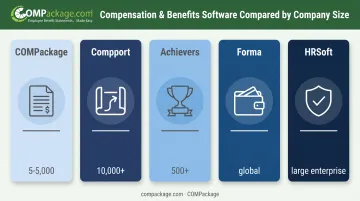
- Top picks: COMPackage, Compport, Achievers, Forma, and HRSoft
- Base your decision on company-size fit and pricing transparency, not feature-list length
- Only 57% of employees feel educated on their benefits; a quarter understand little or none
Overview of Total Rewards Software in the US HR Market
Total rewards software helps HR teams design, administer, or communicate the full value of employee compensation beyond base pay. That's the short version. The longer version involves benefits statements, recognition points, equity plans, and increasingly, compliance documentation.
The market is growing fast. The global compensation software market hit $3.22 billion in 2024, according to P&S Market Research. It is projected to grow at a 9.8% CAGR through 2030. That figure is global, not US-specific, but the trend line matches what's happening domestically.
Part of that growth traces back to pay transparency legislation:
- California now requires salary ranges in job postings for employers with 15+ staff (effective 2023)
- Colorado mandates compensation and benefits details in postings under its Equal Pay for Equal Work Act
- Illinois joined in January 2025 with its own 15-employee threshold
- New York requires salary ranges for employers with just four or more employees
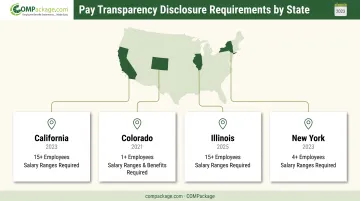
When employees can see a competitor's posted salary range, employers need a clear way to show the rest of the package—benefits, retirement, equity, and extras that base pay alone never captures.
The list below spans platforms built for five-person teams through global enterprises. Match the tool to your organization's scale, not the other way around.
Top Total Rewards Software Platforms for HR
We evaluated each platform on affordability, ease of use, feature depth for the pillar it serves, and proof it works at the scale it claims. That range runs from 20-person shops to 50,000-employee multinationals.
COMPackage
COMPackage launched in 2007 as a self-service total compensation statement platform built specifically for small and mid-sized US businesses, typically 5 to 5,000 employees. It lets companies generate professional benefit reports in-house in hours, without paying a service provider for weeks of turnaround.
Highlights:
- 80+ pre-built benefit categories, from health insurance and 401(k) matches to cell phones, parking, and holiday bonuses
- Employee LOADER bulk-imports Excel censuses (including 1,000+ rows) by mapping column headings
- 12+ auto-calculators for mandated benefits, retirement, time off, and insurance
- 30-day satisfaction guarantee with a full refund—no partial credit, no fine print
| Criterion | Details |
|---|---|
| Best For | Small and mid-sized businesses, insurance agencies, and HR or benefits consultants needing an affordable, in-house statement solution |
| Pricing | Published tiers from $149/year (1–5 employees) to $2,599/year for unlimited employees; free report changes all year with no per-report fees |
| Key Features | Bulk census upload, customizable branding and colors, non-quantifiable benefits shown alongside dollar values |
The Professional tier, priced at $2,999/year, adds multi-client "Foldering" for consultants managing multiple companies under one login. Named customers include Coca-Cola, Harley-Davidson, and Westfield Bank (logo relationships, not documented case studies). Mid-year benefit edits are supported for one-off corrections.
Compport
Compport is a highly configurable total compensation platform built for large, global organizations running complex merit, bonus, and pay equity cycles. It's less a statement generator and more a full compensation planning engine.
Highlights:
- Rule engine with budget guardrails that keeps managers inside policy during merit and bonus planning
- 200+ reporting templates (vendor-reported; not independently audited)
- 4.7/5 G2 rating from 82 verified reviews (August 2026 snapshot)
| Criterion | Details |
|---|---|
| Best For | Large multinational organizations (10,000+ employees) moving off spreadsheets or rigid HCM comp modules |
| Implementation | Multi-week enterprise rollout, typically 8–12 weeks, with dedicated HRIS integration support |
| Key Features | Pay equity monitoring, one-click budget builder, personalized total rewards statements |
Compport reports 200+ customer companies covering over a million employees across 15-plus industries. It's a strong fit if you've outgrown spreadsheet-based comp planning but not if you're a 50-person shop needing something quick to deploy.
Achievers
Achievers is a recognition and rewards marketplace platform built around peer-to-peer appreciation and points-based redemption. Unlike the compensation-planning tools above, its focus is engagement, not statement generation.
Highlights:
- 79% of employees recognized monthly report a strong sense of belonging
- Rewards marketplace with 3M+ locally relevant options across nearly 190 countries
- Native HCM integrations with Workday, Microsoft Teams, and Slack
| Criterion | Details |
|---|---|
| Best For | Organizations of 500+ employees that want high-frequency recognition and a broad rewards catalog |
| Global Reach | Reward fulfillment in ~190 countries; recognition program in 32 languages |
| Key Features | Flexible point economics, mobile-first access, native integrations with major HCM tools |
Treat language coverage (32 languages) and reward-catalog fulfillment (~190 countries, 3M+ options) as separate metrics when you compare vendors.
Forma
Forma administers Lifestyle Spending Accounts, HRAs, pre-tax accounts, and recognition rewards on a single system. Think of it as flexible benefits infrastructure rather than a communication tool.
Highlights:
- Purpose-built spending wallets per use case (wellness stipends stay separate from commuter benefits)
- Notional funding model—employers pay only for dollars employees actually spend
- Coverage in 110+ countries with local currency and cost-of-living adjustments
| Criterion | Details |
|---|---|
| Best For | Global employers consolidating flexible benefits and recognition budgets on one platform |
| Global Reach | 110+ countries with local currency adjustments |
| Key Features | Purpose-built wallets, integrated rewards and recognition, category-level utilization reporting |
That funding model helps cash flow: money moves when employees spend, not when you set the allowance—unlike a prepaid card.
HRSoft
HRSoft targets large, regulated enterprises—banks, asset managers, healthcare systems—that need compensation planning, communication, and compliance documentation in one suite.
Highlights:
- Branded total rewards portal for compensation, benefits, and perks in one place
- Multi-currency statement packs; vendor reports $150 billion in compensation across 84 countries
- LTI and equity administration, including automated agreements and vesting-schedule tracking
| Criterion | Details |
|---|---|
| Best For | Large global enterprises in regulated industries that need integrated compliance and communication |
| Implementation | Averages about four months (G2-reported), typical for enterprise suites |
| Key Features | Configurable comp-cycle planning, multi-language statements, pay-for-performance linkage |
If your organization deals with carried interest, deferred compensation, or heavy regulatory scrutiny, HRSoft's financial-services-specific workflows are worth a closer look. It's overkill for a 40-person startup.
How We Chose the Best Total Rewards Software
The most common buyer mistake in this category is choosing the wrong-sized tool. Teams often choose the platform with the longest feature list or the biggest brand name, then end up with an unused module or an expensive re-platform 18 months later.
Wrong-fit purchases often surface as implementation friction. Gartner reported in May 2025 that 84% of HR software buyers face implementation issues during deployment, a major contributor to purchase regret (Gartner, 2025).
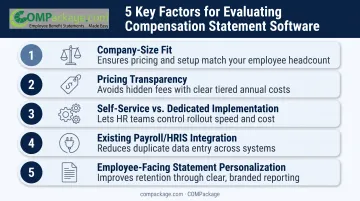
We weighted five factors, each tied to a real business outcome:
- Company-size fit — reduces the odds of paying for enterprise complexity you'll never use
- Pricing transparency — published pricing (like COMPackage's tiers) speeds procurement versus a mandatory discovery call
- Self-service versus dedicated implementation — determines whether you need weeks of vendor support or can launch same-day
- Existing payroll/HRIS integration — directly affects admin time and data accuracy
- Employee-facing statement personalization — ties to retention, since a generic report doesn't land the same as a branded, individualized one
None of these factors matter in isolation. A platform with strong reporting templates is useless if your team can't get it live before the next open enrollment.
Conclusion
The right total rewards partner fits your organization's size, budget, and compensation complexity.
Before committing:
- Pilot the platform with a small employee segment
- Confirm integration requirements with your existing payroll system
- Reassess cost-effectiveness as headcount scales
What works at 50 employees may not work at 500.
Small and mid-sized businesses wanting an affordable, same-day way to show employees their true compensation value can start with a free trial of COMPackage. It's backed by a 30-day satisfaction guarantee and a full refund if it's not the right fit.
Frequently Asked Questions
What is a total rewards program?
A total rewards program is the combined strategy of compensation, benefits, recognition, and development an employer uses to attract, motivate, and retain talent. It goes beyond salary to cover the full employment value proposition.
What are some examples of total rewards programs?
Examples include base pay plus performance bonuses, health and retirement benefits, tuition reimbursement, flexible work arrangements, and peer recognition programs. Most organizations combine several of these into one strategy.
What are the components of total rewards?
WorldatWork defines total rewards as five pillars: compensation, benefits, well-being, career growth, and recognition. Each pillar maps to specific programs, from base pay to formal appreciation initiatives.
What is total rewards software?
Total rewards software is a platform that helps HR design, administer, or communicate compensation and benefits value. This ranges from lightweight statement generators to full benefits and recognition suites with planning tools.
How much does total rewards software cost for small businesses versus enterprises?
SMB-focused tools like COMPackage offer flat annual pricing starting at $149/year. Enterprise suites typically use custom quotes tied to headcount and modules, often requiring a discovery call first.
What's the difference between total rewards software and total compensation statement software?
Total rewards software can span benefits administration, recognition, and compensation planning. Total compensation statement software, like COMPackage, focuses specifically on communicating pay and benefits value directly to employees.