Introduction
Picture this: an employee starts updating their resume because they feel underpaid. Their base salary hasn't moved in two years, and they're comparing paychecks with colleagues at competing firms.
What they're not factoring in — the $900 home office subsidy, $50/month wellness allowance, and $1,200 annual professional development budget — could easily add $2,000 to $3,000 to their real annual compensation.
This kind of disconnect is more common than most employers realize.
Stipend compensation refers to fixed, purpose-specific payments made to employees (or interns and trainees) to cover designated expenses, separate from base salary. Unlike salary, stipends aren't payment for hours worked. They're contributions toward defined needs: a gym membership, a standing desk, an online certification.
This guide covers what stipends are, how they differ from salary, common types, tax rules, and how employers can use them strategically to attract and retain talent.
Key Takeaways
- Stipends are fixed payments for specific purposes (wellness, remote work, professional development) that sit outside base salary
- Taxation, flexibility, and legal rules set stipends apart from regular salary
- Most employee stipends are taxable income and must appear on a W-2; select categories qualify for pre-tax treatment
- Employers can strengthen total compensation packages with stipends without permanent salary increases
- Employees often undervalue stipends until a total compensation statement shows the full picture
What Is Stipend Compensation?
A stipend is a periodic, fixed payment provided to cover designated costs: housing, internet, wellness, professional development, rather than as direct compensation for hours worked. Stipends are not tied to performance metrics or tenure. Each payment is earmarked for a defined expense category.
Historically, stipends appeared in academic fellowships, clergy positions, and research programs. In those contexts, they covered living costs for people whose work didn't fit a traditional wage structure. Over time, the concept moved into corporate settings, and today stipends show up across remote work arrangements, employee wellness programs, commuter benefits, and more.
Who receives stipends?
- Interns and graduate students in training programs
- Trainees in structured learning tracks
- Full-time employees receiving supplemental benefits alongside their salary
That last group is increasingly common. A salaried employee might receive a $75/month internet stipend, a $100/month wellness stipend, and a $1,000/year professional development stipend, all on top of their regular pay. Each is separate, purposeful, and part of their total compensation picture.
In corporate settings, "stipend" is an employer's label for a payment category, not an automatic tax classification. The IRS doesn't recognize a generic "stipend" exemption — it classifies the underlying benefit based on its purpose, structure, and documentation.
Stipend vs. Salary: Key Differences
A salary is broad compensation for an employee's role: payment exchanged for labor. A stipend is narrower: it covers a specific expense category. That distinction shapes everything from tax treatment to spending flexibility.
Taxation
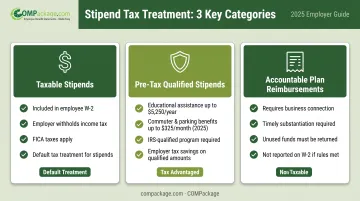
Salary is always fully taxable earned income, subject to federal income tax, Social Security, and Medicare (FICA) withholding. Stipends follow a more complex set of rules with three possible treatments:
Taxable stipends: Most employee stipends are taxable. They're included in W-2 wages, and employers must withhold income taxes and FICA just as they would on salary. This is the default when no specific exclusion applies.
Pre-tax stipends under qualified plans: Certain categories get favorable tax treatment under IRS rules:
- Qualified educational assistance: up to $5,250 per employee per year excluded from taxable income
- Commuter benefits: $325/month per category in 2025 (transit passes and qualified parking are each separate exclusions)
Working condition fringe benefits: A cash payment for a documented business activity may be excludable under an accountable plan (business connection, timely substantiation, and return of excess). Per IRS Publication 15-B, any fringe benefit is taxable unless a specific exclusion applies.
Purpose and Flexibility
Stipends are earmarked for defined categories such as internet access, gym memberships, or home office equipment. Non-taxable stipends under an accountable plan often require receipts. Salaries carry no such restriction; employees spend them however they choose.
Fixed Amount vs. Variable Pay
Stipends tend to be uniform across eligible employees or roles. Every remote worker gets the same $75/month internet allowance; every employee gets the same $1,000 development budget. Salaries vary by experience, performance, negotiation, and geography.
Legal Minimums
Salaries must meet federal and state minimum wage requirements. Stipends have no federally mandated minimum, but they can't be used to avoid wage obligations.
For interns paid a stipend instead of wages, the DOL's "primary beneficiary" test decides whether they are employees entitled to minimum wage. It is a seven-factor, totality-of-circumstances analysis. A stipend label alone does not satisfy FLSA requirements.
Common Types of Employee Stipends
Stipends are flexible by design. Employers can structure them around company values, workforce demographics, and budget. These are the categories employers use most often.
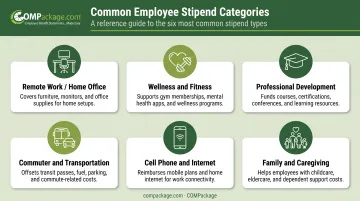
Remote Work / Home Office Stipend
Work-from-home stipends cover equipment like monitors, ergonomic chairs, printers, and desks, as well as monthly internet costs. These became widespread during the shift to remote work.
According to SHRM's 2022 Employee Benefits Survey, 62% of employers offered an at-home office or work-equipment subsidy or reimbursement, with an average of $891. Among those offering it, 95% covered technology and 68% covered general office supplies.
Wellness and Fitness Stipend
Wellness stipends fund gym memberships, fitness classes, meditation apps, mental health counseling, and similar expenses. They're among the most popular employer-sponsored supplemental benefits.
KFF's 2024 Employer Health Benefits Survey found wellness programs at 54% of small firms and 79% of large firms offering health benefits. Typical annual amounts vary widely, so most companies set budgets around workforce size and wellness goals.
Professional Development Stipend
Professional development stipends cover courses, certifications, conferences, and workshops. They differ from tuition reimbursement, which refunds costs after the fact, because funds are usually provided upfront or as a fixed annual allowance.
SHRM found that 86% of HR managers believe training is critical for retention. In 2022, 78% of employers covered opportunities to develop new skills, up from 75% the prior year. Annual allowances vary by role and industry, so employers typically tie amounts to learning goals and budget.
Commuter and Transportation Stipend
Commuter stipends cover transit passes, parking, ride-sharing, tolls, or gas. Employers offering pre-tax commuter benefits can provide up to $325/month per category in 2025. That cap creates a meaningful tax advantage for both sides.
WorldatWork's 2024 member study found 50% of participating employers offered free parking, 31% offered transit passes, and 24% offered transportation benefits through a compensation-reduction agreement.
Other Notable Stipend Types
- Cell phone / internet — Covers employees using personal devices or home connections for work
- Meal stipends — Supports remote workers or in-office employees during specific events or regularly scheduled meals
- Family and caregiving — Childcare support, fertility assistance, elder care contributions
- Lifestyle spending accounts (LSAs) — Flexible employee-directed funds that can be spent across multiple approved categories
Tax Implications of Employee Stipends
The default rule is straightforward: most stipends paid to full-time employees are taxable compensation. They belong on the employee's W-2, and employers are required to withhold federal income tax, Social Security, and Medicare, exactly as they would on salary. Per IRS Publication 15-B, a fringe benefit is taxable unless a specific statutory exclusion applies.
When Stipends Can Be Pre-Tax
Several narrow exclusions exist:
| Stipend Type | Tax Treatment | Annual/Monthly Cap |
|---|---|---|
| Educational assistance | Pre-tax exclusion | $5,250/year |
| Commuter benefits (transit) | Pre-tax exclusion | $325/month (2025) |
| Qualified parking | Pre-tax exclusion | $325/month (2025) |
| Accountable plan reimbursements | Excluded from wages | Actual, substantiated expenses only |
| De minimis fringe benefits | Excluded | Minimal, infrequent items only |
For accountable plan treatment to apply, all three conditions must be met:
- Clear business connection
- Timely substantiation from the employee
- Return of any unused funds
A flat monthly payment with no receipt requirement and no return obligation is a nonaccountable arrangement. Nonaccountable payments are wages, subject to full withholding.
Stipends for Non-Employees
When stipends go to interns or independent contractors rather than employees, a Form 1099-NEC may apply. For 2025 payments, the threshold is $600 for services paid in the payer's trade or business. The 2026 threshold for covered nonemployee services rises to $2,000.
In these cases, the recipient is responsible for self-employment tax and estimated payments, not the employer. Worker classification comes first; the payment label doesn't determine it.
Employers should work with a tax professional or payroll provider to ensure correct classification and withholding on every stipend type.
Why Employers Should Offer Stipends — and How to Communicate Their Value
The Retention and Recruitment Case
Candidates evaluate job offers on total compensation, not just base salary. Gallup found that 64% of U.S. employees rated a significant increase in income or benefits as very important when deciding whether to accept a new job. Stipends let employers enhance that total package without committing to permanent salary increases, which helps when budgets are constrained or market conditions shift.
Cost predictability is another advantage. Because stipends are fixed amounts, budgeting is clean. An employer offering a $75/month internet stipend to 50 remote employees knows exactly what that line item costs annually. There's no open-ended reimbursement exposure, and the program can be adjusted or paused with far less administrative friction than a salary change.
The Hidden Value Problem
Here's the real issue: employees often don't know what their employer actually spends on them.
Employees often assume benefits and perks represent only 10–15% of total compensation, when employer-paid costs can account for 40–60% or more.
When stipends for wellness, home office setup, cell phones, and professional development never show up on a pay stub, they go unacknowledged. Employees may feel underpaid even when total compensation is genuinely competitive.
A SHRM article citing MetLife's 2023 study found that 53% of Gen Z employees did not fully understand elements of their benefits package. That gap is a communication problem, not a lack of engagement.
Making Stipend Value Visible
The solution is a total compensation statement: a single, itemized report showing every form of pay and benefit. Base salary, health insurance, retirement contributions, employer taxes, and all stipends appear clearly labeled and tallied.
COMPackage is self-service total compensation statement software built for this job. Employers generate customized reports across more than 80 benefit and perk categories, such as:
- Cell phone allowances and internet stipends
- Parking, wellness contributions, and home office support
- Professional development funds
Each benefit shows as its own line item, separate from base salary, so employees see exactly what the employer contributes in every category.
Reports can include a company logo and custom colors. For larger teams, COMPackage's Employee LOADER imports a full workforce from an Excel file (100 or 1,000 employees) in minutes, with census completion typically under 90 minutes. Pricing starts at $149/year for up to five employees and scales to $2,099/year for up to 200.
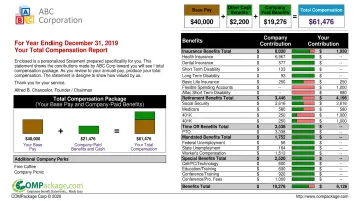
When an employee can see that a $56,000 salary comes with an additional $32,000+ in employer-paid benefits and stipends, the compensation conversation changes entirely.
Frequently Asked Questions
What does it mean to be paid a stipend?
Being paid a stipend means receiving a fixed payment to cover specific costs, such as remote work equipment, wellness, or professional development, rather than pay for hours worked. Stipends usually supplement a base salary within a broader total compensation package.
Does a stipend count as income?
Yes, in most cases. Most stipends are considered taxable income by the IRS, must be reported on a W-2, and are subject to federal income tax and FICA. Specific exceptions apply to qualifying categories like educational assistance (up to $5,250/year) and commuter benefits within monthly IRS limits.
Are employee stipends taxable?
It depends on the structure. Most are fully taxable, but stipends offered under a qualified exclusion — such as educational assistance or commuter benefits — can be provided pre-tax, reducing the tax burden for both the employee and employer.
Do I have to pay back a stipend?
Generally, no. Stipends are payments, not loans. Some employers do include clawback provisions, such as requiring you to stay employed for a set period after professional development funding or repay a portion if you leave early.
Why did I receive a stipend check?
A stipend check typically means your employer or program sponsor is providing a fixed payment toward a designated expense, such as home office costs, wellness, or training. Check with HR to confirm the purpose and whether tax withholding has already been applied.
How much should an employer offer as a stipend?
Amounts vary widely by type. SHRM's 2022 data shows the average remote work subsidy was $891. For wellness or professional development, benchmark against industry competitors and set amounts employees will value without locking in unsustainable budget commitments.