Key Takeaways
- Total rewards span five pillars: compensation, benefits, well-being, recognition, and development — not just base pay
- Companies like Google, Netflix, and Adobe use all five pillars strategically to win and keep top talent
- A Total Rewards Statement makes the full value of employment visible, giving employees a reason to stay before they start looking
- Total Rewards Statements work as both a retention tool and a recruiting differentiator
- A well-designed program only reduces turnover if employees can clearly see what it's worth
Salary alone stopped being the deciding factor in talent decisions a long time ago. Today's candidates evaluate the whole picture — flexibility, development, recognition, benefits — before signing an offer. Yet WTW's 2025 research found that even as employee awareness of benefits improved, satisfaction dropped from 66% to 61% — meaning employees know more about what they have, but value it less than before.
That's a communication and design problem HR Directors can solve.
This article breaks down total rewards by category, shows how leading companies apply all five pillars, and explains what a Total Rewards Statement should include — so you walk away with something you can actually use.
What Are Total Rewards?
Total rewards is the complete package of monetary and non-monetary value an employer provides. That covers everything from base salary and health insurance to flexible schedules, recognition programs, and learning stipends. Treating compensation as just a salary number misses most of the picture.
WorldatWork's Total Rewards framework defines five elements: compensation, benefits, well-being, careers, and recognition. Used together, these aren't perks sitting alongside pay — they're a strategic portfolio for attracting, retaining, and engaging talent.
The distinction HR Directors need to hold clearly:
- Total rewards strategy = the organizational framework that defines what you offer across all five categories and why
- Total Rewards Statement = the communication tool that translates that strategy into a personalized, tangible document for each employee
Most organizations have more of a rewards program than employees realize. The gap isn't always in what's offered — it's in what's communicated. The examples and frameworks below show how to close that gap — and what effective communication looks like in practice.
The 5 Pillars of Total Rewards: Examples for Each
No single pillar wins talent alone. The employers employees genuinely stay at tend to cover all five — even at different depths depending on company size and budget.
Compensation
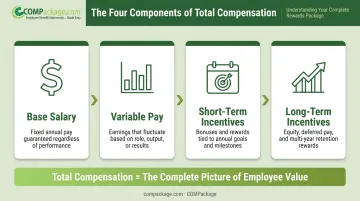
Compensation is broader than a paycheck. The full picture includes:
- Base salary — fixed pay tied to role and market rate
- Variable pay — bonuses, commissions, profit-sharing tied to performance
- Short-term incentives — annual performance bonuses with clear KPI targets
- Long-term incentives — stock options, RSUs, or deferred compensation
A concrete example: a sales rep earning $70,000 base with uncapped commission has a very different compensation profile than a software engineer earning $130,000 base with RSUs vesting over four years. Both are competitive — but for different reasons, and for different people.
Annual salary benchmarking is non-negotiable. HR Directors should review pay bands against current market data at least once a year and adjust the organization's pay philosophy before compensation drift creates a retention risk.
Benefits
Standard benefits — health, dental, vision, disability, life insurance, and a retirement plan — are the floor, not the ceiling. The employers that stand out go further:
- Pet insurance
- Legal services subscriptions
- College savings plan contributions (529 plans)
- Mental health apps and counseling access
- Identity theft protection
Retirement contributions deserve particular attention as a dollar-value differentiator. SHRM's 2025 Employee Benefits Survey found a 6.30% average traditional 401(k) employer match across nearly 4,000 U.S. organizations. On a $60,000 salary, that's $3,780 annually in employer-paid retirement contributions — money most employees don't mentally count as part of their pay.
Most employees underestimate their benefits by a significant margin. Making that dollar value explicit — in a total compensation statement rather than buried in a benefits handbook — is what converts a strong benefits package into a retention tool.
Well-Being and Work-Life Flexibility
This pillar has shifted from a nice-to-have to a baseline expectation. Practical examples include:
- Remote and hybrid work options
- Compressed workweeks (4x10 schedules)
- Paid parental leave
- Sabbaticals after tenure milestones
- Volunteer days with paid time
- Annual wellness stipends ($500–$1,500 is typical)
Spotify's Work From Anywhere program offers a real-world data point: after launching flexibility for its roughly 6,500 employees, Q2 2022 attrition ran 15% below Q2 2019 levels. That's not a controlled study, but it's a directional signal HR Directors shouldn't ignore.
Flexibility alone isn't the full picture. Mental health support has crossed from differentiator to baseline — and EAPs, counseling subscriptions, and mindfulness apps should be explicitly listed in total rewards documentation, not buried where employees won't see them.
Recognition and Performance
Recognition works when it's systematic, not spontaneous. The most effective programs combine multiple mechanisms:
- Peer-to-peer recognition — platforms where colleagues award points redeemable for merchandise or experiences
- Performance bonuses — tied to specific, measurable KPIs rather than manager discretion
- Milestone awards — tenure recognition at 1, 3, 5, and 10-year marks
- Appreciation events — quarterly or annual celebrations that reinforce culture
Cisco's Connected Recognition program is a documented example: employees can receive $25–$250 for individual recognition and $500 or more for larger team achievements, built into the company's broader connected employee experience.
The data behind recognition is hard to ignore. A Gallup longitudinal study tracking nearly 3,500 employees from 2022 to 2024 found well-recognized employees were 45% less likely to change organizations — and those experiencing recognition that met four strategic pillars were 65% less likely to be actively job-seeking. Only 22% of employees said they received the right amount of recognition.
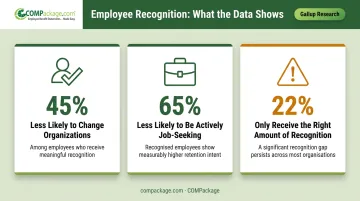
For most organizations, recognition is the fastest pillar to improve — and the one with the clearest retention ROI.
Growth and Development
Development opportunities do two things simultaneously: they build organizational capability and signal long-term investment in the individual. Both reduce turnover intent.
Common examples:
- Tuition reimbursement (up to $5,250 is tax-exempt; many employers go higher)
- Paid certifications and professional licenses
- Internal mentorship programs and leadership tracks
- Access to e-learning platforms (LinkedIn Learning, Coursera, Udemy for Business)
- Dedicated development time built into the work week
Adobe's education reimbursement is one of the most cited examples — up to $10,000 per year for eligible employees pursuing academic degrees, credentials, advanced specializations, or technical certifications. That's a tangible investment that shows up on a resume and in employee loyalty.
Career growth ranks among the top reasons employees leave — and unlike compensation, development investments are often far less expensive to implement. If this pillar is absent from your total rewards framework, it's the one worth addressing first.
Real-World Total Rewards Program Examples
Studying how top employers actually implement all five pillars — not just one or two — gives HR Directors a practical benchmark for spotting gaps.
Google's total rewards profile spans every pillar: competitive base pay with equity grants, comprehensive health benefits including mental health support, generous parental leave, flexible scheduling, and access to an extensive internal learning library.
Google treats every reward category as a talent signal, not a perk. Financial security, development access, and well-being support reinforce each other — each benefit making the others feel more worthwhile to employees.
Netflix
Netflix's approach is built on trust. Salaried employees have no prescribed time-off policy — they manage their own schedules in exchange for high accountability and performance expectations. Mental health benefits include mindfulness, meditation, free counseling, and coaching.
The strategic lesson: flexibility and autonomy are themselves rewards. When structured clearly with high expectations on both sides, they can replace costly perks while driving stronger retention.
Note: Netflix has adjusted several policies in recent years — HR Directors should verify current details directly with Netflix's published careers pages before benchmarking against specific claims.
Adobe
Adobe's standout elements include its $10,000 annual education reimbursement, an employee stock purchase plan, and exempt employees working 24+ hours who handle time off as needed rather than accruing a fixed bank. A strong diversity and inclusion program ties directly into leadership development tracks.
What sets Adobe apart is the signal these rewards send: the company is investing in employees' futures, not just their current roles. That positioning attracts ambitious talent looking for a long-term career, not just a paycheck.
Unilever
Unilever's Heroes Awards recognize employees who go beyond their regular roles — an annual program that spotlights meaningful contributions rather than routine performance. The company has also partnered with benefits flexibility platforms to let employees customize their rewards mix.
Personalization is the lesson worth carrying forward. Giving employees some say in how they're rewarded increases perceived value and engagement — and mid-sized organizations can apply this principle without enterprise-level infrastructure.
Southwest Airlines
Southwest's SWAG (Southwest Airlines Gratitude) program lets employees send peer recognition and nominate colleagues, with eligible employees and dependents receiving free unlimited travel privileges. The 401(k) includes a dollar-for-dollar company match (subject to vesting schedules and compensation limits).
Recognition embedded in daily culture — not reserved for annual reviews — is what makes SWAG effective. Peer-driven programs consistently outperform top-down, calendar-driven alternatives in sustained engagement.
What These Examples Have in Common
Across all five employers, a few patterns stand out:
- Multi-pillar coverage: No single reward category carries the full weight — compensation, well-being, flexibility, recognition, and development work together
- Strategic framing: Each benefit communicates something about the company's values, not just the dollar amount
- Culture alignment: Recognition and flexibility programs are embedded in day-to-day operations, not treated as add-ons
- Personalization signals: Programs that give employees choice — whether in time off, benefits mix, or peer recognition — consistently show stronger perceived value
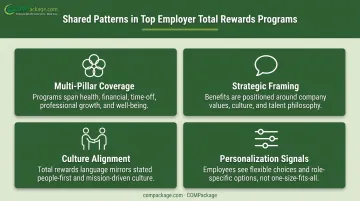
HR Directors benchmarking against these examples don't need to replicate them at scale. The underlying mechanics — clear communication, multi-pillar thinking, and employee visibility into total value — are accessible at any company size.
What Does a Total Rewards Statement Look Like?
A Total Rewards Statement (TRS) is a personalized document that translates an employee's full compensation package into a clear, readable summary. Unlike a pay stub — which shows earnings and deductions for a single period — a TRS shows the total investment the employer makes, including benefits and perks employees rarely see tallied up in one place.
Core Sections of a Well-Structured TRS
| Section | What It Includes |
|---|---|
| Employment Value Proposition | Brief summary of role, tenure, and organizational context |
| Financial Rewards | Base salary, bonuses, commissions, retirement contributions |
| Benefits | Employer-paid health, dental, vision, disability, life insurance |
| Non-Financial Rewards | Leave entitlements, learning budget, wellness stipends |
| Intangible Rewards | Flexibility, remote work access, equipment, commuter benefits |
The same template populates very differently by role. A senior engineer's statement might emphasize RSU vesting schedules and a $10,000 education reimbursement. A sales manager's statement leads with commission structure, car allowance, and performance bonus tiers. Same document format — completely different value story.
A practical warning on data accuracy: The biggest TRS implementation risk is distributing statements with incorrect benefit valuations. Before sending company-wide, cross-check a sample set of 10–15 statements against HR records to catch calculation errors, missing data, or outdated benefit costs.
For HR teams that previously relied on costly consultants to generate individual statements, self-service tools have made in-house production practical. COMPackage, for example, lets HR teams produce personalized total compensation reports in-house, covering workforces from 5 to 5,000 employees with over 80 benefit categories and built-in auto-calculators. The cost runs a fraction of what third-party processing used to require.
How HR Directors Should Evaluate and Communicate Their Total Rewards Strategy
Before redesigning anything, audit what you already have. Three questions to start:
- Are all five pillars represented — even minimally? A gap in any one area is a talent risk.
- Do employees actually know what they receive? If not, communication is the first fix — not new programs.
- Does the rewards mix reflect what employees and candidates actually value? Anonymous surveys and exit interview data will tell you more than assumptions.
Those three questions often reveal the same gap: the program exists, but employees don't know it. Designing a solid total rewards package and then failing to communicate it is the most common mistake organizations make. Employees who don't understand their full package are more vulnerable to competitor offers, even when their current employer is objectively more generous.
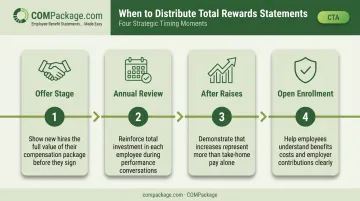
Timing matters too. Total rewards statements are most effective when distributed at key moments:
- At the offer stage: show candidates what the full package is worth before they compare your salary to a competitor's
- Annually: reinforce the ongoing investment the organization makes
- After raises: frame the increase within the total package
- During open enrollment: when employees are actively thinking about benefits
Employee expectations around personalization are also rising. MetLife's 2023 Employee Benefit Trends Study found 63% of Gen Z and 54% of all employees want personalized benefits recommendations — and 65% want year-round communication, not a single annual push.
For most organizations, the highest-ROI move isn't adding new perks — it's making existing ones visible. A clear, well-timed total rewards statement can shift how employees perceive their compensation without changing a single dollar of spend.
Frequently Asked Questions
What are some examples of total rewards?
Total rewards include base salary, performance bonuses, employer-paid health insurance, retirement contributions, paid time off, remote work flexibility, tuition reimbursement, employee recognition programs, and career development opportunities. Most employees significantly underestimate how much of this value they're actually receiving.
What are the 5 pillars of total rewards?
The five pillars are compensation, benefits, well-being and work-life flexibility, recognition and performance, and growth and development. Competitive employers address all five — though the depth in each area will vary by organization size and budget.
What does a total rewards statement look like?
A TRS is a personalized document summarizing an employee's full compensation value — salary, employer-paid benefits, retirement contributions, equity, leave entitlements, and non-financial perks. Most are formatted as a clean visual summary that employees can read and reference easily, rather than a dense spreadsheet export.
How do total rewards differ from base salary?
Base salary is one line item within total rewards. The full package also includes employer-paid benefits, retirement contributions, equity awards, paid leave, wellness programs, and intangible perks — which can add tens of thousands of dollars in annual value beyond the paycheck alone.
How can small or mid-sized businesses implement a total rewards program?
Start by auditing existing benefits and organizing them across the five pillars. Many SMBs already have more to offer than employees realize. Self-service tools make it possible to generate personalized total compensation statements in-house at minimal cost — and simply showing employees what they're already receiving can meaningfully improve satisfaction and retention.