Introduction
Spreadsheets used to be enough. One tab tracked salaries, another handled bonuses, and HR forwarded a static PDF around review season. That approach is falling apart fast.
Many HR teams now juggle pay transparency laws across a dozen states, remote employees in three time zones, and a workforce that expects to see, in plain numbers, what they're actually earning. Manual spreadsheets can't keep up with any of that.
The market is responding. Technavio values the global compensation software market at $3.21 billion in 2024. Growth is projected through the early 2030s as AI, compliance pressure, and demand for pay transparency push adoption.
Whether you run HR for a 12-person firm or a 5,000-employee company, these shifts affect how you hire, retain talent, and stay compliant. Here's what's changing, why it's happening, and what to watch next.
Key Takeaways
- AI shifts pay planning from reactive spreadsheets to proactive, data-backed decisions
- Pay transparency laws across states and the EU are pushing software adoption at every company size
- Total compensation statements boost retention by showing employees their full pay value
- Cloud subscription platforms put full-featured compensation tools within small-business reach
- Market forecasts project strong growth, with some nearing double-digit CAGR through 2030
Key Trends Shaping the Compensation Software Market
Five forces are reshaping how companies plan, communicate, and comply on pay. Here's what's driving each one.
AI-Driven Compensation Recommendations and Predictive Analytics
Machine learning has changed what a "pay review" even means. Instead of one static cycle per year, algorithms now cross-reference performance data, market benchmarks, and internal equity patterns to flag pay adjustments as conditions change.
Mercer estimates that AI and automation could handle 52% of a total rewards team's workload, including the routine data work that used to eat up analyst hours.
HR teams can now model multiple pay scenarios in roughly the time it once took to update a single spreadsheet formula, freeing time for:
- Strategic pay policy design
- Internal equity audits
- Manager coaching on pay conversations
Teams spend less time defending past decisions and more time shaping future pay strategy.
Pay Transparency and Compliance Automation
A growing patchwork of laws is forcing employers to publish salary ranges and document the reasoning behind pay decisions. Manual tracking across jurisdictions is becoming close to impossible.
Consider the current landscape:
- California: Employers with 15 or more employees must include pay scales in job postings, a requirement in effect since January 2023
- New York: Businesses with four or more employees must disclose salary ranges, effective September 2023
- Illinois: Employers with 15 or more employees must post pay scale and benefits information (effective January 2025; records kept five years)
- European Union: The EU Pay Transparency Directive requires pre-hire pay range disclosure and pay-gap reporting for companies with 100+ workers, plus joint audits when unjustified gaps hit 5% or more
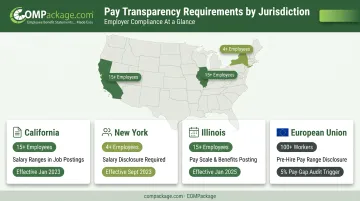
For companies operating across several states or countries, this isn't a spreadsheet problem anymore. It's a compliance risk, and software that tracks jurisdiction-specific requirements automatically is moving from optional to necessary.
Total Rewards and Total Compensation Statements for Retention
Employees consistently underestimate what they actually earn. Base salary is the number on a paycheck, but it's rarely the full story once health insurance, retirement contributions, PTO, and perks get factored in.
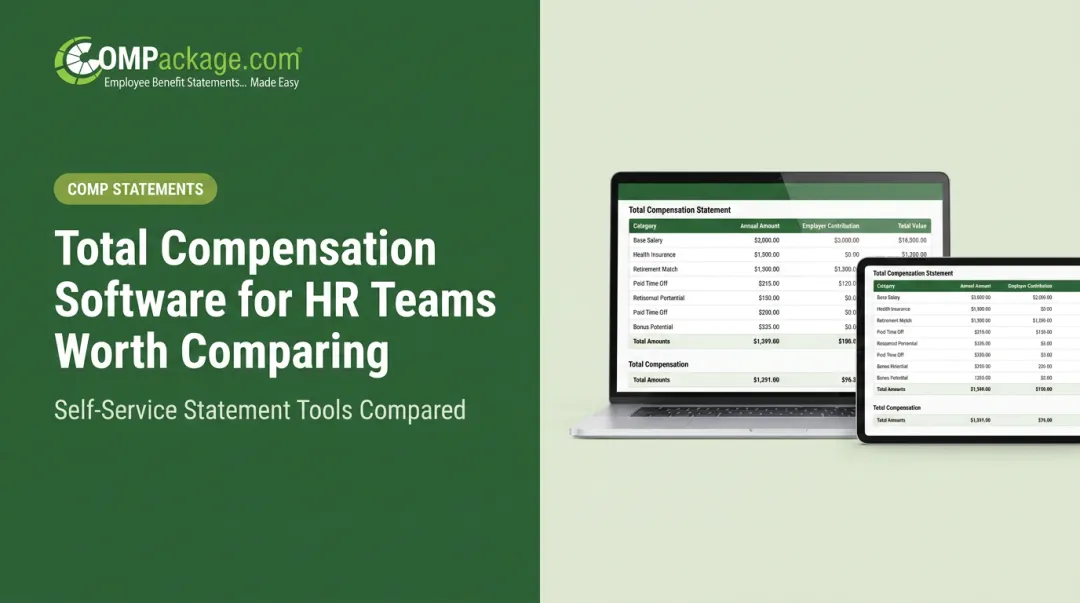
Total compensation statements close that gap. They itemize salary, bonuses, benefits, and perks into one document showing the real value of an employment package, not just the base number. WTW notes that personalized total rewards communication builds employee trust and can reduce benefits-related service center calls by up to 25%.
This is where a platform like COMPackage fits in. Its self-service model lets HR teams import an entire employee census from Excel using a built-in Employee LOADER, apply more than 80 preprogrammed benefit categories, and generate a full set of customized statements in a few hours rather than weeks.
Updates run free throughout the year, so a report built in January still reflects a benefits change made in September.
One documented example: Napa Valley Petroleum found fringe benefits added 35% to total pay for its lowest-paid workers, and up to 50% for others, according to the company's own customer data. Numbers most employees never see without a formal statement.
Cloud-Based, Self-Service Platforms Expanding Access for SMBs
The market is moving away from costly on-premises systems that required IT teams and long rollout timelines. Technavio identifies cloud-based deployment as capturing the largest share of the compensation software market in 2024, with vendors increasingly adopting SaaS and pay-per-employee pricing models to fit smaller budgets.
Why this shift matters:
- Lower IT overhead - no servers, no dedicated installation
- Faster rollout - some platforms go live in hours, not months
- Predictable costs - subscription pricing scales with headcount
COMPackage's tiered annual pricing shows how far this has gone. Packages start at $149 per year for one to five employees and scale up to $2,599 for unlimited employees, with a separate $2,999 Professional tier built for benefits consultants and accounting firms managing multiple clients.
That range puts full-featured compensation reporting within reach of a five-person shop and a 3,000-employee company alike.
Deeper Integration with HRIS, Payroll, and Performance Systems
Standalone compensation tools are losing ground to platforms built to plug into existing HR tech stacks. Pave's product documentation, for instance, lists native connections to ADP, BambooHR, Gusto, Rippling, and Workday, among others, syncing employee and job data in real time.
When compensation data lives in one synced system instead of three disconnected ones, errors from outdated records or mismatched entries mostly disappear. SHRM points to payroll errors caused by mismatched attendance data and stale employee records as a common cost of siloed HR systems. A single source of truth means fewer reconciliation headaches before an audit or a board meeting.
What's Driving These Compensation Software Trends
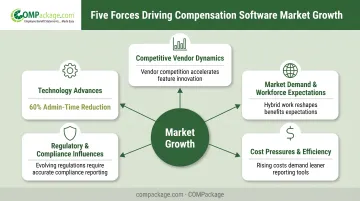
Several forces are pushing growth at once, and the market's trajectory reflects how urgent each one has become.
- Technology advances: Automated workflows cut manual processing time fast. Technavio reports more than a 60% reduction in compensation-cycle admin time, shrinking merit cycles from weeks to days.
- Market demand and workforce expectations: Hybrid work erased geographic pay boundaries. Companies now compete for talent nationally, sometimes globally, pushing them toward more transparent, competitive total rewards packages just to stay in the running.
- Cost pressures and efficiency needs: Budget-conscious small and mid-sized businesses can't always justify a five-figure consultant engagement for something a few-hundred-dollar-a-year platform can handle in-house.
- Regulatory and compliance influences: Expanding pay transparency and AI governance laws require documentation that manual processes struggle to produce, including audit trails, pay equity rationale, and bias-testing records.
- Competitive dynamics: The vendor landscape is fragmented and growing. Technavio names players including beqom, Cegid, CompLogix, CompUp, Decusoft, HRSoft, and Payscale. That crowded field fuels feature innovation and price competition.
How These Trends Are Impacting Businesses and HR Teams
These shifts aren't theoretical anymore. They're changing how HR teams operate, how businesses budget, and how employees experience their pay. Automated compensation workflows already cut administrative time by more than 60%, according to Technavio's research.
Operational Impact
Manual, error-prone spreadsheet workflows are giving way to automated systems with built-in compliance tracking and audit trails. Work that once took an analyst weeks of cross-referencing pay bands, checking equity gaps, and formatting review packets now finishes in days.
Faster cycles also mean fewer version-control errors. Everyone works from one synced dataset instead of five spreadsheet copies floating around in email threads.
Business Impact
Compensation technology is moving from a line item in the HR budget to a strategic investment. Leadership increasingly treats it like CRM or ERP systems: infrastructure that protects revenue and reduces risk.
WTW's modeled example illustrates the stakes: retaining just 10 employees who might otherwise leave can save a company $25,570 in recruiting costs alone. When compensation transparency helps close that retention gap, the software pays for itself quickly, especially for SMBs where one bad hiring cycle strains a tight budget.
Workforce Impact
HR roles are shifting away from manual calculation work and toward strategic advisory functions as automation absorbs the routine tasks. Compensation analysts increasingly spend time interpreting data and advising managers rather than building spreadsheets from scratch.
Employees, meanwhile, expect real-time visibility into how their pay was decided and what their full package is worth. That expectation is reshaping internal communication, as annual pay letters give way to on-demand statements employees can check whenever they want.
Future Signals for Compensation Software in the Coming Years
These trends are still evolving. Watch three signals over the next one to three years:
- Expanding AI-governance regulation: Illinois’s amended Human Rights Act (Jan 2026) bars AI with discriminatory employment effects; Colorado’s SB26-189 adds disclosure and human-review rights for pay-related automated decisions in 2027. Bias-testing and audit docs will move from add-ons to standard features.
- Predictive, scenario-based budgeting becomes standard: Multi-scenario pay modeling—once enterprise-only—is reaching smaller companies as vendors compete on ease of use.
- Market consolidation alongside continued differentiation: Expect enterprise consolidation, while SMB vendors compete on affordability and self-service. Total compensation statements are shifting from a large-company perk to a mainstream retention tool.
Conclusion
AI, expanding pay transparency laws, and the push for clearer total rewards communication are reshaping compensation software all at once. The market's growth trajectory backs that up, with continued expansion projected through the early 2030s.
Organizations that adapt early gain a real edge. Small businesses that once relied on annual raise letters can now generate the same total compensation clarity that a much larger company offers, at a fraction of the cost. Enterprises that automate compliance documentation reduce legal exposure while competitors scramble to catch up state by state.
The tools you choose today shape how competitive your compensation strategy looks three years from now. In a talent market this tight, that's not a small decision.
Frequently Asked Questions
What are the new trends in compensation?
AI-driven pay recommendations, expanding pay transparency laws, and rising demand for total rewards statements are the three biggest shifts. Together they're pushing companies of every size toward more automated, transparent compensation practices.
What is compensation management software and how does it work?
It centralizes pay data, automates planning and benchmarking, and connects with existing HR and payroll systems. This helps HR teams make faster, more accurate and compliant pay decisions.
How much does compensation software cost for small and mid-sized businesses?
Self-service platforms built for SMB budgets can start under $300 per year. Enterprise suites with consultant support typically run into the thousands and are often quote-based.
Is cloud-based or on-premise compensation software better for my business?
Cloud-based solutions dominate the market thanks to lower cost, faster setup, and no IT overhead. On-premise systems still make sense for organizations with strict data residency requirements.
What is a total compensation statement, and why does it matter for retention?
It itemizes salary, benefits, bonuses, and perks so employees see the full value of their pay package, not just their paycheck. That clarity builds trust and helps reduce turnover.
What size company needs compensation software?
Modern platforms scale from five-person businesses to companies with thousands of employees. Flexible, tiered pricing has made full-featured compensation tools practical at nearly any company size.