Most businesses already provide solid compensation packages: employer-paid health coverage, 401(k) contributions, paid time off, performance bonuses. The issue isn't what's being offered — it's that none of it shows up on a pay stub. Employees see their net paycheck and assume that's the whole story.
This article covers how total compensation software creates a measurable edge in retaining and attracting talent — specifically through three operational advantages that HR teams can observe and track over time.
Key Takeaways
- Employees routinely underestimate their total compensation, creating preventable turnover
- Total compensation software generates personalized reports covering salary, benefits, retirement contributions, and every other element of pay
- Stronger compensation communication improves recruiting, retention, and pay satisfaction without requiring a salary increase
- Small and mid-sized businesses can now access self-service tools starting at an accessible price point
- Each report delivered helps employees see their full value — reducing the chance they leave for a salary number alone
What Is Total Compensation Software?
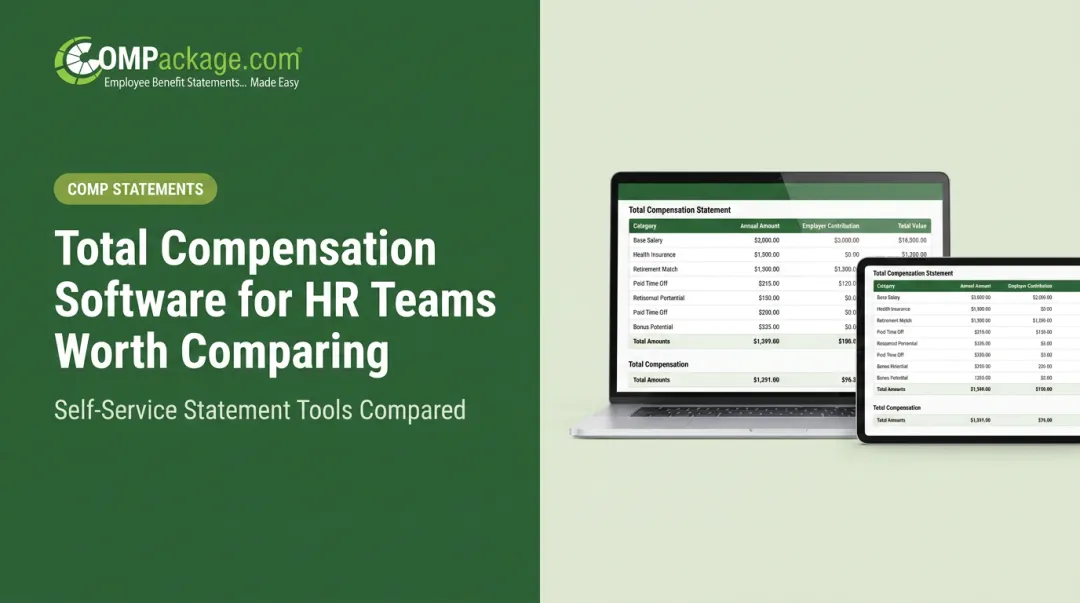
Total compensation software calculates, organizes, and presents the complete value of what an employee receives — salary, benefits, retirement contributions, and every other element the employer funds.
A typical report covers:
- Employer-paid health, dental, and vision premiums
- 401(k) or retirement plan contributions
- Paid time off, expressed in dollar value
- Life and disability insurance
- Performance bonuses and variable pay
- Any additional perks or non-quantifiable benefits
HR teams and business owners use these reports during onboarding, annual reviews, recruiting conversations, and compensation change discussions. The purpose is strategic: make the real value of employment visible, so employees weigh retention decisions against the full picture — not just their paycheck.
Key Advantages of Total Compensation Software
The advantages below are tied to outcomes organizations already track: voluntary turnover rates, offer acceptance rates, and employee satisfaction scores. Each one is a direct result of giving employees accurate information rather than letting them guess.
Advantage 1: Closing the Employee Perception Gap to Reduce Voluntary Turnover
Most employees consistently underestimate what they're actually receiving. They see their net paycheck — and that's it. The employer's contributions to health coverage, retirement matching, and other indirect pay are functionally invisible without a formal statement.
The numbers back this up. According to the 2025 EBRI Workplace Wellness Survey, workers estimate that benefits represent about 16% of their total compensation.
The Bureau of Labor Statistics puts the actual figure at 30.1% for private-industry employees — a gap of more than 14 percentage points. That's a substantial portion of employment value going unrecognized every day.
Total compensation software closes that gap by generating a personalized report for each employee that itemizes every element of their package in dollar terms. When the full picture is visible, the perceived difference between a current job and a competing offer often shrinks considerably.
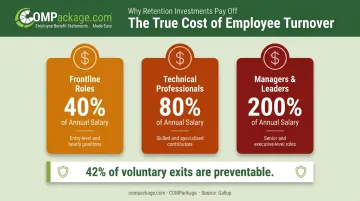
The cost of getting this wrong is real. Gallup estimates replacement costs at 40% of annual salary for frontline roles, 80% for technical professionals, and up to 200% for managers and leaders. Gallup also found that 42% of voluntary exits are preventable — meaning the employee could have been retained with different actions by the organization.
KPIs this affects:
- Voluntary turnover rate
- Employee retention rate
- Cost-per-hire savings from avoided backfills
- Compensation-related satisfaction scores
When it matters most: This advantage has the highest impact in organizations where compensation is genuinely competitive but employees don't know it — mid-sized businesses, companies with strong benefits packages, and any employer whose exit interview data points to pay perception as a driver of departures.
Advantage 2: Strengthening Recruiting by Showing Candidates the Full Offer
During hiring, most employers present a base salary number and expect candidates to infer the rest. A total compensation report changes that equation entirely.
HR teams can generate a candidate-specific report at the offer stage that shows the employer's contributions to health insurance, retirement matching, paid time off, and other benefits alongside base salary. The full offer becomes visible and concrete before the candidate signs — not something they have to calculate or take on faith.
This matters because candidates evaluating multiple offers are almost always comparing a known number (base salary) against unknowns. According to Gallup's 2025 study of 10,342 U.S. employees, 54% rated better pay and benefits as very important when considering a new job — up from 41% before the pandemic. Candidates are paying close attention to total value, but most employers still lead with salary alone.
The employer who makes the full package visible changes the comparison in its favor. When base pay is similar across competing offers, the clearer picture wins.
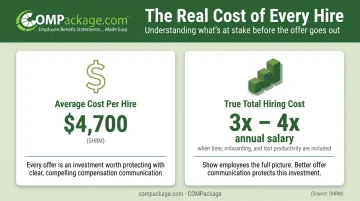
Recruiting is expensive to get wrong. SHRM reports that the average cost per hire sits at nearly $4,700, with many organizations estimating total hiring costs at 3x to 4x the position's annual salary when time, onboarding, and lost productivity are factored in. Better offer communication protects that investment.
KPIs this affects:
- Offer acceptance rate
- Time-to-fill
- Cost-per-hire
- Quality of hire (candidates self-selecting based on accurate value alignment)
When it matters most: Most powerful when recruiting in competitive markets, when base salaries are constrained but benefits are strong, or when the total package is genuinely generous but rarely communicated clearly during the hiring process.
Advantage 3: Increasing Pay Satisfaction Without Increasing Base Salary
Pay dissatisfaction frequently reflects incomplete information, not an inadequate paycheck. When employees don't know what they're receiving, their default assumption runs low — and that gap shows up as dissatisfaction on engagement surveys.
Total compensation software addresses the problem at the source. Personalized reports delivered at meaningful moments — after a raise, following benefit changes, during annual review season — reinforce the full value of employment in a way a pay stub never does.
The WorldatWork 2026 State of Rewards data makes the opportunity concrete: employee satisfaction with benefits sat at 77%, while satisfaction with compensation was only 69%.
That gap suggests employees are genuinely undervaluing what they receive. Connecting them to the full picture — particularly the benefits they tend to overlook — can shift compensation perception without touching base salary.
For small and mid-sized businesses operating in industries with intense salary competition, this matters. Salary increases are expensive and often only temporarily satisfying. Improving compensation communication delivers a sustained benefit at a fraction of the cost, because employees are now making accurate assessments rather than incomplete ones.
KPIs this affects:
- Employee satisfaction scores (compensation-related)
- Engagement survey results
- Annual review outcomes where compensation disputes arise
- Absenteeism rates
Where this pays off: Companies with strong benefits that go underappreciated, organizations entering or exiting annual review cycles, and employers in high-salary-competition industries where benefits are a genuine differentiator.
What Happens When Total Compensation Software Is Missing
When employees have no clear picture of their full compensation, they fill the gap with assumptions. Those assumptions almost always run lower than reality.
The consequences compound over time:
- Preventable voluntary turnover — employees accept competing offers without realizing those offers aren't actually better on a total-value basis
- Weaker recruiting outcomes — candidates compare a concrete competing salary to a vague sense of what the full package might be, and default to the clearer option
- Rising pay dissatisfaction — shows up on engagement surveys as a compensation problem, prompting reactive salary increases that address the symptom rather than the cause
- No return on benefits investment — if employees never see the employer's contributions to health coverage and retirement, those investments generate no goodwill or loyalty
- Increased HR burden — compensation-related questions and retention conversations consume time that could go toward higher-value work
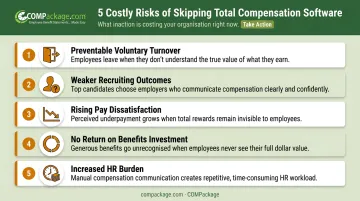
Each of these outcomes traces back to the same gap: employees don't see the full picture. The Gallup research cited earlier found that 30% of preventable departure actions involved additional compensation or benefits — meaning the solution often already exists within what the employer provides. The value is there. Without a clear way to show it, that investment goes unrecognized.
How to Get the Most Value from Total Compensation Software
The impact of total compensation software compounds when it's applied consistently — not just at annual reviews, but at every meaningful touchpoint in the employee lifecycle.
Conditions for highest impact:
- Personalize every report so only the benefits each employee actually receives appear — generic statements reduce credibility fast
- Distribute reports when employees are actively evaluating their situation: after a raise, during review season, after benefit changes, or when a competing offer surfaces
- Use data patterns to guide communication — if employees consistently undervalue a specific benefit, that's a gap worth addressing directly
Putting these practices in place doesn't require an enterprise HR budget. COMPackage is built for companies with 5 to 5,000 employees — reports are personalized, branded, and can be rerun throughout the year at no additional charge, so you're covered at every stage of the employee lifecycle. No installation required, and a 30-day satisfaction guarantee applies.
Conclusion
The value of total compensation software lies in clarity and consistency. It gives employees an accurate picture of what their employment is worth, gives HR teams a proactive retention tool rather than a reactive one, and gives leadership a way to get full return on benefits investment.
Every report delivered builds employee awareness. Every recruiting conversation that leads with total value improves hiring outcomes. And every retention issue caught early — before it becomes a resignation — reduces cost.
The companies that do this consistently aren't paying more than their competitors. They're communicating their value more effectively — and that's what keeps their best people from quietly updating their resumes.
Frequently Asked Questions
What is compensation software?
Compensation software helps businesses plan, manage, and communicate employee pay and benefits — covering everything from base salary to bonuses, retirement contributions, and health benefits. The goal is to give both employers and employees a clear, accurate view of the full value of total compensation.
What is a 70/30 split salary?
A 70/30 split refers to a structure where 70% of an employee's earnings come from a fixed base salary and 30% from variable pay such as commissions, performance bonuses, or incentives. It's common in sales roles where compensation is tied directly to individual output.
What is included in a total compensation package?
A total compensation package includes base salary, bonuses, employer contributions to health insurance and retirement plans, paid time off value, and equity or stock options if applicable. It also covers non-cash perks and benefits — the full dollar value of everything an employee receives for their work.
How does total compensation software help with employee retention?
Total compensation software closes the perception gap that drives preventable turnover by showing employees the full dollar value of their compensation, including benefits they rarely see quantified. When employees can compare total value rather than base salary alone, competing offers become far less appealing.
Can small businesses use total compensation software?
Yes. Self-service platforms like COMPackage are built for small and mid-sized businesses, with plans starting at companies as small as five employees. There's no installation, no enterprise pricing, and reports can be generated in-house in hours.
How often should total compensation reports be updated and distributed?
At minimum, annually — ideally timed around annual reviews or open enrollment. Reports should also be updated whenever significant changes occur, such as benefit cost adjustments, salary changes, or the addition of new perks, to keep employee awareness current throughout the year.