This guide gives you 30 employee benefits survey questions for 2026, grouped by awareness, satisfaction, usage, access, priorities, and unmet needs. You'll also see when to run the survey, how to protect confidentiality, and how to turn feedback into better communication and planning decisions.
Key Takeaways
- Measure awareness, access, usage, satisfaction, and unmet needs separately, not with one overall rating.
- Run the main survey early enough to act before renewal or open enrollment.
- Compare responses with utilization, cost, eligibility, and benchmark data.
- Tell employees what will change, what can't, and how their feedback shaped the decision.
30 Employee Benefits Survey Questions for 2026
Pick the questions that serve your decision, not all 30 by default. Add "not applicable" and "I don't know" options wherever eligibility or awareness may vary.
Overall Benefits Awareness and Communication
- How familiar are you with the benefits available to you? (Likert)
- I understand what each of my current benefits covers. (Likert)
- I know where to go when I have a benefits question. (Likert)
- How easy is it to find benefits information? (Likert)
- How clearly does the company communicate benefits changes? (Likert)
- Which benefit were you surprised to learn the company offers? (open text)
Awareness questions help you tell a communication problem from a design problem. Compare what employees say they know with your actual benefits list. If people name only half of what you offer, the issue is visibility, not the plan.
Health, Insurance, and Financial Benefits
- How satisfied are you with your medical coverage?
- I understand what my health plan covers and what I may pay out of pocket.
- How satisfied are you with dental and vision coverage? (ask separately in practice)
- Do you understand how to use an HSA (health savings account) or FSA (flexible spending account)?
- Do you contribute to the company retirement plan?
- If you do not contribute, what is the main reason?
Include a "not eligible" option. Cost context matters here: the KFF 2026 survey reports an average family premium of $28,303, with workers paying about 27% of premiums.
Your own numbers will differ by plan and size, so ask about both employee contributions and perceived value.
PTO, Leave, Flexibility, and Caregiving
- I can use my paid time off when I need it.
- I understand the company's parental, medical, and bereavement leave policies.
- Has anything prevented you from using time off you were entitled to?
- Do you have the flexibility needed to manage work and personal responsibilities?
- Are flexible work policies applied fairly?
- What caregiving support, if any, is missing?
Keep wording neutral. Don't assume family structure, caregiving duties, work location, or employment status, and always offer "not applicable."
Wellbeing, Mental Health, and Learning
- I know how to access the company's mental health and wellbeing resources.
- I feel comfortable using those resources.
- Which wellbeing benefits have you used in the past 12 months?
- Are the company's learning and development benefits relevant to your goals?
- Do you have enough time to use learning benefits?
- Which wellbeing or development benefit would be most valuable to you?
Low usage doesn't automatically mean low value. Ask whether barriers are stigma, awareness, eligibility, scheduling, cost, or hard-to-use programs.
Priorities, Unmet Needs, and Retention
- Which three benefits matter most to you right now? (ranking)
- If the company could invest in one benefits area next year, which should it be? (forced choice)
- Which benefit would you most regret losing?
- What is one unmet need the current package does not support?
- What is one thing we could improve?
- How much do the company's benefits influence your decision to stay? (Likert)
Mix ranking, forced-choice, Likert, and open-ended formats so employees reveal trade-offs instead of rating everything important.
In WTW's 2026 US survey of 6,000 full-time employees, improving core benefits ranked first. WTW's research also found nearly a third skipped a medical or dental appointment because of cost.

How to Write and Run an Effective Benefits Survey
Define the Objective First
Start with the decision the survey informs: renewing a medical plan, fixing communication, evaluating a new benefit, reviewing contributions, or understanding why a program is underused. A focused objective kills vague questions like "Do you like our benefits?" and ties each response to an action.
Match Question Types to the Information Needed
- Likert scales: satisfaction, understanding, confidence, agreement
- Multiple choice: awareness and usage
- Ranking: priorities
- Open text: barriers and unmet needs
Use consistent scales, clear labels, and "not applicable" choices. Limit open-ended questions to avoid fatigue.
Write Neutral, Specific Questions
Ask one thing at a time. Split medical from dental, define HSA and FSA, and avoid leading language. Don't imply that the most-requested benefit will be added. Ask "Which option would be most valuable?" rather than "Which benefit should we introduce?"
Time the Survey Well
Higginbotham recommends running a strategy survey about one month before you meet your broker and before open enrollment. Assess the enrollment process soon after it ends, while memories are fresh. Add short follow-ups after major changes or once new hires have used their benefits.
Protect Confidentiality
Health, finances, and family topics demand clarity. Know the difference: anonymous means identities aren't collected; confidential means researchers can see them but won't disclose them. Tell employees:
- Why you're surveying and how responses will be used
- How long it takes and when they'll hear back
- Who can access data, and the minimum group size for reporting
- That demographic questions are voluntary
For comparison, the federal OPM playbook suppresses groups under 10 respondents. That's a federal standard, not a legal rule for private employers.
Participation also depends on access. Make the survey mobile-friendly for deskless and remote workers.
How to Analyze and Act on Survey Results
Segment Without Exposing People
Review by tenure, role, employment type, or work arrangement only when groups are large enough to protect identities. Company-wide averages can hide a problem affecting one group, such as part-time staff. BLS data shows medical access of 87% for full-time workers versus 23% for part-time.

Separate Awareness, Access, Usage, and Satisfaction
Use a simple diagnostic:
- Low awareness: improve communication
- High awareness, low usage: look at cost, eligibility, complexity, or relevance
- High usage, low satisfaction: examine service quality or plan design
Pair survey answers with enrollment, claims, retirement contribution, PTO, and utilization data where legally and operationally appropriate.
Benchmark Responsibly
Benchmarking compares your costs, offerings, participation, or perceptions with outside organizations. Useful sources include the SHRM 2026 Employee Benefits Survey (5,472 US organizations), KFF for health premiums, and BLS for access and take-up. Benchmarks give context, not answers. Adjust for company size, industry, workforce mix, and plan design.

Prioritize by Value, Feasibility, and Risk
Rank findings by employee impact, frequency, cost, compliance, and effort. Ask whether communication alone can fix it. Pair quick wins (clearer guides, reminders) with longer projects (plan redesign, vendor review). Employee preference is input, not the final financial or legal decision.
Show Employees the Full Value
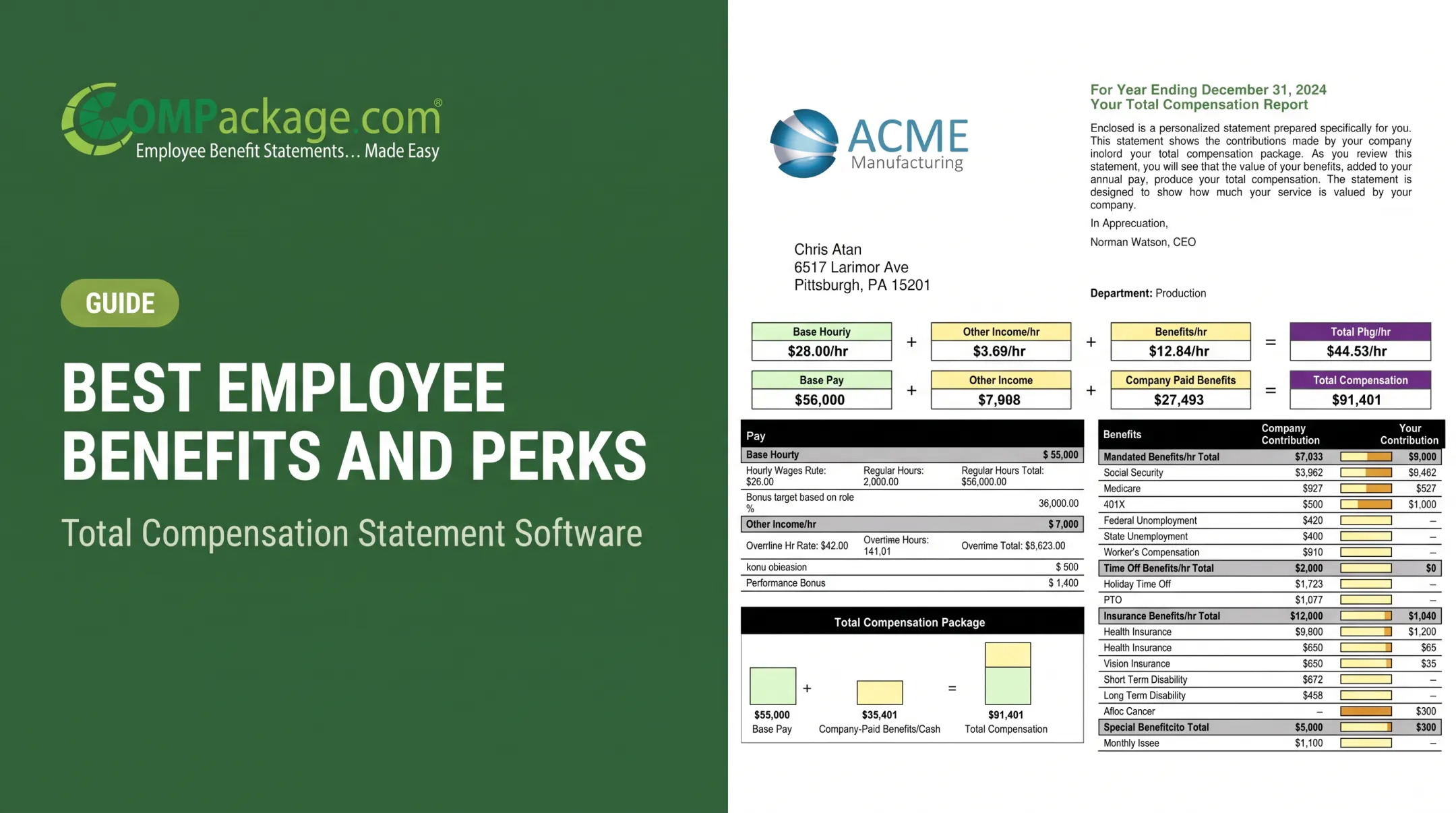
Surveys often reveal that employees don't see the total value of employer-paid insurance, retirement contributions, PTO, and non-cash perks. LIMRA reports only 42% of employees receive total compensation statements, and statement availability is associated with better understanding of insurance and retirement benefits. That's an association, not proof of retention gains.
If your results show an awareness gap, COMPackage's self-service total compensation reports give each employee a customized view of their full package, including applicable benefit details and non-quantifiable benefits.
Close the Feedback Loop
Share key findings, planned changes, items you can't change and why, without revealing individual comments. After changes land, repeat a small set of core questions to see whether awareness, access, satisfaction, or perceived value improved.
2026 Benefits Survey Best Practices and Common Mistakes
Best practices:
- Ask throughout the year, not just annually
- Keep pulse surveys short and tied to a clear decision
Avoid these mistakes:
- Treating the most-requested benefit as an automatic mandate
- Confusing low usage with low value
- Asking only satisfaction questions
- Collecting feedback with no follow-up plan
Evaluate benefits alongside pay, workload, management, career development, cost, and compliance. A new benefit can't fix every employee experience problem.
Frequently Asked Questions
What is the average cost of benefits for an employee?
It varies by employer size, industry, plan design, and contributions. BLS reports private employers spent $14.07 per hour on benefits in June 2026, about 30.0% of compensation.
Are employee engagement surveys useful?
Yes, but they're broader than benefits surveys. Engagement results can flag benefits-related themes, which a focused follow-up survey can then explore.
What are good questions to ask about benefits?
Cover awareness, access, usage, satisfaction, importance, barriers, unmet needs, and understanding of total compensation.
What is benchmarking in employee benefits?
It compares your offerings, costs, participation, or perceptions with relevant external data. Benchmarks should inform, not replace, your own analysis.
What are good questions for an employee engagement survey?
Ask about belonging, leadership, workload, recognition, growth, communication, and intent to stay. Analyze benefits questions as a separate topic.
What questions to ask about benefits during an interview?
Ask about medical plan options, employee contributions, retirement match, PTO, leave, flexibility, waiting periods, and how the employer communicates total compensation.