Benefits get discussed as a recruiting tool. Their real value shows up elsewhere: a covered doctor visit, a week off after surgery, a retirement account that grows while you're busy living.
Employer costs for benefits average $14.07 per hour worked, about 30% of private-industry compensation, according to the BLS June 2026 data. This article covers why benefits matter, which ones tend to count most, what happens when they're weak or poorly explained, and how to make their value visible.
Key Takeaways
- Benefits add health, financial, and family protection on top of wages.
- The most valuable benefits depend on dependents, health needs, and career stage.
- Satisfaction rises when employees actually understand their coverage.
- Employers should judge benefits by need, use, affordability, and clear communication.
What Are Employee Benefits?
Employee benefits are non-wage compensation and workplace support provided on top of salary. Common examples:
- Employer-sponsored health, dental and vision plans
- Retirement plans with employer matching
- Paid vacation, sick and parental leave
- Life and disability insurance
- Flexible work, wellness and mental health resources
- Professional development and family support
Some benefits are required by law. Social Security, Medicare, unemployment insurance and workers' compensation are the classic examples. Others are voluntary or go beyond the minimum.
Eligibility varies by federal law, state law, employee classification, employer size and plan design. FMLA, for instance, covers only employers with 50 or more employees. ACA employer coverage rules generally apply at 50 or more full-time employees, including full-time equivalents.
Benefits help people manage health costs, protect income, balance work and home, prepare for the future, and judge the true value of a job offer.
There is no universally perfect package. A benefit is valuable when it is relevant, affordable, accessible and understood.
Key Advantages of Employee Benefits
Advantage 1: Financial Security and Protection
Health, dental, vision, disability and life insurance, FSAs and HSAs, and retirement plans shield employees from large, unpredictable costs. Employer contributions and group purchasing mean workers don't carry that burden alone.
The funding split is striking. KFF's 2026 survey puts average family premiums at $28,303, with employers paying $20,833 and workers $7,471.
Worries remain. EBRI's 2026 Retirement Confidence Survey found nearly 6 in 10 workers say healthcare costs hurt their ability to save for retirement. These are reported concerns, not measured effects of specific plans.

- KPIs: benefits satisfaction, enrollment, retirement contribution rates, plan utilization, voluntary turnover
- Matters most for: employees with dependents, ongoing health needs, thin savings or large financial obligations
Advantage 2: Health, Wellbeing and Work-Life Balance
Paid time off, sick leave, parental leave, flexible schedules, employee assistance programs and caregiving support give people room to handle illness, appointments, family needs and recovery.
A 2025 study of 11 state paid sick leave laws found access rose 14 percentage points and working while sick fell 3 points, with little measurable effect on downstream health or wellbeing.
A 2024 JAMA Network Open study linked schedule flexibility to lower odds of serious psychological distress (OR 0.74), though its cross-sectional design can't prove causation.
Benefits don't erase workplace stress. They only help when employees can use them without confusion, stigma or obstacles.
- KPIs: leave utilization, unscheduled absence, wellbeing scores, EAP usage, burnout indicators
- Matters most for: caregivers, parents, people managing health conditions, and anyone juggling heavy demands
Advantage 3: Satisfaction, Engagement and Performance
A good package signals that an employer sees staff as people with health, financial and family needs. Less financial pressure makes it easier to focus and collaborate.
Aflac's 2025-2026 WorkForces Report found employees who were only "somewhat" satisfied with benefits were nearly half as likely to report high job satisfaction as highly satisfied peers. It's a correlation. It doesn't prove that adding benefits raises productivity.
Offering benefits isn't enough. Fair eligibility rules, easy access and responsive support create the experience.
- KPIs: satisfaction, engagement, performance consistency, absenteeism, benefits questions and complaints
- Matters most during: organizational change, heavy workloads and tight labor markets
Advantage 4: Retention and Talent Attraction
Candidates and current employees weigh benefits when comparing offers. A relevant, clearly explained package differentiates an employer without relying on raises or flashy perks.
Aflac's 2026-2027 data shows 39% of employees would trade some salary for stronger benefits, rising to 53% among Gen Z. That's stated willingness, not observed job changes.
Gallup found that 54% of workers rate better pay and benefits as very important in choosing a job, though it combines the two.

Keeping experienced people also preserves institutional knowledge and avoids repeated hiring and onboarding. COMPackage's internal figures put replacement cost at no less than 25% of annual salary, while Work Institute links costs to compensation, time to productivity and specialized skills.
- KPIs: qualified applicants, offer acceptance, time to fill, voluntary turnover, referrals
- Matters most for: small and mid-sized businesses competing with larger employers, and those hiring specialized talent
What Happens When Benefits Are Missing or Ignored
Limited benefits, weak design, and poor communication hurt employees and employers alike.
Consequences for Employees
- Greater exposure to healthcare bills
- Less support during illness or family changes
- Weaker retirement preparation
- More stress and a strained work-life balance
A benefit can be effectively missing if people don't understand eligibility, deadlines, limits, or how to use it. MetLife's 2025 study found 38% of workers struggle to understand benefits and open-enrollment communications. In Aflac's 2026-2027 survey, 32% said they overpaid for healthcare because they misunderstood coverage. That's self-reported harm, not a measured dollar loss.
Consequences for Employers
- Inconsistent employee experiences and enrollment errors
- A steady stream of reactive HR questions
- Higher administrative costs and harder-to-scale benefits processes
- Weaker retention and harder recruiting
Underuse is a real risk too. EBRI's 2025 survey of large employers found engagement barriers such as:
- Low awareness (47%)
- Stigma (43%)
- Confidentiality worries (40%)
Only 22% track mental health utilization.

How to Get the Most Value from Employee Benefits
Benefits work best when they're reviewed regularly, explained clearly and tied to real needs, not treated as a once-a-year enrollment chore.
For Employees: Understand and Use the Package
- Read the key documents. The Summary Plan Description explains plan operation and rights; the Summary of Benefits and Coverage summarizes costs and limits in plain language.
- Check the numbers. Look at contributions, deductibles, coverage limits, leave policies and match conditions. A retirement match usually requires you to contribute.
- Watch the deadlines. Special enrollment after marriage, birth, adoption or loss of coverage generally gives at least 30 days.
- Ask questions. HR or the plan administrator can clarify terms, dependents and unused resources.
For Employers: Design Around Real Needs
Use surveys, focus groups, utilization data and market benchmarks to see what people value and which programs are hard to use. Review plan documents and legal duties with qualified legal, tax, benefits or compliance professionals instead of relying on generic lists of mandatory benefits.
Communicate Total Compensation Clearly
Employees undervalue what they can't see. Employer-paid premiums, retirement contributions and paid leave rarely appear next to salary in plain language.
Practical tools include:
- Onboarding walkthroughs and annual enrollment guides
- Life-event reminders and employee portals
- Manager training
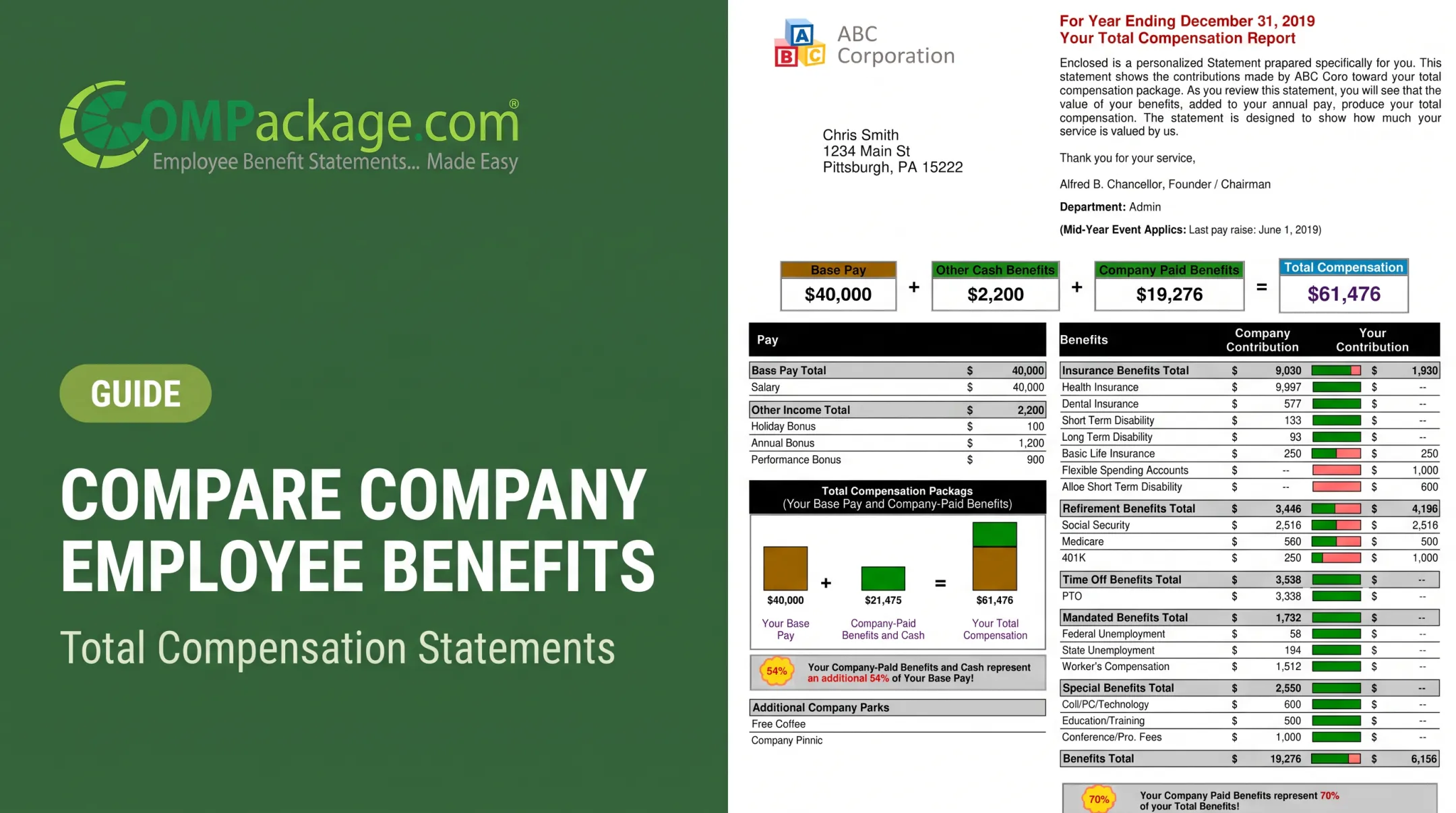
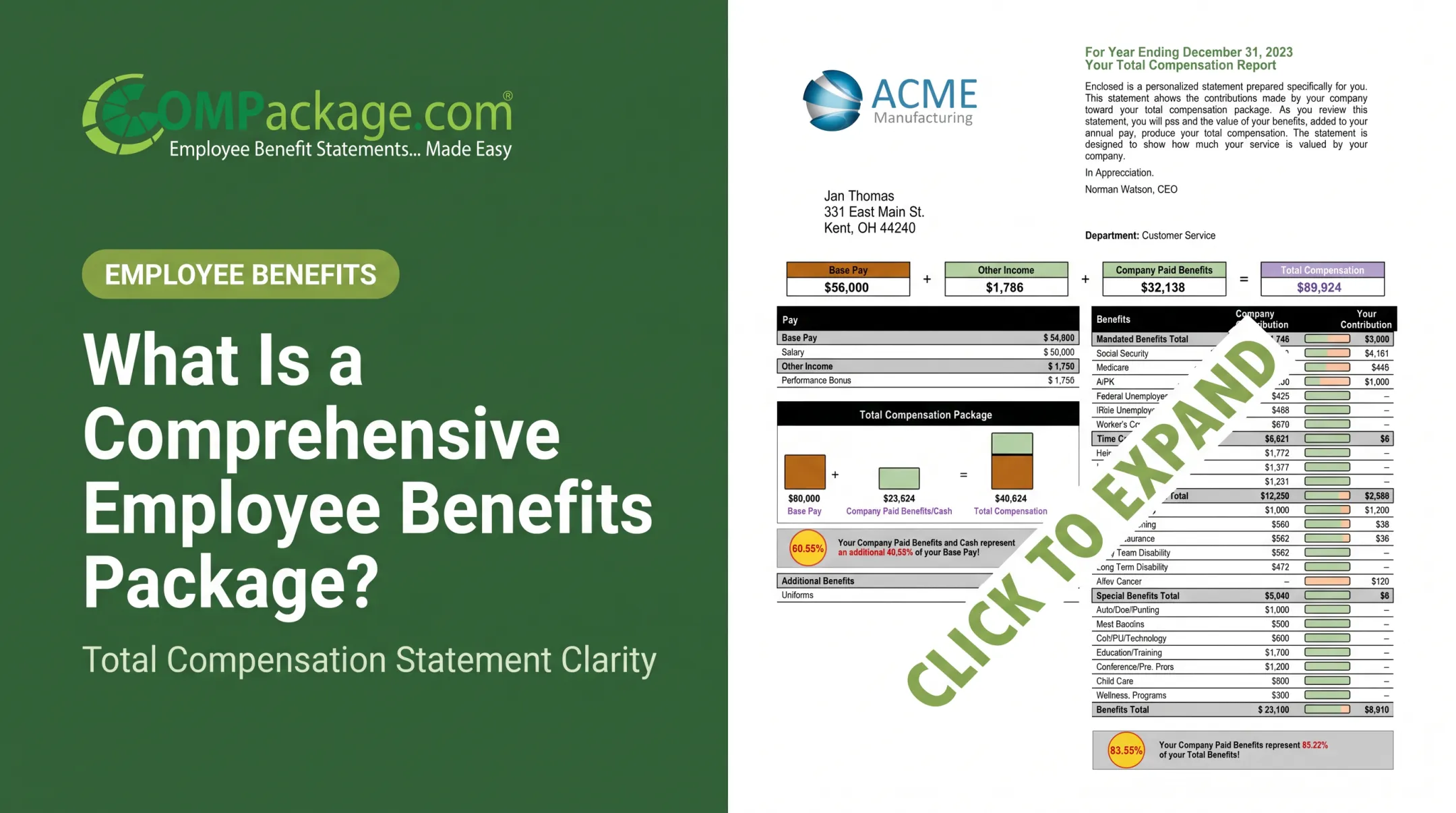
- Individualized total compensation statements
COMPackage offers self-service software that lets employers build individualized reports showing the benefits and compensation elements that apply to each employee.
One example shows an employee earning $50,000 with total compensation of $71,839, including $6,322 in insurance and $4,957 in paid leave. Seeing that on one page makes the package easier to discuss.
Evidence that statements directly improve enrollment or retention is limited, so treat them as a clarity tool, not a guarantee.
Review Outcomes and Improve
Track participation, understanding, satisfaction, utilization, retention, absenteeism, recruiting results and recurring questions. Then act: simplify communication, improve access, rework underused programs, or add benefits that meet demonstrated needs.
Conclusion
Benefits matter because they support employees beyond wages: health, finances, family responsibilities, well-being, and long-term goals.
The strongest package isn't necessarily the biggest or priciest. It's relevant, accessible, clearly explained, and matched to the workforce.
Benefits deliver the most when employers spell out their full contribution and employees can see how the package supports their lives and careers.
Frequently Asked Questions
Why are employee benefits important?
They protect financial security, support health and work-life balance, help families, build retirement savings and add real value to a job beyond pay.
Which employee benefits are most important and why?
Health coverage, paid time off, retirement support, income protection, flexibility, and family or mental health resources are common priorities. Importance varies with each person's circumstances.
What types of employee benefits can employers offer?
Options include health and insurance plans, paid leave, retirement plans, flexible work, wellness and mental health support, professional development and family assistance. Legal requirements vary across the US.
Are employee benefits part of total compensation?
Yes. Total compensation is wages plus employer-paid benefits, retirement contributions, paid time off, insurance, bonuses and other direct or indirect pay.
Are employee benefits more important than salary?
They serve different needs. Most people weigh the whole package: pay, healthcare costs, time off, financial protection and flexibility, based on their circumstances.
How can employees understand the value of their benefits?
Review plan documents, employer contributions, eligibility rules, out-of-pocket costs and leave policies. Ask HR or the plan administrator to clarify anything unclear.