Introduction
A job offer lists a salary, but the paycheck is only part of what an employer spends on you. Benefits sit alongside wages in offer letters, onboarding packets, payroll systems, and every annual enrollment window.
The numbers are large. BLS employer cost data shows benefits make up 30.0% of private-industry compensation costs, or $14.07 of every $46.89 spent per hour worked. Yet many employees can't say what their eligibility is, what the employer contributes, or how their 401(k) is taxed.
This guide walks through how benefits and 401(k) plans work, from enrollment through withdrawal.
Key Takeaways
- Benefits are non-wage compensation, paid by the employer, shared, or funded through payroll deductions.
- A 401(k) is an employer-sponsored defined-contribution plan funded mostly by payroll deferrals.
- Traditional and Roth deferrals differ mainly in when taxes are paid.
- Matching, vesting, eligibility, and fees depend on your plan documents.
What Are Employee Benefits and 401(k) Plans?
Employee benefits
Employee benefits are compensation or workplace programs provided in addition to regular wages. The Bureau of Labor Statistics (BLS) treats them as nonwage compensation through employer-sponsored programs, including retirement, healthcare, life insurance, paid leave, and disability coverage.
They add to base pay rather than replace it. Employers offer them to support health and financial security. Employees gain coverage, paid time off, tax advantages, employer contributions, and group pricing.
Benefits are not salary, bonuses, or commissions. They also differ from legally required programs such as Social Security, Medicare, unemployment insurance, and workers' compensation. Not every worker has access to every benefit, and funding varies.
The 401(k)
A 401(k) is a tax-advantaged retirement plan named after Section 401(k) of the Internal Revenue Code. Per the IRS, it is a defined-contribution plan: contributions go into your individual account.
How a 401(k) differs from related options:
- Pension: a defined-benefit plan that promises a set monthly payment
- IRA: an individual account opened with a financial institution, not through an employer
- Brokerage account: no special tax treatment and no employer plan rules
Types of Employee Benefits and 401(k) Plans
Common benefit categories
- Medical, dental, and vision insurance
- Life and disability insurance
- Paid time off, plus paid family or medical leave where state law provides it
- Flexible spending or health savings arrangements
- Wellness programs
- Retirement plans
401(k) designs
| Feature | What it means |
|---|---|
| Traditional | Deferrals generally aren't included in current federal taxable income |
| Roth | Contributions are taxed now; qualified distributions are tax-free after five tax years and age 59½, disability, or death |
| Safe harbor | Required employer contributions provide relief from annual nondiscrimination testing |
| Profit-sharing | Employer contributions can be discretionary, even zero in a given year |
| Automatic enrollment | Employees start at a default rate unless they opt out or pick another |

Pretax and Roth deferrals can coexist in one plan. Safe harbor, profit-sharing, and auto-enrollment are separate design choices.
2026 limits
- Employee deferrals: $24,500
- Catch-up for age 50+: $8,000
- Catch-up for ages 60-63: $11,250
- Total annual additions: lesser of $72,000 or 100% of compensation, excluding catch-ups
Participants whose 2025 wages from the plan sponsor exceeded $150,000 must make catch-up contributions on a Roth basis. Limits change yearly, so confirm current IRS figures.
How Do Employee Benefits and 401(k) Plans Work?
Benefits and 401(k) plans follow a set sequence. The employer picks plans, employees meet eligibility and enroll, payroll takes deductions and adds employer money, providers administer coverage or investments, and employees receive statements.
Initiation
Employers choose benefit offerings, plan documents, providers, contribution policies, and enrollment procedures. HR, payroll, benefits administrators, recordkeepers, and outside advisers each handle part of this, and no single party covers everything.
Employees then become eligible. A 401(k) plan generally requires age 21 and one year of service, or 1,000 hours in a 12-month period. Under SECURE 2.0, long-term part-time employees can qualify after two consecutive 12-month periods of at least 500 hours each, for plan years beginning after 2024.
Plans may also use waiting periods, automatic enrollment with opt-out rights, and beneficiary designations. Read the Summary Plan Description (SPD), which participants generally receive within 90 days of joining.
Core operation
Non-retirement benefits. Employees may pay premiums through payroll deductions while employers cover part of the cost. An insurer processes claims, coverage changes, and annual elections. Qualifying life events, such as marriage or birth, open special enrollment. For employer health plans, that request generally must come within 30 days.
401(k) contributions. You elect a percentage or dollar amount. Payroll deducts it pretax (traditional) or after tax (Roth). The employer may add a match or profit-sharing contribution under the plan's formula. The IRS gives one illustration: an employer adding 50 cents for every dollar contributed.
Investments. You choose from the plan's menu, such as mutual funds or target-date funds. Returns aren't guaranteed, and target-date funds don't guarantee sufficient retirement income.
Vesting. Your own deferrals are always 100% vested. Employer matching follows the plan's schedule:
- 3-year cliff vesting
- 6-year graded vesting (20% after year 2, rising to 100% after year 6)
- Immediate vesting for standard safe harbor matches (QACA safe harbor may take up to 2 years)

Regulation and control
Several rules keep plans honest:
- Annual contribution limits and payroll accuracy
- ADP/ACP nondiscrimination testing for traditional plans
- ERISA fiduciary duties: act solely for participants, act prudently, follow plan documents, diversify, and pay only reasonable expenses
- Fee disclosures from service providers and to participants, with quarterly statements of fees actually charged
- Annual Form 5500 reporting and required notices
Output and result
For employees, the result is coverage, workplace programs, and a growing retirement account with statements and tax reporting. When employment ends, options include staying in the plan, rolling over, or taking a distribution.
- Direct rollover: the administrator sends funds straight to another retirement account, with no mandatory withholding
- Paid to you: 20% mandatory withholding applies, and you generally have 60 days to roll over the full amount
Related distribution rules still apply:
- Early withdrawals: before 59½, an additional 10% tax generally applies unless an exception fits
- RMDs: required minimum distributions start at 73, and designated Roth 401(k)s have none during the owner's lifetime
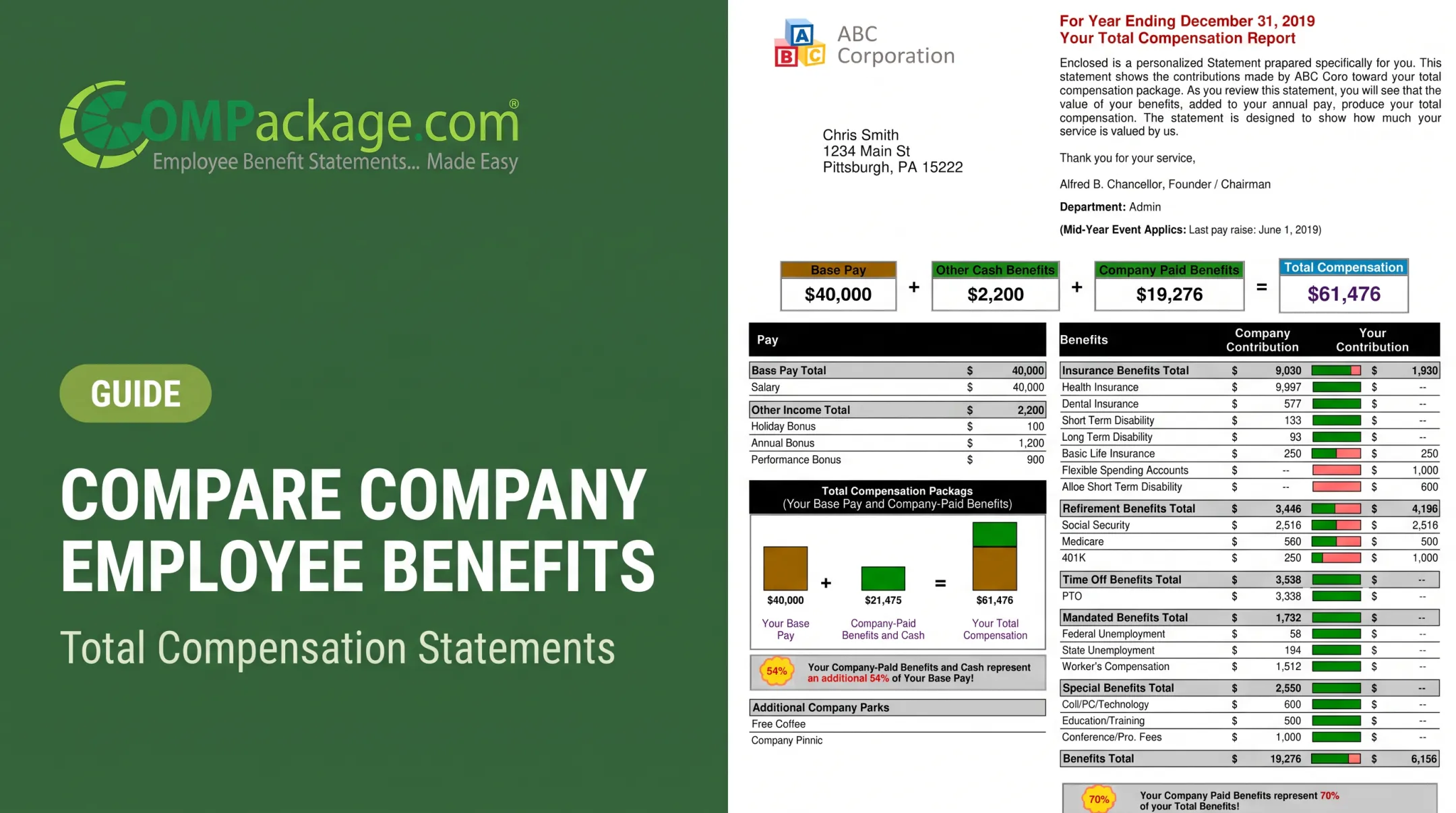
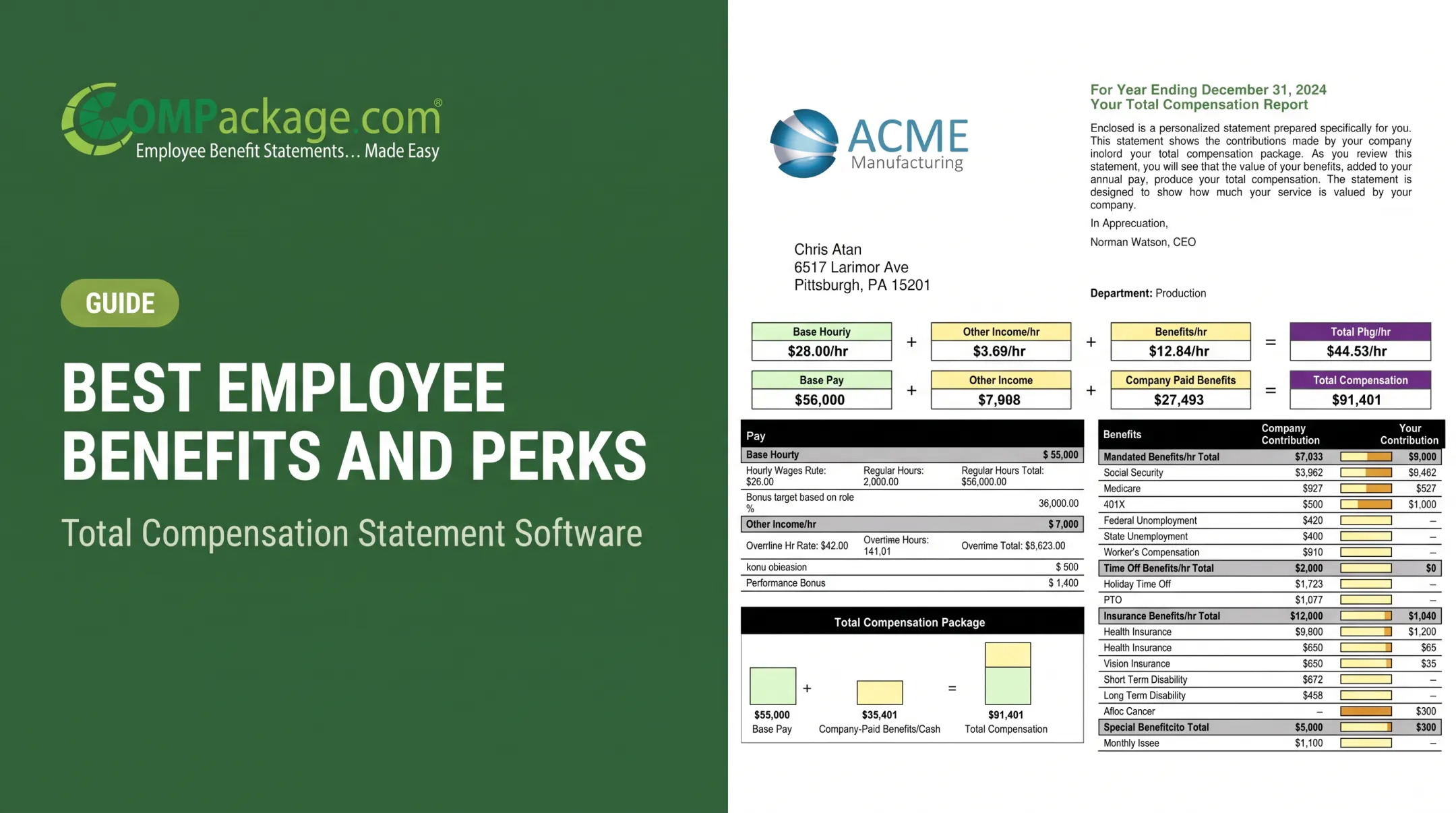
The account is only part of total pay. Employers want staff to see the full value of benefits beside wages. MetLife's 2025 study found only 57% of employees fully understand their benefit coverage, and 72% want tailored communications.

COMPackage helps close that gap. Its software produces customizable total compensation reports showing benefits and retirement contributions. In one sample summary, direct pay of $63,408 sat beside $30,724 in company benefit contributions. It doesn't replace your 401(k) provider or financial adviser.
Where Employee Benefits and 401(k) Plans Are Used
Across the employee lifecycle
Benefits come up during:
- Recruiting and offer comparisons
- Onboarding and payroll setup
- Annual open enrollment and qualifying life events
- Compensation reviews and leave
- Termination, retirement, and rollover decisions
Across employer types
Size drives access. BLS data on private-industry workers shows retirement access of 55% at establishments with 1-49 workers versus 91% at those with 500 or more. Participation rates are 37% versus 76%.

Budget, industry, demographics, and state rules also shape design. California, for example, requires employers with at least one eligible employee to register with CalSavers or claim an exemption through a qualifying plan. Small employers may also qualify for IRS startup tax credits.
Insurance agencies, accounting firms, payroll providers, and HR consultants help employers navigate these choices.
When clear communication matters most
Clear communication is especially useful when:
- Comparing job offers
- Separating employer-paid from employee-paid value
- Checking your match and vesting schedule
- Preparing for retirement
Use current plan documents, and bring in a qualified benefits, tax, or financial professional for individual decisions.
Conclusion
Benefits are a broader compensation system. A 401(k) is one retirement-focused piece, covering employer setup, eligibility, payroll contributions, investment, administration, and eventual distribution.
Before changing anything, review:
- Your benefits summary and 401(k) elections
- Contribution and vesting rules
- Fees and beneficiaries
- Tax implications
This article is educational and is not individualized legal, tax, or investment advice.
Frequently Asked Questions
How much do I need in a 401k to get $10,000 a month?
There's no universal number. Needs depend on age, returns, taxes, Social Security, other income, and withdrawal strategy. Fidelity's guidance suggests 4%-5% in year one as a guideline; a financial professional can model your case.
How does a 401k work?
Payroll deductions, plus any employer contributions, go into your plan account. You invest them according to your selections. Traditional deferrals are taxed at withdrawal; Roth contributions are taxed upfront.
What is a 401k?
It's an employer-sponsored, tax-advantaged defined-contribution retirement plan. Unlike a pension, it promises no set payout. Unlike an IRA, it's offered through your employer.
What are 401k eligible hours?
They're the hours or service criteria a plan uses to decide participation, such as 1,000 hours in 12 months. Requirements vary, so check your plan document or ask HR.
How do I contact my 401k for withdrawal?
Start with the plan recordkeeper through your account portal or statement, or ask HR. Review distribution eligibility, tax withholding, penalties, and rollover options before requesting funds.