Introduction
A $20-an-hour wage is not a $20-an-hour cost. Hiring someone triggers a one-time expense to find and onboard them, then a recurring bill for wages, taxes, benefits, and the time it takes them to become productive.
Those are two different calculations, and mixing them up is how budgets go wrong. The total shifts with the role, pay structure, hiring channel, state, compliance rules, and ramp-up speed.
Below, we compare cost-per-hire benchmarks with fully loaded employment costs, break down one-time and recurring expenses, and walk through building a realistic budget.
Key Takeaways
- No single national price exists; SHRM's 2025 mean cost per hire is $5,475 for nonexecutives.
- First-year cost includes wages, taxes, benefits, recruiting, equipment, onboarding, and ramp-up.
- Specialized roles, agencies, urgent hiring, and long training raise the total.
- Retention and process efficiency control costs better than picking the cheapest option.
How Much Does It Cost to Hire an Employee? (Pricing Overview)
"Cost to hire" and "cost to employ" are separate numbers. Cost per hire covers internal and external recruiting expenses. Fully loaded annual cost adds wages, employer taxes, benefits, and other employment costs.
Typical Cost Bands
SHRM's 2025 benchmarking report, drawn from SHRM's recruiting survey, shows how far the mean and median sit apart:
| 2025 measure | Nonexecutive | Executive |
|---|---|---|
| Mean cost per hire | $5,475 | $35,879 |
| Median cost per hire | $1,200 | $10,625 |
The figures are respondent benchmarks from 2,371 SHRM members, not a census of US hiring. They divide recruiting costs by hires.
- Internal costs: recruiting staff and talent-acquisition systems
- External costs: agency fees, advertising, job boards, career fairs, referral payments, travel, and relocation
They exclude wages, benefits, payroll taxes, and lost productivity. Treat the median as what a typical employer spends, and the mean as what agency-heavy or relocation-heavy hires can push higher. Agency involvement, relocation, and travel are the main drivers that separate a lean hire from a high-touch one.

A $20-an-Hour Employee Example
A single all-in total for a $20-an-hour worker varies by employer and location. Here is a transparent illustration. Assumptions: 2,080 paid hours (40 hours, 52 weeks, paid leave included), no overtime.
- Gross wages: $20 × 2,080 = $41,600
- Social Security (6.2%): $2,579
- Medicare (1.45%): $603
- Federal unemployment (0.6% of first $7,000): $42 at the maximum credit
- State unemployment: varies. California's experience-rated range is 1.5% to 6.2% on the first $7,000; Texas taxes the first $9,000.
- Workers' compensation: varies by state and job class
- Benefits, recruiting, equipment, onboarding: depend on your plan
Federal taxes alone add roughly $3,224, about 7.75% on top of wages, before state unemployment, workers' comp, or any benefits. Add a health plan and the gap widens quickly.
Present the result as two figures: a one-time hiring and onboarding spend, and a recurring annual cost. Verify rates with the IRS Publication 15 and your state agency, or an accountant.

Key Factors That Affect the Cost of Hiring an Employee
Hiring costs come from technical, operational, legal, and business factors, not salary alone.
Role Type, Experience, and Labor-Market Conditions
Entry-level roles often fill from direct applicants. Skilled, regulated, and hard-to-fill positions need more sourcing, deeper screening, and higher pay. Executive searches cost the most: SHRM's mean cost for executive hires is more than six times the nonexecutive figure.
Compensation and Benefits Package
Wages are the start. Overtime, shift differentials, paid leave, health coverage, retirement matches, and bonuses all add up.
- BLS puts private-industry benefits at $14.07 per hour worked, or 30.0% of total compensation (June 2026).
- KFF reports an average employer family-coverage contribution of $20,833 a year.
- Vanguard data shows a 4.7% average promised 401(k) match.
Coverage tier matters as much as hourly pay.
Hiring Channel and Recruitment Support
Cost depends on the channel:
- Direct applications and referrals: mostly staff time
- Job boards and career events: listing and event fees
- Staffing firms and agencies: a negotiated share of first-year pay, or flat fees, hourly charges, or retainers
No standard percentage applies, so get quotes in writing.
Company Size, Hiring Volume, and Infrastructure
A small business whose manager runs interviews between other jobs absorbs that time as a hidden cost. Larger employers spread recruiting software and HR staff across many hires. Benefits costs also scale with size: BLS shows $9.76 per hour worked at establishments with 1 to 49 workers versus $23.87 at 500 or more.
Location and Compliance Requirements
Federal rules set the floor, but states differ on unemployment insurance, workers' comp, required notices, and screening. California's Fair Chance Act, for example, bars conviction-history questions before an offer for employers with five or more employees. Don't treat one state's rules as universal.
Time-to-Fill, Onboarding, and Productivity
SHRM reports a 2025 median time to fill of 44 days for nonexecutives. Every open week means lost output or overtime for the team. After the offer comes training, mentoring, equipment setup, and a ramp-up period when pay exceeds output.

Cost Breakdown of Hiring and Employing an Employee
Separate expenses into one-time, variable, recurring, and indirect buckets. That keeps recruiting spend from blurring into ongoing compensation.
Recruitment and Selection Expenses
One-time or variable, depending on the hire:
- Job ads, sourcing tools, and referral bonuses
- Recruiter or agency fees
- Interview time and candidate travel
- Assessments
- Background checks: Checkr lists packages at $29.99, $59.99, and $94.99 per report
- Drug screening: from about $60 per test
Those are one provider's prices, not national averages. E-Verify is free.
Compensation and Employer Payroll Costs
Wages are recurring. On top of base pay, budget for:
- Employer Social Security and Medicare
- Unemployment taxes
- Workers' comp
- Payroll administration
Nonexempt staff earn 1.5 times their regular rate beyond 40 hours a week, so budget for overtime exposure.
Benefits and Total Compensation
Employer-paid benefits typically include:
- Health, dental, and vision
- Disability and life insurance
- Retirement contributions
- Paid leave, bonuses, and stipends
Count only the employer-paid share; employee deductions aren't your cost. BLS shows 11 average vacation days after one year of service, rising to 16 after five.
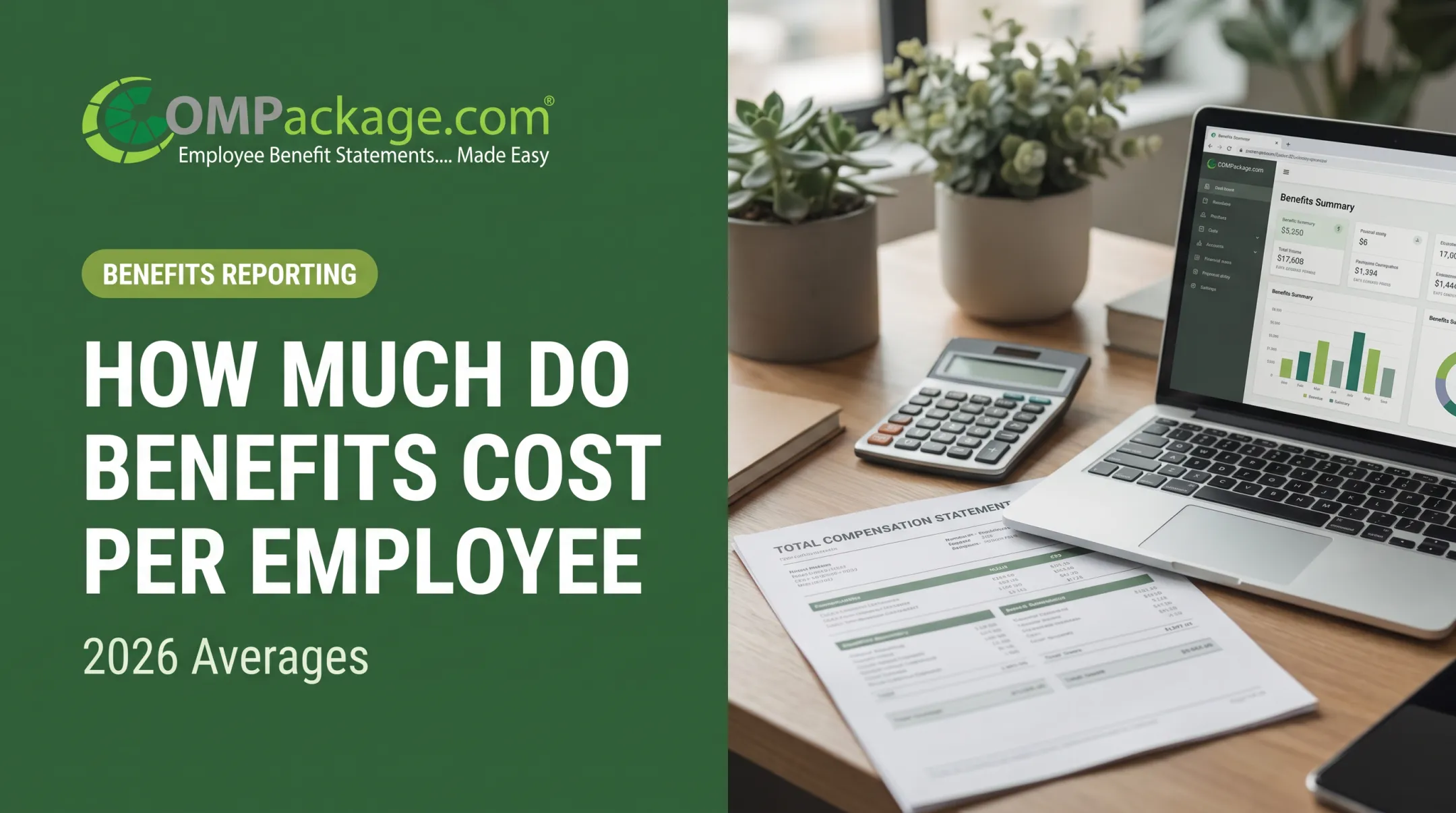
COMPackage's sample reports illustrate the scale. One $50,000-salary employee shows $71,839 in total compensation, including $6,322 for insurance and $5,532 for legally required benefits.
Onboarding, Equipment, and Training
Equipment and setup come before the first productive day:
- Laptops, phones, desks, software seats, and home-office setup
- Orientation, I-9 and W-4 paperwork, and new-hire reporting (generally within 20 days)
- Manager time during ramp-up
Training magazine's 2026 survey found $1,023 average spending per learner, an ongoing training figure rather than an onboarding price.
Indirect and Lifecycle Costs
Payroll reports miss costs that still hit the business:
- Vacancy delays and reduced team output
- Supervision and culture integration
- Turnover
Gallup estimates replacement costs near 40% of salary for frontline staff, 80% for technical professionals, and 200% for leaders. These are estimates, not guarantees.
Low-Cost vs High-Cost Hiring Approaches
| Factor | Lower-cost approach | Higher-cost approach |
|---|---|---|
| Speed | Slower | Faster |
| Candidate reach | Narrow | Broad |
| Screening depth | Light | Thorough |
| Onboarding support | Informal | Structured |
| Retention risk | Higher if poorly matched | Lower if well matched |
Higher upfront spend can pay for itself if it prevents a mis-hire.
How to Estimate the Right Budget for an Employee
The right budget reflects the role's expected contribution, required quality, timeline, and the full employment commitment.
Build a worksheet that covers:
- One-time recruiting costs
- Onboarding and setup costs
- First-year wages
- Employer payroll costs
- Benefits
- Allocated HR and manager time
- Expected ramp-up cost
Run low, expected, and high scenarios. Then add a documented contingency for agency use, relocation, overtime, extended vacancies, or extra training. Have an accountant or HR professional review it.
Once the full cost is clear, share enough of that picture with candidates and employees to support retention. In SHRM's pay-range survey, 70% of employers listing ranges reported more applicants. Employees often undervalue benefits when they only see base pay. COMPackage offers self-service total compensation reports that show the full package value, without replacing your recruiting or payroll systems.
What Most People Miss When It Comes to Hiring Cost
- The advertised wage: employer taxes, benefits, equipment, onboarding, and manager time sit outside it.
- Soft costs: vacancy disruption, interview hours, slow ramp-up, and lost institutional knowledge never arrive as invoices, so estimate them anyway.
- The cheapest channel: it may sacrifice quality, compliance, or time-to-fill, and replacing a poor-fit hire costs more than a better search would have.
Conclusion
The true cost of an employee has two parts: filling the position and employing the person year after year. A role-specific, source-backed estimate beats a national average because it balances pay, hiring efficiency, retention, and long-term value.
Frequently Asked Questions
How much does it actually cost to hire an employee?
Recruitment and onboarding are one-time costs; wages, taxes, benefits, equipment, and productivity costs recur. The total varies widely by role and employer.
What is a typical cost per hire?
SHRM's 2025 benchmark is a $5,475 mean and $1,200 median cost per hire for nonexecutives. Executive hiring is far higher, at a $35,879 mean.
How much does a $20 an hour employee cost an employer?
Assuming 2,080 hours, wages are $41,600. Federal payroll taxes add about $3,224, before state unemployment, workers' comp, benefits, recruiting, and onboarding.
Does it cost to go through a recruitment agency?
Yes. Fees are usually a negotiated percentage of first-year pay, though flat fees and retainers exist. Agencies can be worthwhile for specialized or urgent roles.
How can you control hiring costs?
Use referrals, targeted ads, structured interviews, and efficient onboarding, then track cost per hire. Reduce avoidable turnover without cutting compliance or candidate quality.
Is it cheaper to hire a new employee or keep an existing one?
Retaining someone usually avoids recruiting, vacancy, onboarding, and ramp-up costs. The comparison still depends on pay, training, performance, and business needs.