Introduction
Benefits are a big piece of what a job is worth, and most of that value never shows up in the salary figure on an offer letter. Health coverage, retirement contributions, paid time off, and flexibility all count.
For U.S. employers, the stakes are practical. Private-industry benefits averaged $14.07 per hour, or 30.0% of compensation, according to BLS's June 2026 data. Yet many employees can't say what their package covers.
This article defines corporate benefits, walks through four practical categories, compares their strengths and trade-offs, and shows how to choose a mix that fits your workforce and budget.
Key Takeaways
- Corporate benefits are compensation and support offered on top of base wages.
- Four categories cover most programs: health and insurance, retirement, leave and flexibility, and well-being perks.
- The right mix depends on workforce needs, budget, administrative capacity, and U.S. legal requirements.
- A benefit only creates value when employees understand it.
What Are Corporate Benefits?
Corporate benefits are employer-provided programs, contributions, services, protections, and policies offered in addition to regular wages. They are part of total compensation, which the Bureau of Labor Statistics (BLS) defines as wages and salaries plus benefits.
Some benefits have a clear dollar value, such as employer-paid premiums. Others are harder to price, such as flexibility, professional growth, or recognition.
Four terms are often used interchangeably:
- Legally required benefits: Social Security, Medicare, unemployment insurance, and workers' compensation
- Voluntary benefits: health plans, retirement plans, and paid leave beyond legal minimums
- Perks: convenience items such as meals or discounts
- Rewards: recognition and bonuses tied to performance
Requirements differ by benefit, state, and locality, so confirm current rules before you build or change a plan.
Why Are Corporate Benefits Important for Employers and Employees?
For employees, benefits support health, financial resilience, work-life balance, and career growth. For employers, they offer ways to compete for talent beyond base pay.
Employee satisfaction still lags. EBRI's 2026 survey found that only 52% of employees were very or extremely satisfied with their benefits package.
Poor selection or communication causes real damage:
- Low participation and unused programs
- Employee confusion about what is covered
- Inconsistent administration
- Avoidable costs
- A perception that the package is worth less than its true value
That confusion is widespread. MetLife's September 2025 research found only 57% of employees fully understood their benefits, and 72% wanted communications tailored to them.
Every benefit also creates employer duties: plan administration, eligibility rules, communication, cost control, and compliance. Judge each one on employee appeal and operational feasibility.
Types of Corporate Benefits
No classification is universal. Some benefits overlap categories, and employers label programs differently. The four categories below are a practical working framework.
Health and Insurance Benefits
These benefits help employees and eligible dependents manage healthcare costs or protect income against specific risks. Employers may pay the full cost, employees may pay it, or the two may share it.
Common examples include medical, dental, vision, life, disability, accident, and employee assistance coverage. Insurance differs from savings accounts and wellness services, which sit in other categories.
BLS March 2026 data for private industry shows the gap between availability and enrollment:
| Benefit | Access | Participation |
|---|---|---|
| Medical | 71% | 46% |
| Dental | 44% | 32% |
| Vision | 29% | 22% |
| Life insurance | 59% | 58% |
KFF's 2026 survey puts average annual premiums at $9,804 for single coverage and $28,303 for family coverage. Employers cover most of it: $8,132 and $20,832 respectively.

Best for: employers building a competitive core package. Strengths: reduced financial risk for employees. Limits: premiums, plan complexity, eligibility rules, and administrative obligations.
Employers averaging 50 or more full-time employees, including full-time equivalents, face ACA shared-responsibility rules.
Retirement and Financial-Security Benefits
These help employees save for the future or ease near-term financial pressure. Examples include 401(k) plans with employer contributions, health savings accounts, flexible spending accounts, emergency savings, equity arrangements, and student-loan assistance.
They differ from health coverage and ordinary wages by focusing on long-term savings, tax advantages, or targeted support. Confirm current IRS rules when you design or update plans. The 2026 limits include:
- 401(k) employee deferral: $24,500
- HSA contribution: $4,400 self-only, $8,750 family
- Health FSA: $3,400
- Section 127 educational assistance, including qualifying student-loan payments: $5,250
BLS reports 72% access and 52% participation in retirement benefits for private industry. Small employers may qualify for a startup credit of up to $5,000 a year for three years.

Who benefits most: employees focused on retirement readiness or financial stability. Strengths: long-term value and retention potential. Trade-offs: plan administration, employee education, participation, nondiscrimination testing, and employer cost.
Paid Leave, Family Support, and Work Flexibility Benefits
This category covers time away and control over when or where work happens: PTO, sick leave, holidays, parental and bereavement leave, caregiving support, flexible schedules, remote work, and hybrid work.
Unlike insurance or financial plans, these support time, autonomy, and caregiving. Private-industry access in March 2026 was 80% for paid vacation, 81% for sick leave, 81% for holidays, and 49% for paid family and medical leave.
Flexibility is practical mainly in roles that don't require on-site presence. Among remote-capable employees, Gallup's data shows 54% work hybrid today, while 61% prefer it.
Strengths: better employee experience and wider recruiting reach. Limits:
- Staffing coverage and scheduling
- Role suitability and fairness across job types
- Productivity expectations
- Leave rules that vary by state, plus FMLA for employers with 50 or more employees
Well-Being, Development, Lifestyle, and Workplace Perks
This broad category improves daily experience, health habits, growth, belonging, or convenience. Examples: wellness programs, mental-health resources, tuition assistance, professional development, discounts, meals, transportation, childcare assistance, recognition, and company events.
Perks supplement core pay, required programs, and essential health and financial benefits. They don't replace them. Value also varies by group: a parking subsidy means little to a remote team.
Use varies too. SHRM's 2026 snapshot found 55% of workers rarely or never used their organization's mental health benefits. Nonuse doesn't make a benefit worthless, but it signals a communication or fit problem.
Strengths: flexibility, customization, and relatively low-cost options. Trade-offs: uneven participation, unclear value, cultural mismatch, and administration. The biggest risk is promoting perks while pay or workplace problems go unaddressed.
How to Choose the Right Type of Corporate Benefits
The right package depends on goals, employee needs, affordability, administrative capacity, and compliance. Copying the most elaborate package from a large company is a common mistake.
Purpose and Goals
Start with the outcome you want, then match a category:
- Attract candidates: competitive health coverage, flexibility
- Retain critical roles: retirement matching, development
- Improve well-being: mental-health resources, leave
- Support retirement readiness: 401(k) with a match
Decide upfront how you'll measure success: participation, employee feedback, recruiting outcomes, retention trends, or usage.
Employee Needs and Workforce Composition
Review what your workforce actually needs:
- Demographics and career stages
- Job types and income levels
- Caregiving needs and work locations
- Direct employee feedback
A package should stay relevant across groups. Have a qualified professional review eligibility classifications and nondiscrimination rules.
Scale, Frequency, and Administration
Some benefits need ongoing administration and recurring enrollment, such as health plans. Others can be offered on demand or through a third party. Factor in:
- Workforce size and payroll integration
- Enrollment frequency and employee support
- Data security and in-house expertise
Budget and Total Cost
Look past the headline price. Count the full stack of costs:
- Employer contributions, cost-sharing, and premiums
- Matching, setup, and administrative fees
- Communication costs and year-over-year increases
For scale, establishments with 1-49 workers averaged $9.76 per hour in benefits, or 25.9% of compensation, per BLS establishment-size data. A few well-used benefits usually beat a long list of ignored ones.

Skill, Expertise, Compliance, and Long-Term Flexibility
Decide whether you need a broker, benefits consultant, payroll provider, tax professional, or legal adviser. Review plan documents, eligibility, notices, recordkeeping, privacy, tax treatment, and reporting before launch and at every change.
Also ask whether the benefit scales with hiring, adapts to changing needs, and stays sustainable if budgets or workforce structure shift.
What to Check Before Finalising a Benefits Package
What to Check Before Finalizing a Benefits Package
Don't pick the most advanced or fashionable benefit when a simpler program meets your goals. Before committing, confirm:
- Limitations and employee eligibility
- Employer and employee costs
- Administrative workload
- Realistic participation assumptions
- Legal and tax considerations
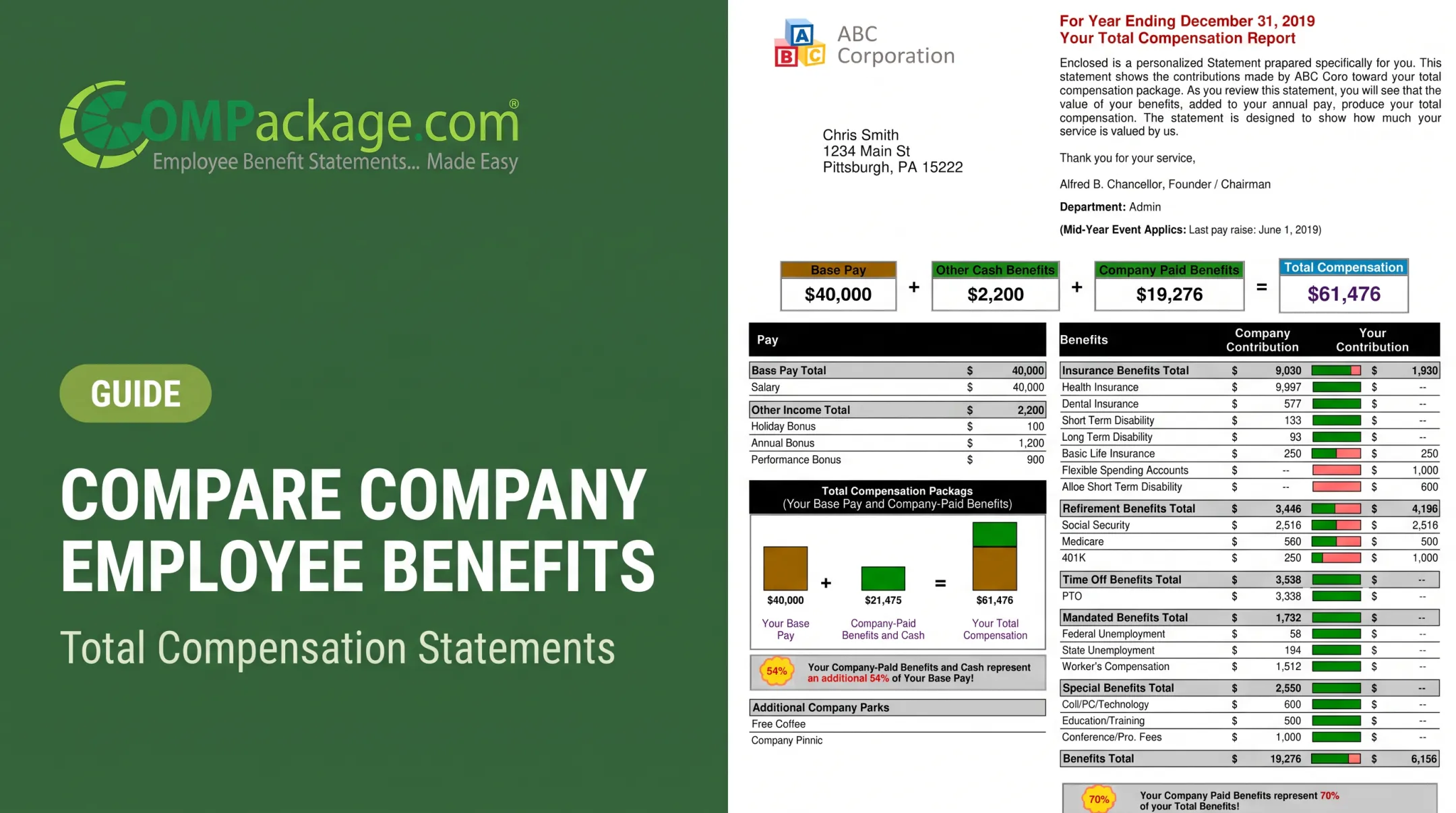
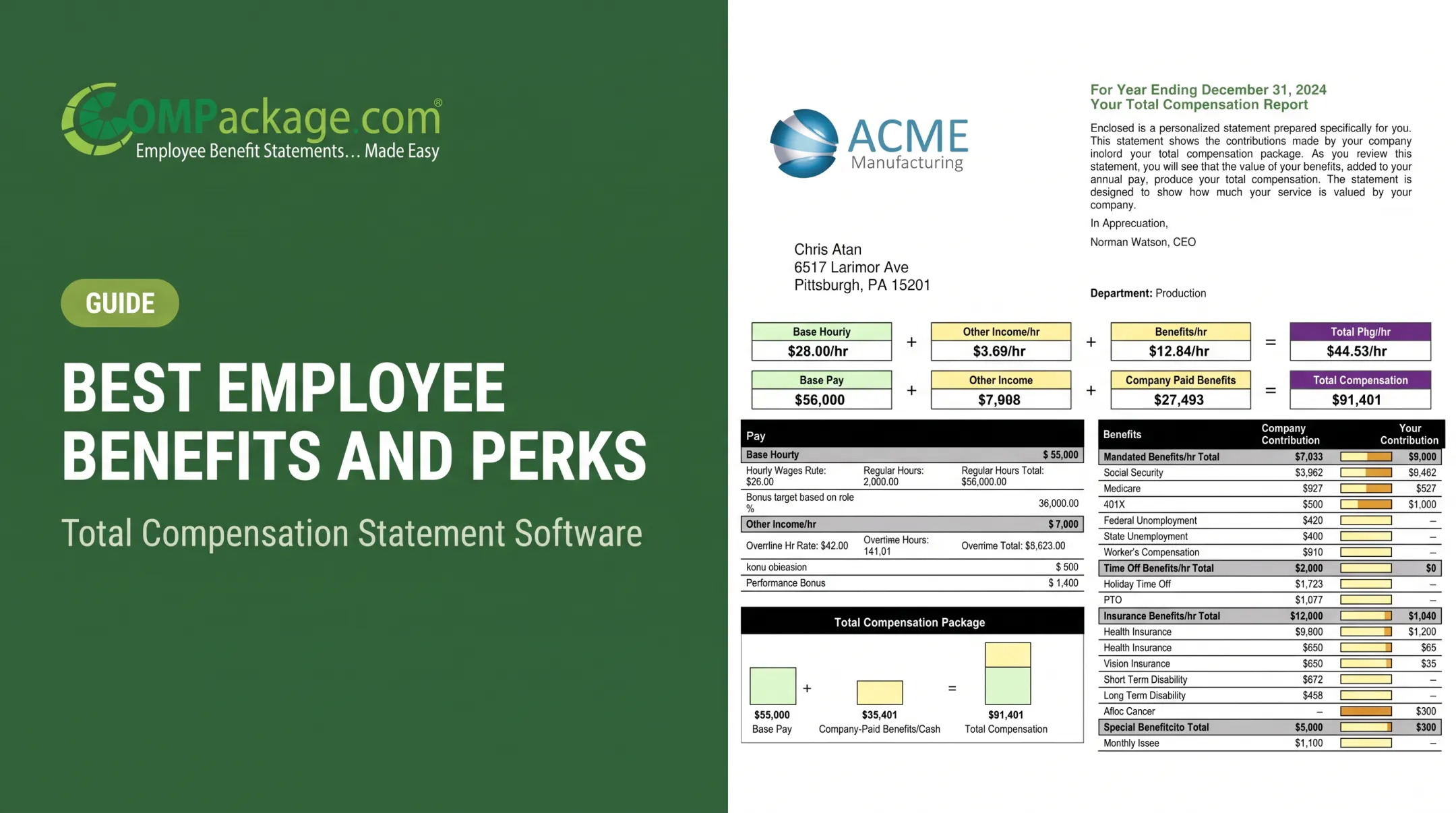
Then check whether employees will understand the value. COMPackage helps employers create employee-specific total compensation reports that show salary and applicable benefits together. In one sample report, direct pay of $63,408 sits beside $30,724 in company benefit contributions.
Finally, review the package periodically. Use employee feedback, participation data, recruiting and retention indicators, and current regulatory guidance, not familiarity or competitor marketing.
Conclusion
Corporate benefits go well beyond health insurance. They cover health protection, financial security, time away, flexibility, development, and daily well-being.
The four categories serve different needs and carry different costs, administrative demands, and trade-offs. Build a sustainable package around your workforce and business goals, then communicate its full value as part of total compensation.
Frequently Asked Questions
How much does it cost to offer employee benefits?
Cost varies by benefit type, plan design, employer contribution, cost-sharing, workforce size, location, and fees. Build a total-cost estimate for your own situation rather than relying on a general average.
How can I offer my employees benefits?
Options include insurers, retirement-plan providers, brokers, benefits consultants, payroll platforms, professional employer organizations, and voluntary-benefit providers. Review the administration and compliance duties each one leaves with you.
What employee benefits should you offer?
Start with legal obligations, workforce needs, business goals, budget, and hiring competition. Then combine core benefits with targeted voluntary or low-cost programs.
What are the four main types of employee benefits?
Health and insurance; retirement and financial security; paid leave, family support, and flexibility; and well-being, development, lifestyle, and workplace perks.
Can I offer benefits to some employees and not others?
Eligibility can depend on plan terms, job classification, employment status, hours, and location, subject to nondiscrimination and other legal rules. Get professional advice before excluding any group.
Why do companies offer benefits to their employees?
Benefits support recruitment, retention, health, financial security, and engagement, and they raise the perceived value of compensation. Each program also adds cost and administrative responsibility.