Well-designed incentives can reinforce the behaviors you value. They can't replace fair base pay or good management. This guide is for business owners, HR leaders, managers, and consultants. It covers definitions, reward examples, program design, communication, risks, and measurement.
Key Takeaways
- Incentives target specific behaviors or outcomes; recognition and rewards work more broadly.
- Strong programs pair clear goals and fair rules with meaningful reward choices.
- Safeguards against gaming and legal missteps matter as much as the rewards.
- Showing total compensation makes incentives and benefits easier to appreciate.
What Are Employee Incentive Programs and Rewards?
An employee incentive program is a planned system that links desired behaviors, performance, milestones, or business outcomes to financial or non-financial rewards. It can apply to individuals, teams, departments, or the whole organization.
Incentive, Reward, Recognition, Bonus, Commission
These terms overlap, but they aren't interchangeable:
- Incentive pay: earnings related to actual individual or group production, according to the Bureau of Labor Statistics (BLS).
- Bonus: a payment in addition to regular earnings, whether or not it's tied to production.
- Commission: pay calculated as a percentage of sales, sometimes alongside a salary.
- Recognition: a gesture that acknowledges, thanks, or celebrates a behavior, event, or result.
- Total rewards: the monetary and nonmonetary returns employees receive for their time, talent, and effort. This is broader than incentive pay.
A label doesn't decide legal treatment. Under wage-and-hour rules, what matters is how a bonus is structured, not what you call it.
What Incentives Can't Fix
Rewards complement fair base pay, benefits, career development, and effective leadership. They don't substitute for them. A 1999 meta-analysis of 128 studies found that expected tangible rewards can undermine intrinsic motivation, while positive feedback enhances it. If turnover stems from poor management or underpay, a bonus plan will only mask the problem.
Types and Examples of Employee Incentives and Rewards
Monetary Incentives
Cash remains the most familiar tool. BLS data shows 51% of private-industry workers have access to nonproduction bonuses. Among surveyed U.S. organizations, WorldatWork reports roughly 60% offer spot bonuses and 66% offer retention bonuses.
- Performance bonuses reward results over a set period
- Spot bonuses recognize a specific effort quickly
- Referral bonuses support recruiting
- Retention bonuses keep critical people through transitions
- Commissions tie pay to sales
- Profit sharing and gainsharing spread company or group gains
Document eligibility, timing, and payout rules for each. A holiday bonus, for example, is not an employer obligation, so say clearly whether it is discretionary.
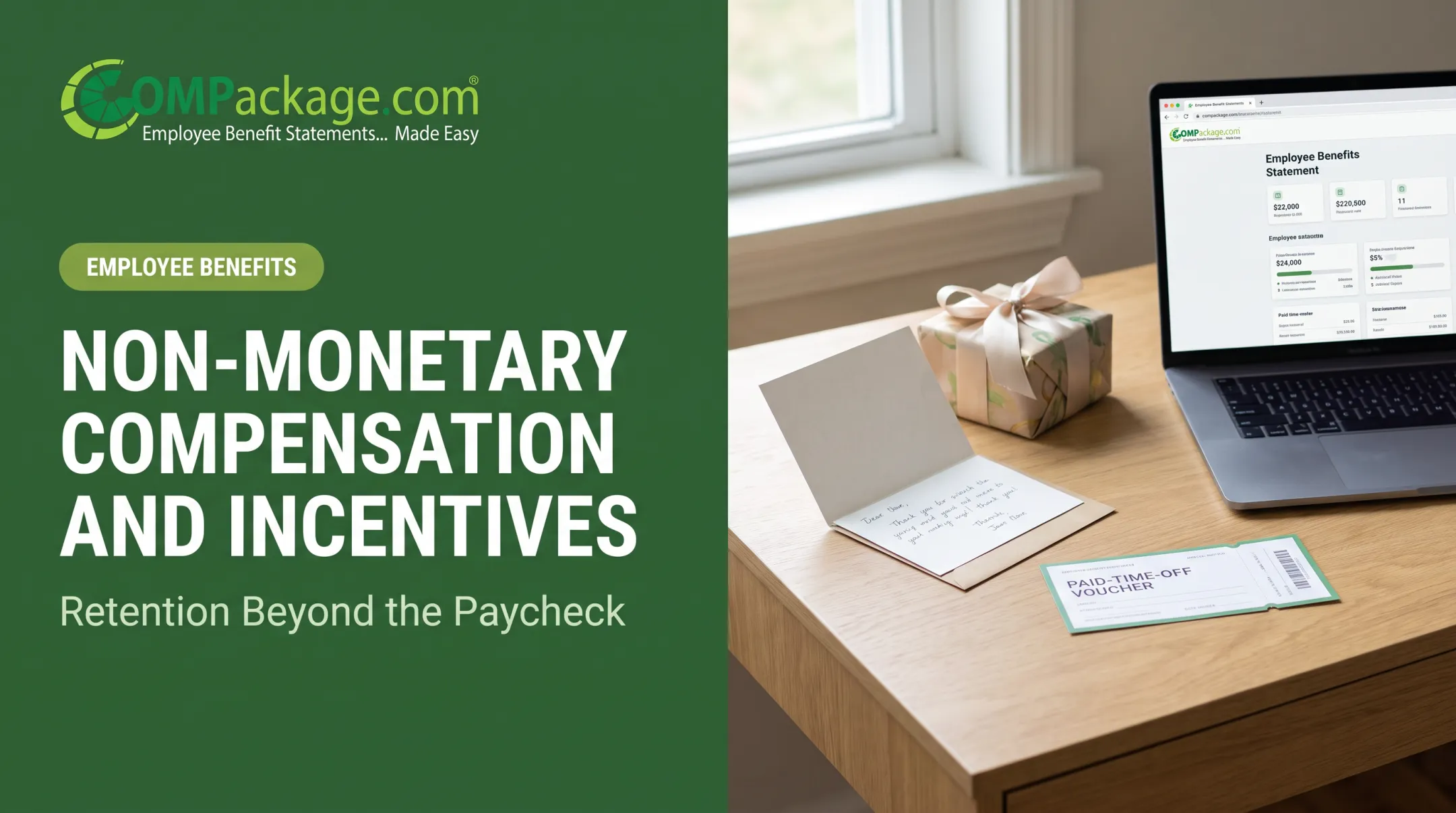
Non-Monetary Incentives
Flexibility often beats cash for people with different needs. SHRM's 2026 survey found 57% of employers offer hybrid work and 68% offer a combined PTO plan.
Other common options include:
- Professional development and tuition support
- Wellness resources
- Better tools and more autonomy
These are mostly benefit offerings, so decide whether you'll tie any of them to performance.
Recognition-Based Rewards
Praise works when it's specific and prompt. "Great job" fades fast. "Your Tuesday call saved the account, and here's why it mattered" sticks. Gallup recommends recognition at least every seven days, though that's management guidance rather than a proven optimal interval.
Options include:
- Manager praise
- Peer recognition
- Values-based awards
- Milestone acknowledgments
- Handwritten notes
Ask people whether they prefer public or private appreciation.
Experiential, Personalized, and Digital Rewards
These rewards take many forms:
- Gift cards and points catalogs
- Team events and learning experiences
- Charitable donations and branded merchandise
Choice matters. Participants in a 2026 Incentive Research Foundation study valued personally relevant rewards.
For remote and hybrid staff, favor digital or mailed rewards and include remote employees deliberately in recognition. Gallup stresses judging outcomes, not physical presence.
Matching Rewards to Objectives
| Objective | Good fit |
|---|---|
| Retention | Retention bonuses, development, total compensation statements |
| Collaboration | Team awards, gainsharing |
| Customer service | Peer recognition, spot bonuses |
| Innovation | Learning time, autonomy, values-based awards |
| Recruiting | Referral bonuses, pro forma offer reports |
| Measurable output | Commissions, tiered performance bonuses |

Use individual rewards when one person controls the result. Use team rewards when the outcome depends on collaboration. Many programs blend both.
Benefits, Risks, and Safeguards
Business Benefits
Well-run programs can lift motivation, engagement, and satisfaction. Gallup finds that employees whose recognition meets at least four quality pillars are 9 times as likely to be engaged as those meeting none. That's an association, not a guaranteed program effect.
Recognition, development, and clearly communicated pay also help retention and recruiting. Many employees underestimate what employers invest in them, sometimes by tens of thousands of dollars a year, per COMPackage's internal research. Team and values-based incentives further align daily work with company goals.
Risks and Safeguards
Incentives can backfire:
- Gaming metrics or sacrificing quality and safety for speed
- Chasing short-term results
- Unhealthy competition or dependence on ever-larger rewards
The Wells Fargo case is a cautionary example: sales incentives contributed to unauthorized accounts and a $100M CFPB penalty. Counter that risk with quality controls and balanced measures that reward how results are achieved, not only the numbers.
Beyond those pitfalls, trust erodes through unclear eligibility, favoritism, inaccessible rewards, or inconsistent administration. Keep these federal basics in mind:
- Gift cards: cash equivalents can't be excluded as de minimis fringe benefits, however small.
- Bonus withholding: supplemental wages may be withheld at a flat 22% federal rate only when IRS conditions are met.
- Overtime: for nonexempt employees, nondiscretionary bonuses generally enter the regular rate.
- Discrimination and accessibility: compensation protections cover bonuses and profit sharing, and accommodations may be needed for equal access.
- Records: FLSA payroll records generally require three years of retention.

This is general federal information. State rules and plan details change the answer, so consult a qualified tax or employment-law professional.
How to Design an Effective Employee Incentive Program
Define the Objective and Participants
Start with one business or people objective. Identify behaviors employees can actually influence, and set measurable, time-bound goals. Specific, difficult goals outperform vague "do your best" instructions, as Locke and Latham's goal-setting research shows. Avoid targets that invite unsafe, unethical, or sloppy work.
Then decide:
- Who's eligible
- Whether the program rewards individuals or teams
- How different roles get evaluated fairly
- What baseline data you need first
Build the Rules, Budget, and Rewards
Document clear rules for:
- Measurement period and performance formula
- Thresholds, tiers, and caps
- Payout timing
- Treatment of leave and role changes
- Approval process and dispute resolution

Budget for rewards, administration, communications, taxes, and technology. Compare expected business value with full cost, and don't promise what you can't sustain.
Choose rewards using employee feedback, role needs, and accessibility. Mix financial and non-financial options and offer choice. No single reward motivates everyone.
Test and Launch Responsibly
Pilot with a representative group or limited period. Check calculations, confirm employees understand the rules, gather feedback, and fix confusing parts before expanding.
A Harvard Business School working paper on a laundry company's attendance awards shows the risk. When the program rolled out at one of five plants, employees gamed eligibility and overall plant productivity fell 1.4%.
How to Communicate, Administer, and Measure the Program
Launch Communication
Your launch message should cover:
- Purpose and eligible participants
- Goals and how they're measured
- Examples of qualifying behavior
- Reward options and payout timing
- Tax or payroll treatment
- Where to ask questions
Share progress updates regularly, without turning them into a leaderboard that breeds unhealthy rivalry.
Show the Whole Package
Incentive pay lands inside a bigger package. After-tax paychecks represent only about 50% to 65% of total compensation, according to COMPackage's internal research. A total compensation statement helps employees see that bigger picture.
COMPackage is a self-service total compensation reporting tool that complements an incentive program. It isn't an incentive-payout calculator.
With it, you can:
- Import employee data from Excel with Employee LOADER
- Update details manually
- Choose from 60 customizable benefit areas
- Produce customized reports
A sample report shows a $1,786 performance bonus beside $56,000 base pay and $32,138 in company-paid benefits, which puts a modest bonus in proper context.

Measure and Adjust
Track:
- Participation and employee understanding
- Goal attainment and quality
- Customer or operational outcomes
- Retention and satisfaction
- Reward cost and administrative time
Compare against a pre-program baseline where possible. Participation and satisfaction aren't the same as attributable business impact, so isolate program effects before calculating ROI. Audit payouts, collect feedback, and review on a set schedule.
Conclusion: Build a Program Employees Can Understand and Trust
The best incentive programs are transparent systems that connect meaningful goals to fair rewards, recognition, and development.
Start with one objective, then:
- Involve employees in choosing rewards
- Explain the rules plainly
- Watch for unintended effects
- Improve the program with evidence and feedback
Frequently Asked Questions
What are incentive rewards?
Incentive rewards are financial or non-financial benefits offered to encourage specific behaviors, achievements, or outcomes. A sales team earning a bonus for hitting a quarterly target is one example.
What is the difference between an incentive and a reward?
An incentive is the broader program or mechanism that motivates behavior. A reward is the benefit delivered afterward, and it can exist outside a formal incentive program.
What are some examples of incentive programs for employees?
Common examples include performance bonuses, profit sharing, referral programs, recognition awards, flexible work, professional development, extra time off, wellness benefits, and team-based rewards.
What are the four types of incentives?
A practical grouping is financial, non-financial, recognition-based, and experiential or personalized. Other organizations may categorize them differently.
What is incentive pay?
Incentive pay is variable compensation tied to criteria such as performance, sales, productivity, quality, or profit. Unlike fixed base pay, it changes with results.
How are rewards used in motivation?
Rewards direct attention to desired behaviors and reinforce achievement. They work best when goals are fair and rewards are meaningful, alongside good working conditions and intrinsic motivation.