Introduction
U.S. employers heading into 2026 struggle with rising healthcare costs, worker financial pressure, new benefits technology, and growing regulatory complexity. Those forces are reshaping the benefits, rewards, support programs, and delivery experiences used to attract, retain, and support workers.
The cost pressure is real. Large employers project a 9% median increase in 2026 health costs before plan changes. This article covers the leading trends, what drives them, how they affect employers and employees, and which signals to watch next.
Key Takeaways
- Benefits are getting more personalized and tied to physical, mental, financial, and family needs.
- Rising healthcare and drug costs push employers toward deliberate plan design and preventive care.
- AI and analytics can improve administration, but privacy and human review come first.
- Employees undervalue benefits they don't understand, so communication matters.
- Test every trend against workforce data, affordability, and compliance before adopting it.
Key Employee Benefits Trends for 2026
Healthcare costs, prescription drugs, and preventive care
Business Group on Health's 2026 survey of 121 large employers found a 9% median cost increase before plan changes and 7.6% after. Drivers include GLP-1 drugs, cancer, mental health services, and chronic conditions.
Pharmacy costs are forecast to grow 11% to 12%. 41% of employers are changing pharmacy benefit managers or running an RFP.
Employers are responding with:
- Plan design changes that shift cost without cutting access
- Navigation and primary care programs
- Screenings and immunizations
- Chronic-condition support
- Virtual mental health channels
GLP-1s force specific decisions. In a Business Group on Health survey of its members, 67% cover GLP-1s for weight management, and nearly eight in ten say they raise costs.

Common controls include biometric eligibility validation, required participation in a weight-management program, designated prescribers, and formulary exclusions. Whatever you choose, explain the criteria to employees plainly.
Whole-person wellness expands beyond physical health
Employers increasingly treat mental, financial, and physical health as one system rather than separate perks. Examples include behavioral health access, employee assistance resources, budgeting tools, retirement guidance, and preventive-care programs.
Listing a benefit isn't the same as delivering access. SHRM's 2026 research found 55% of U.S. workers rarely or never use their organization's mental health benefits, while only 6% of HR professionals report high utilization.
On the financial side, only 38% of workers report being offered a financial wellness program, and 55% of those offered one participated, per EBRI's 2025 survey.
MetLife's 2026 data links holistic health with 25% greater productivity and loyalty and 10% fewer sick days. These are associations, not proof of cause.
To measure impact, track enrollment, utilization by program, and post-use feedback, then compare against retention and absence trends.
Personalized, flexible, and life-stage benefits
One-size-fits-all packages miss workers who differ by age, family structure, health, work arrangement, and caregiving load. Prudential's 2026 research shows the gap: 85% of employers say benefits meet life-stage challenges, versus 64% of employees.

Employers are filling that gap with:
- Dependent-care FSAs (50% of employers, per SHRM 2026)
- Paid parental leave (46%)
- Hybrid work (57%)
- Critical illness coverage (53%) and hospital indemnity (40%)
- Lifestyle spending accounts, which are growing from a small base
Eldercare support remains thin: only 13% offer referral services. Employees asked for greater employer contributions (48%), more choice and flexibility (34%), and financial wellbeing support (33%).
Before investing, survey employees, segment utilization data by age and role, and talk to different workforce groups. Build for the needs you find, not the ones you assume.
AI, analytics, and digital administration
Employers use automation for eligibility checks, enrollment messages, benefits questions, data validation, and utilization analysis. Employees need a simple digital path to compare, understand, enroll in, and use benefits all year, not just during open enrollment.
Interest is ahead of practice. Prudential found 83% of employers are interested in AI for benefits understanding, 58% of employees would use it, and 24% do today. Privacy and security worry 49% of employers and 52% of employees.

Key risks to manage:
- Inaccurate AI answers when tools lack employer-specific plan documents
- Fragmented data across vendors
- Cybersecurity and privacy exposure
- Bias in recommendations
SHRM's AI playbook stresses transparency, data privacy, and human oversight. Keep a person in the loop for anything that affects coverage decisions.
Total compensation transparency and benefits communication
Employees often focus on salary because they can't see what the employer pays for health coverage, retirement, leave, and insurance. BLS data shows benefits make up 30.0% of private-industry compensation ($14.07 of $46.89 per hour), a share many workers never see.
Seeing that share only helps if the message is clear. MetLife's 2025 study found 38% struggle to understand benefits communications, and those who do understand are almost 2x as likely to trust leadership.
Better communication looks like:
- Plain language instead of plan jargon
- Personalized examples showing each person's employer-paid value
- Year-round touchpoints, not one annual notice
- Use in recruiting, onboarding, and retention conversations
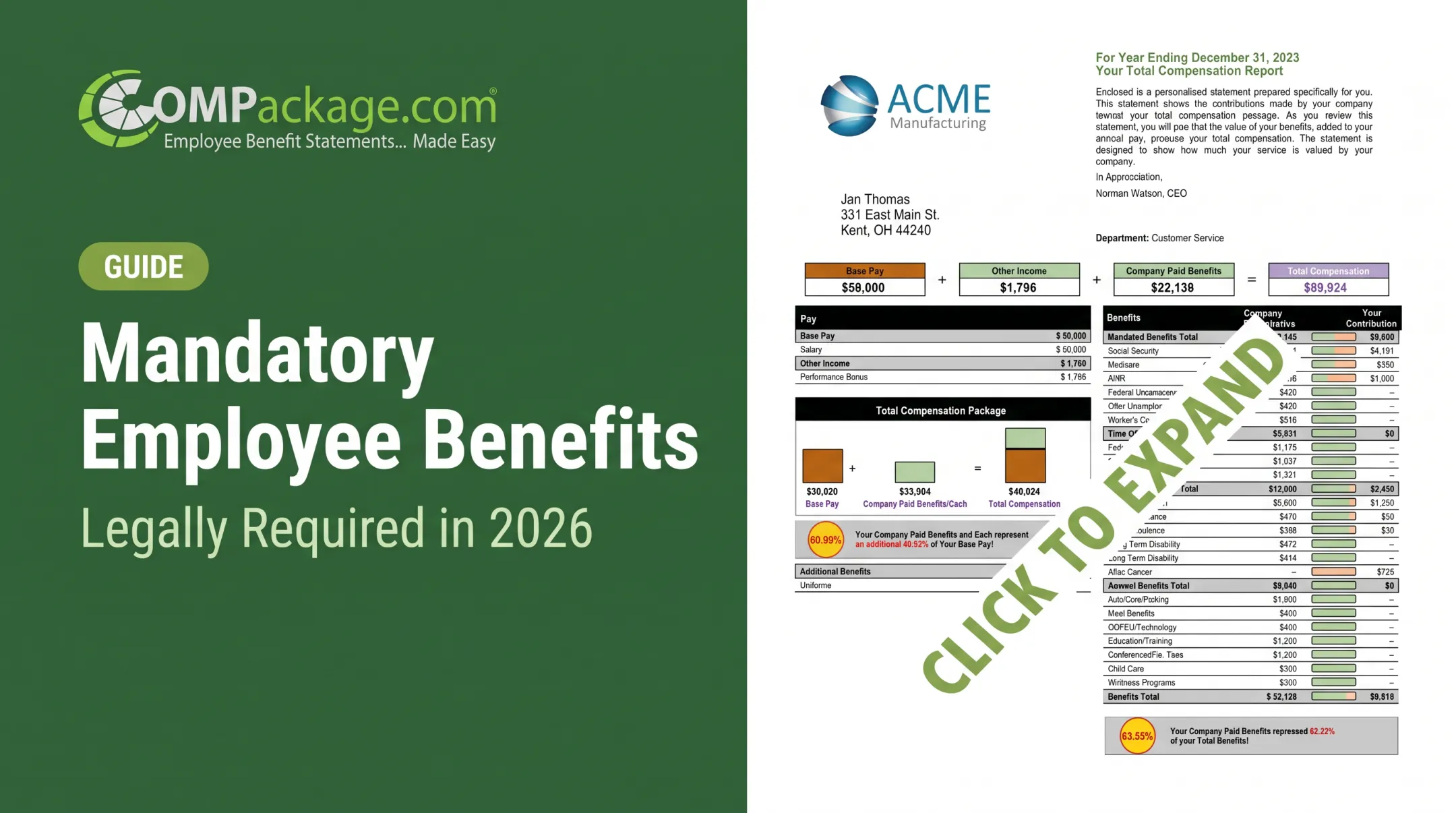
Self-service total compensation reports put those personalized figures in each employee's hands. COMPackage offers reporting for companies with 5 to 5,000 employees, so employers can generate customized statements that show only the benefits and pay elements that apply to each person.
What's Driving These Employee Benefits Trends
Technology advances and innovation
AI, analytics, telehealth, digital financial tools, and integrated platforms make personalized administration possible. They also create governance duties around data, accuracy, and vendor oversight.
Market demand and employee expectations
Workers weigh benefits heavily when deciding where to work:
- Health insurance (72%) and retirement savings (62%) influence stay-or-leave decisions (EBRI)
- 53% rank work-life balance among their top three non-income benefits (EBRI)
- 82% say benefits matter when considering a new job (The Hartford)
- 58% would consider a new job for more comprehensive benefits (The Hartford)
Cost pressures and efficiency needs
Healthcare inflation, specialty drugs, and thin HR capacity encourage employers to improve utilization and target spending rather than keep adding programs. KFF's 2026 survey shows workers pay on average 18% of single and 27% of family premiums, so cost shifting has limits.
Regulatory and compliance influences
Recent developments to track:
- The Department of Labor says new 2024 mental health parity provisions won't be enforced, but comparative-analysis duties remain.
- The ACA affordability threshold is 9.96% for 2026.
- 2026 limits: HSA $4,400/$8,750, health FSA $3,400, 401(k) deferral $24,500.
- SECURE 2.0 requires automatic enrollment in many newer 401(k)/403(b) plans, and Roth catch-ups for higher earners.
- The DOL removed its 2024 fiduciary rule after courts vacated it.
- Paid leave programs are enacted in 13 states plus DC.

Rules change and depend on plan type, so consult legal counsel or a benefits advisor before plan-specific decisions.
Competitive dynamics and measurable objectives
Employers increasingly link benefits to recruitment, retention, engagement, productivity, and absence. Define the purpose and success measure for each major investment before launch.
How These Trends Are Impacting Employers and Employees
The trends reach beyond the benefits menu. They change administration, budgeting, workforce planning, and how organizations show the value of pay.
Operational impact
More categories, personalization, and compliance mean more work. The Hartford found 84% of employers report expanded HR responsibilities and 85% say HR technology demands new skills. Practical responses:
- Keep employee data clean and current
- Document processes
- Share ownership between HR and finance
- Review plans on a regular schedule
Business impact
Spending is shifting toward cost management, targeted wellbeing, flexible benefits, digital tools, and communication. Measure outcomes such as:
- Participation and utilization
- Retention and recruiting success
- Absence and satisfaction
Don't assume results you haven't tracked.
Workforce impact
Benefits shape who accepts offers and who stays. Caregiving shows the stakes: one 2026 employer survey reported 52.6% saw caregiving-related impacts, including employees leaving, retiring, or taking less demanding roles. Managers need to discuss benefits with confidence. Multigenerational teams need options that fit different life stages.
Employee experience and perceived value
A benefit's value depends on whether employees understand it, can reach it, and believe it meets a real need. Strengthen that value with a few practical steps:
- Segment messages by audience
- State employer-paid costs clearly
- Review questions and low-use areas after enrollment
This is where total compensation reporting helps. COMPackage is one option for presenting personalized benefit detail in a clear, employee-friendly format.
Future Signals for Employee Benefits in the U.S.
Trends will keep shifting through 2026 and beyond. Track hard evidence instead of hype or one-off examples.
Early indicators of future shifts
- Healthcare and drug cost movement: Mercer's preliminary 2027 forecast is 8.2% after planned reductions, or 11% without action
- Utilization patterns by benefit that show what employees actually use
- Demand for caregiving and family support
- Participation in financial wellbeing programs
- Gaps between benefits offered and benefits used
Related drug-cost pressure shows up in GLP-1 coverage: 72% of employers covering them are likely to continue in 2027, and 10% are likely not to.
Technologies and developments to watch
- AI assistants grounded in verified plan documents
- Predictive benefits analytics
- Integrated total rewards platforms
- Digital health tools
- Privacy and cybersecurity standards
Scenarios for the next 1 to 3 years
Two paths stand out over the next one to three years.
Personalized path: Employers build data-informed strategies. Watch participation, satisfaction, and retention to decide where to expand.
Cost-pressure path: Costs and complexity grow without better visibility. Watch cost trend, administrative workload, and offered-versus-used gaps to decide where to cut or consolidate.

Conclusion
Benefits in 2026 are shaped by healthcare costs, whole-person wellbeing, personalization, caregiving needs, technology, transparency, and pressure to prove value.
Employers don't need to adopt every popular benefit. Prioritize these steps:
- Identify workforce needs
- Set business objectives
- Check affordability and compliance
- Communicate the full package clearly
Proactive review and better total compensation visibility help employers make informed decisions and compete for talent.
Frequently Asked Questions
What is the average percentage of employee benefits?
It depends on the measure. BLS reports benefits at 30.0% of private-industry compensation in June 2026. KFF finds employers pay 82% of single and 73% of family health premiums on average.
What are the current trends in employee benefits?
Current trends include healthcare cost management, financial and mental wellbeing, personalization, family and caregiving support, flexible work, AI-enabled administration, and total compensation transparency.
What are the key trends in employee wellness for 2026?
Key wellness trends include integrated physical, mental, and financial wellbeing, preventive care, chronic-condition support, accessible behavioral health, and measuring participation and outcomes.
What are the top 3 most sought after employee benefits?
Rankings vary by workforce. In EBRI's 2025 survey, workers most wanted greater employer contributions (48%), choice and flexibility (34%), and financial wellbeing support (33%).
What are typical benefits offered to employees?
Typical offerings include health coverage, retirement plans, paid time off, dental and vision, life and disability, leave, wellness resources, and voluntary benefits. BLS shows 71% medical and 72% retirement access among private-industry workers, with offerings varying by size and industry.
What industries have the best benefits?
No single industry wins across the board. BLS data shows paid sick leave access ranging from 58% in leisure and hospitality to 98% in finance and insurance. Compare benchmarks for your role and region.