Introduction
Two job offers can show the same salary and still differ by tens of thousands of dollars. Employer-paid premiums, retirement matches, paid leave, and flexibility change what an offer is worth.
Private-industry benefits average $14.07 per hour, or 30.0% of compensation, according to BLS data from June 2026. Many employees never see that number.
Employee benefits are direct and indirect compensation on top of base pay. Comparing them for a job offer is personal. Benchmarking an employer's package against peers is a business exercise.
This guide covers what to compare, how to normalize it, how to put a dollar value on it, how to benchmark against US peers, and how to present the result clearly.
Key Takeaways
- Compare employer contribution, employee cost, coverage, eligibility, and long-term value for each benefit.
- Judge total compensation, and separate guaranteed value from conditional value.
- Use personal needs for offers; use industry, size, and workforce mix for benchmarking.
- Present the result in plain language employees can act on.
Employee Benefits to Compare
Direct pay and employer-funded benefits
Total compensation is wages plus benefits. Base salary, bonuses, commissions, equity, employer-paid premiums, retirement contributions, and paid leave all belong in the comparison.
Sort each item by how certain it is:
- Guaranteed: base pay, employer-paid premiums once you're enrolled
- Conditional: bonuses, commissions, equity, and anything tied to vesting, eligibility, or continued employment
Health, dental, and vision coverage
Premiums are only part of the story. Compare deductibles, copayments, coinsurance, out-of-pocket limits, prescription coverage, provider networks, and dependent costs.
KFF's 2026 survey puts average annual premiums at $9,804 for single coverage and $28,303 for family coverage. Workers pay about $1,672 for single coverage and $7,471 for family coverage.
Think about expected usage. A lower paycheck deduction can hide a high deductible. If you or a dependent expects regular care, a pricier premium may cost less overall.
Retirement, insurance, and financial protection
Key items to review:
- Match formula and cap
- Vesting schedule and waiting period
- Investment options
- Life and disability coverage
Value the match by what you would actually receive. An "up to 6%" match delivers less if you contribute only 2%, and unvested funds disappear when you leave. Vanguard's average promised maximum match is 4.7% of pay, but that is the formula, not the deposit.

Paid time off, leave, and flexibility
Compare vacation, sick leave, holidays, family leave, carryover rules, blackout periods, and remote or hybrid options. BLS data shows private-industry workers average 11 vacation days after one year and 20 days after twenty years.
Ask whether people use the time. A generous policy with blackout periods or a culture of working through vacations is worth less than its headline number. Note that FMLA leave is generally unpaid.
Additional and non-quantifiable benefits
Tuition assistance, professional development, employee assistance programs, wellness resources, commuter support, and childcare help all count.
- Price what you can: tuition assistance, commuter subsidies, childcare contributions
- Describe the rest qualitatively: autonomy, security, wellbeing, career growth
How to Compare Company Employee Benefits Side by Side
Set criteria first
Employees should rank their priorities:
- Lower monthly costs
- Healthcare access
- Retirement savings
- Family protection
- Leave
- Remote work
- Growth
Employers should define the goal, such as recruiting, reducing turnover, closing a market gap, or controlling cost.
Collect comparable documents
Gather these documents:
- Offer letters
- Benefits guides
- Contribution schedules
- PTO policies
- Retirement plan documents
For health plans, the Summary of Benefits and Coverage uses a standard template, so two plans line up field by field. The Summary Plan Description explains eligibility and claims rules.
When marketing language is vague about exclusions, waiting periods, or vesting, ask HR or check the plan document.
Normalize the numbers
Follow these steps:
- Convert monthly premiums, per-paycheck deductions, and hourly PTO into annual figures.
- Compare equivalent tiers: employee-only against employee-only, family against family.
- Label every estimate and assumption.
- Never count a maximum possible benefit as guaranteed pay.

Evaluate value, access, and fit
Ask whether your doctors are in network, whether your prescriptions are covered, and whether you will realistically use each benefit. Check timing too. Some benefits start on day one, others after a waiting period, and some disappear when you leave.
Access is not participation. BLS reports 87% of full-time but only 23% of part-time private-industry workers have access to medical plans, so employment status matters.
Document the tradeoffs
Write down which package wins each category, which assumptions you used, and which differences could flip the result. Confirm tax, insurance, and retirement implications with qualified professionals. A comparison is not individualized financial or legal advice.
How to Calculate the Monetary Value of an Employee Benefits Package
Separate employer-paid from employee-paid costs
Add the employer's annual contributions for health, dental, vision, life, disability, retirement, paid leave, and other benefits. List your required premiums, deductibles, and likely out-of-pocket costs separately. That shows both package value and personal cost.
Annualize with stated assumptions
Convert everything to a yearly amount:
- Monthly premium × 12
- Per-paycheck deduction × number of paychecks
- PTO value: daily pay × days of leave
Hypothetical example (not industry data):
- Offer A: $70,000 salary + $8,000 employer health + $2,100 match = $80,100
- Offer B: $74,000 salary + $4,000 employer health + no match = $78,000

Offer A leads on total package value before employee costs.
Look past the premium
Add deductibles, copays, coinsurance, prescriptions, and the out-of-pocket maximum to the premium. For a family with regular care needs, the lowest-premium plan often carries the highest total cost.
Account for retirement vesting
Estimate the match from the plan formula and your expected contribution. Then check vesting. Under IRS rules, ordinary employer matches vest on at most a three-year cliff or six-year graded schedule. Your own deferrals are always fully vested.
Treat variable benefits carefully
Label bonuses, commissions, equity, wellness savings, tuition aid, and flexibility as guaranteed, estimated, conditional, or qualitative. Don't force every benefit into an unsupported dollar figure. Keep a separate qualitative assessment, and research current tax treatment where relevant.
Benchmarking a Company Benefits Package Against the Market
Define a relevant peer group
Match peers by industry, employee count, US region, workforce type, and job category. A national average can mislead.
- A small employer and an enterprise differ sharply. KFF found 66% of firms with 10-199 workers offer coverage versus 98% of firms with 200+.
- Hourly and professional workforces differ too. BLS puts manufacturing benefits at $16.12 per hour versus $13.67 for service-providing industries.

Use credible, current data
Draw on government publications, insurer reports, and benefits surveys. Check the publication date and methodology every time.
Surveys measure different populations, so their figures aren't interchangeable. KFF covers employers with 10+ workers, while Vanguard reflects its own plan records.
Compare measurable items:
- Employer contribution levels
- Plan availability
- Paid leave
- Retirement matches
- Participation
Move from market position to action
Decide whether you are above, near, or below market, or misaligned with what employees want. Then separate a recruiting gap from an unnecessary cost.
Test the benchmark against your own data:
- Employee surveys
- Enrollment and utilization
- Retention
- Recruiter feedback
A gap that doesn't affect hiring or retention may not need fixing.
Turning Comparisons Into Employee-Ready Total Compensation Reports
A comparison only helps if employees understand it. Aflac's 2026 research found 40% of employees cite unclear costs as a barrier to understanding their benefits.
A good report shows:
- Salary and bonuses
- Employer-paid and employee-paid costs, side by side
- Paid time off and retirement contributions
- Insurance protection
- Relevant non-dollar benefits
COMPackage is one self-service option. It includes:
- Over 80 preprogrammed benefit categories
- An Excel-based Employee LOADER for bulk import
- Auto-calculators for government, 401(k), time-off, and insurance items
- Manual editing when you need it
- Free report changes throughout the year
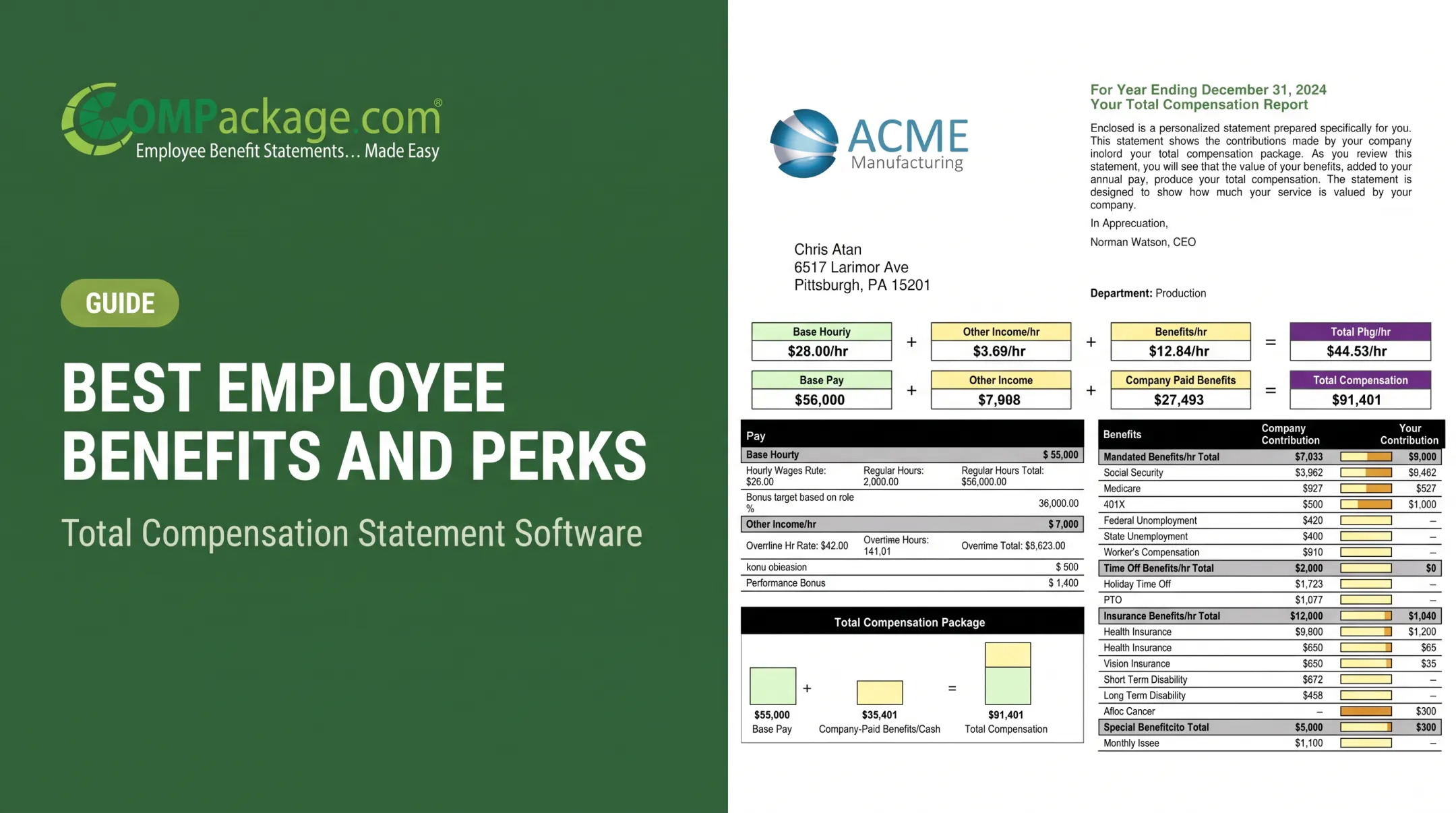
Reports show only the benefits each employee receives, so they stay accurate and easy to read. One sample lists $56,000 base pay, a $1,786 bonus, and $32,138 in company-paid benefits, which is 60.58% above base salary.

Before distributing reports:
- Check accuracy against plan documents
- Limit access to those who need it, since compensation data is personal information
- Update at each benefit year
Then measure results. Track whether employees ask better questions, recruiting conversations improve, or retention discussions change.
Frequently Asked Questions
How do I compare company benefits when evaluating job offers?
Annualize salary, employer contributions, and your own costs for the same coverage tier. Add healthcare exposure, retirement terms, leave, flexibility, and eligibility rules, then weigh them against your priorities.
How do you calculate the monetary value of an employee benefits package?
Annualize employer contributions and quantifiable benefits, and show employee costs separately. Factor in healthcare usage and vesting, and label estimates and conditional benefits clearly.
What are the most sought-after employee benefits?
In EBRI's 2026 survey, workers prioritized work-life balance (49%), schedule flexibility (37%), paid time off (35%), health benefits (33%), and retirement benefits (31%).
What should be included when comparing employee benefits?
Include employer and employee costs, coverage levels, eligibility, waiting periods, deductibles, retirement terms, PTO, insurance, flexibility, and development. Note which benefits are hard to quantify.
What is the difference between employee benefits and total compensation?
Benefits are one component of total compensation. Total compensation also includes salary, bonuses, commissions, equity, and other pay.