This guide focuses on the US, where preferences shift with demographics, job type, work arrangement, and personal responsibilities. A remote-capable engineer and a site-based caregiver with two kids want different things.
Below, we cover five benefit categories that keep showing up in US research, how to evaluate them, and why communicating total value matters as much as the benefits themselves.
Key Takeaways
- Health coverage, paid time off, retirement support, flexibility, and family or well-being benefits recur in US surveys.
- The right package depends on employee needs, budget, workforce structure, and federal or state rules.
- Ask employees and review usage data instead of copying competitors.
- Benefits only feel valuable when employees understand them.
Overview of the Most Wanted Employee Benefits in the US
What counts as an employee benefit
The Bureau of Labor Statistics defines benefits as nonwage compensation provided by employers. That covers insurance, paid leave, retirement contributions, flexibility, and support programs.
Employers spend heavily on them. Private-industry benefits cost $14.07 per hour, or 30.0% of compensation, in BLS's June 2026 data, and that figure includes legally required benefits.
| Component | Employer cost per hour | Share of compensation |
|---|---|---|
| Insurance | $3.69 | 7.9% |
| Paid leave | $3.54 | 7.5% |
| Legally required | $3.40 | 7.2% |
| Supplemental pay | $1.88 | 4.0% |
| Retirement and savings | $1.57 | 3.3% |

Core benefits, voluntary benefits, and perks
Think of three tiers:
- Core benefits: health insurance, retirement plans, paid leave
- Voluntary benefits: employee-paid or shared options, such as supplemental insurance
- Perks: snacks, discounts, social events
Perks are nice. Core benefits drive decisions.
The categories below recur in worker research, but adapt them to your own employee population.
Top 5 Most Wanted Employee Benefits in the US
We ranked these using five criteria:
- Frequency in employee surveys
- Perceived financial or lifestyle value
- Influence on recruiting and retention
- Accessibility for workers
- Feasibility across employer sizes
No study establishes one universal national top five, so treat this as a well-supported shortlist.
1. Health, Dental, and Vision Insurance
Medical coverage protects against large, unexpected costs. Dental and vision cover routine needs. Employer-sponsored plans are partly employer-paid, while voluntary options are fully employee-paid.
Access is uneven. In BLS's March 2026 data, private-industry access was 71% for medical, 44% for dental, and 29% for vision. EBRI's 2025 survey found 72% of workers rated health insurance important in deciding whether to stay or leave.
Compare these points when choosing plans:
- Employer premium contribution
- Deductibles and provider networks
- Family coverage and eligibility
- Telehealth and HSA or FSA compatibility
- ACA (50+ full-time employees), COBRA (20+), and ERISA compliance
The KFF 2026 survey found average annual premiums of $9,804 for single and $28,303 for family coverage. Workers contribute $1,672 and $7,471 respectively, with a single-coverage deductible of $1,955.

2. Paid Time Off and Paid Leave
Vacation, sick days, personal days, and holidays support recovery and work-life balance. In Pew's 2023 survey, 62% of workers called PTO extremely important, ahead of employer-paid health insurance at 51%.
Employers tend to rank health first. SHRM's 2025 survey of 3,969 organizations found employers rating health (88%) above leave (81%). It's a small gap, but it shows employees may prize time off more than management assumes.
Private-industry access is broad: 80% for paid vacation, 81% for sick leave and holidays, but only 49% for paid family and medical leave.
Policy design choices:
- Accrual-based PTO: fair to tenure, more tracking
- Front-loaded leave: simple, but risky for new hires who leave
- Separate vacation and sick banks: clear purpose, less flexibility
- Unlimited PTO: offered by just 6% of organizations, with no proof it improves outcomes
Weigh coverage, documentation, and rollover. The FLSA doesn't require paid vacation, but 18 states plus DC have paid-sick-leave laws and 14 states plus DC have paid family and medical leave laws, per KFF.
FMLA adds up to 12 weeks of unpaid, job-protected leave for eligible employees.
3. Retirement Plans and Financial Wellness
Common offerings include 401(k) plans with employer matching, retirement education, emergency savings, financial counseling, and student-loan matching. Retirement matters: 44% of Pew respondents called it extremely important, and EBRI found 62% weigh it in stay-or-leave decisions.
Plan design affects results. Vanguard's How America Saves 2026 reports 94% participation in automatic-enrollment plans versus 64% in voluntary plans. That's an observational comparison, not proof of cause. The average promised match is 4.7% of pay.

Evaluate:
- Eligibility and employer match
- Vesting (three-year cliff or graded over two to six years)
- Administrative fees and investment choices
- Automatic enrollment and education
Verify current IRS and DOL rules. For 2026, the 401(k) deferral limit is $24,500. SECURE 2.0 also requires automatic enrollment in most new 401(k) plans, and offers optional emergency savings accounts and student-loan matching.
Financial stress is real. EBRI found 46% of workers listed retirement saving among top stressors and 43% listed emergency saving.
4. Flexible Work Options
Flexibility spans remote work, hybrid schedules, flexible hours, compressed workweeks, job sharing, and predictable scheduling. It helps with caregiving, commuting, and autonomy.
Preferences split by job type. Pew's January 2025 report found 72% of hybrid workers preferred hybrid over fully remote (24%). Among those working from home, 46% said they'd be unlikely to stay if the option ended. That's stated intent, not measured turnover, and it covers remote-capable roles only.
For site-based roles, flexibility looks different: predictable schedules, shift swaps, advance notice. SHRM reports Fair Workweek laws improve schedule predictability.
Set clear rules on:
- Eligibility fairness and performance expectations
- Communication norms
- Equipment, cybersecurity, and expense reimbursement
- Equal access for employees who can't work remotely
5. Family, Caregiving, and Mental-Health Support
This category includes parental leave, dependent-care assistance, eldercare resources, fertility support, employee assistance programs (EAPs), counseling, and behavioral-health coverage.
Demand tracks real strain. In caregiving research, 49% of working caregivers reported arriving late, leaving early, or taking daytime time off. Another 18% cut hours or went part-time. That's disruption, not proof a given benefit fixes it.

Availability varies:
- 43% of private-industry workers had dependent-care benefits in March 2026
- 72% of large employers offered an EAP, but only 22% tracked use (EBRI 2025)
- IVF coverage reached 47% of employers with 500+ employees (Mercer 2024)
Dependent-care FSAs allow up to $7,500 in 2026 tax-free. Compare employer-paid programs, insurance coverage, stipends, and referral services. Protect privacy, keep access inclusive, communicate clearly, and follow mental-health parity rules for covered plans.
How We Chose the Best Employee Benefits
No universal package exists. Employers commonly copy competitors, overinvest in visible perks, or skip the step of asking employees.
Ask, then measure
Survey by role, location, work arrangement, age range, and family responsibilities. Keep responses confidential and avoid assumptions based on age or gender. Then evaluate each benefit on:
- Total employer cost and employee out-of-pocket cost
- Participation and utilization
- Administrative workload
- Tax treatment and legal requirements
Combine foundational benefits with lower-cost voluntary options or flexible choices. Serving a diverse workforce doesn't mean treating everyone identically.
Small employers face tougher math. KFF found 66% of firms with 10-199 workers offer health benefits versus 98% of larger firms. The IRS retirement startup credit, up to $5,000 annually for three years, can offset plan costs.
Communicate the value
Employees underestimate what they get. EBRI respondents guessed benefits equal 16% of compensation, while BLS puts employer cost near 30% (the two measures differ, so it's not a precise shortfall).
MetLife found employees who understood benefits communications were almost twice as likely to trust leadership. That finding is an association rather than proven cause.
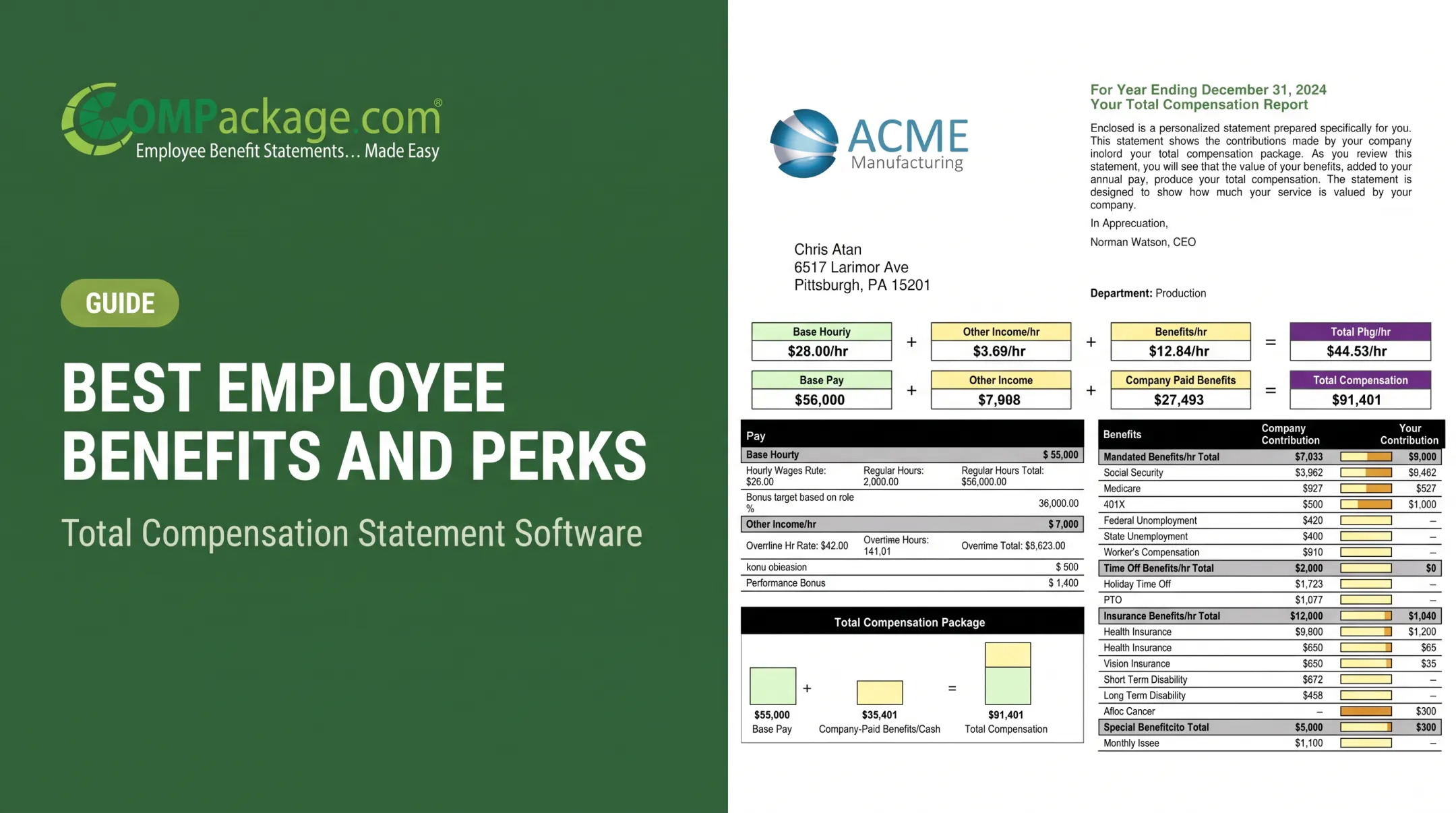
Explain employer contributions, eligibility, coverage limits, and enrollment deadlines in plain language. A personalized total compensation statement shows pay plus benefits as one package. In one sample, $32,138 in company-paid benefits added 60.58% to a $56,000 base salary.

Conclusion
The most wanted benefits deliver financial protection, time flexibility, health support, or long-term security. They aren't necessarily the most visible office perks.
Reassess your package regularly using:
- Employee feedback
- Utilization data
- Workforce changes
- Affordability
- Compliance review
- Recruiting and retention goals
COMPackage offers self-service total compensation reporting software that helps employers show personalized benefit details alongside base pay, so employees see the full value of what they earn.
Frequently Asked Questions
What are the most requested employee benefits?
Paid time off, health insurance, retirement plans, paid family leave, and flexible work rank highest in US research. Rankings vary by workforce, survey method, job type, and circumstances.
What are the typical employee benefits offered in the UK?
UK employers must provide statutory holiday (5.6 weeks), Statutory Sick Pay, and workplace pensions, and the NHS covers core healthcare. Verify current rules at GOV.UK.
What employee benefits should a small business offer?
Start with affordable foundations: paid leave, retirement support (use the startup credit), and flexibility where practical. Add voluntary benefits based on employee feedback and budget.
How do employers find out which benefits employees want?
Use anonymous surveys, interviews, utilization reviews, and open-enrollment feedback. Segment results by role and life stage instead of relying on management assumptions.
Are employee benefits more important than salary?
They serve different needs. In EBRI's 2025 ranking that included salary, salary came first at 62%. Employees weigh total compensation, affordability, coverage quality, and flexibility.
How can employers show employees the value of their benefits?
Use plain-language enrollment explanations and personalized total compensation statements. Include simple examples of employer-paid versus employee-paid costs.