A compensation package is the collection of pay and employment-related rewards an employer offers in exchange for a person's work or services.
This article explains how salary differs from compensation, lays out the typical elements of a package, walks through an example, and shows how employers can communicate total value clearly.
Key Takeaways
- A compensation package combines direct pay with benefits, incentives, and other rewards.
- Salary is one part of the package, not the whole.
- Common elements: base pay, variable pay, benefits, paid leave, retirement, and non-cash rewards.
- Employers should spell out package details so candidates see the full offer value.
What Is a Compensation Package? Definition and Meaning
In plain terms, a compensation package is everything an employer provides in return for work. The term gets used two ways:
- Narrow: mostly cash pay, such as salary, commissions, and bonuses.
- Broad: cash plus benefits and perks, often called total compensation or total rewards.
Official definitions reflect this split. The Bureau of Labor Statistics (BLS) treats total compensation as wages and salaries plus employer benefit costs. WorldatWork's model treats compensation as pay and keeps benefits as a separate element.
There's also a gap between perceived value and employer cost. Health coverage might cost an employer thousands of dollars a year, yet never appear on a paycheck. Employees often underestimate that investment because they never see it itemized.
Salary vs. Compensation
Salary is a fixed form of direct pay. Compensation is the wider term, covering wages, salary, commissions, bonuses, benefits, and other rewards.
Being paid a salary also does not mean you are exempt from overtime. Under Department of Labor rules, exemption depends on duties and pay tests, not job titles.
A good offer letter or total compensation statement should state which elements are:
- Guaranteed or performance-based
- Employer-paid or employee-paid
- Taxable or tax-advantaged
- Subject to eligibility or vesting rules
What Are the Main Components of a Compensation Package?
Direct Compensation
Fixed cash pay is an annual salary or hourly wage. Structure depends on the role, schedule, classification, and employment agreement.
Variable cash pay includes commissions, bonuses, overtime, incentive pay, and profit-sharing. These often hinge on targets or business results, so they aren't guaranteed.
Indirect Compensation and Benefits
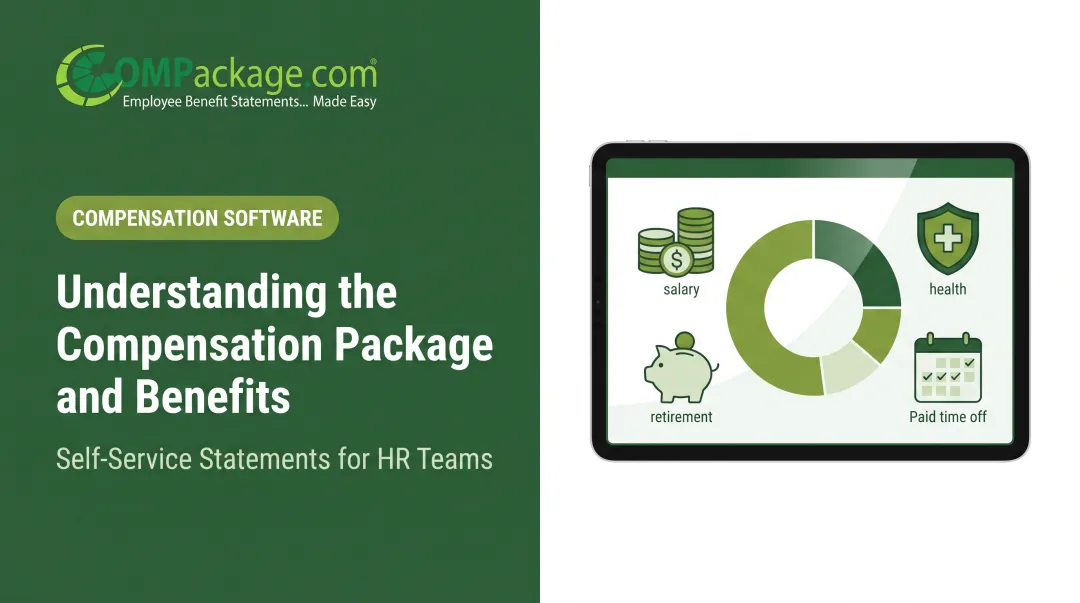
Employer-provided benefits typically include:
- Health, dental, and vision insurance
- Life and disability insurance
- Retirement contributions
- Paid time off, holidays, and parental or family leave
- Wellness programs, tuition assistance, and commuting support
- Technology or vehicle allowances
The BLS reports that private-employer compensation averages $46.89 per hour worked, with $32.82 (70%) going to wages and $14.07 (30%) to benefits, per its June 2026 data. Those averages include workers with no benefit access, so they understate what a covered employee receives.

Non-Monetary Rewards
Flexible schedules, remote or hybrid work, professional development, mentorship, recognition, and career advancement all count toward the overall package. They don't arrive as cash, but candidates weigh them heavily.
Availability, cost, and value vary by employer, job level, location, and employment status.
Total Compensation vs. Total Rewards
Total compensation is direct plus indirect pay. Total rewards goes further, adding workplace experience, development, recognition, and culture.
Don't compare offers by headline salary alone. Look at premiums, deductibles, matching rules, leave policies, bonus conditions, and vesting schedules.
Compensation Package Example
The figures below are hypothetical, for a US full-time employee. They illustrate the structure, not a standard or recommendation.
| Element | Assumed annual value |
|---|---|
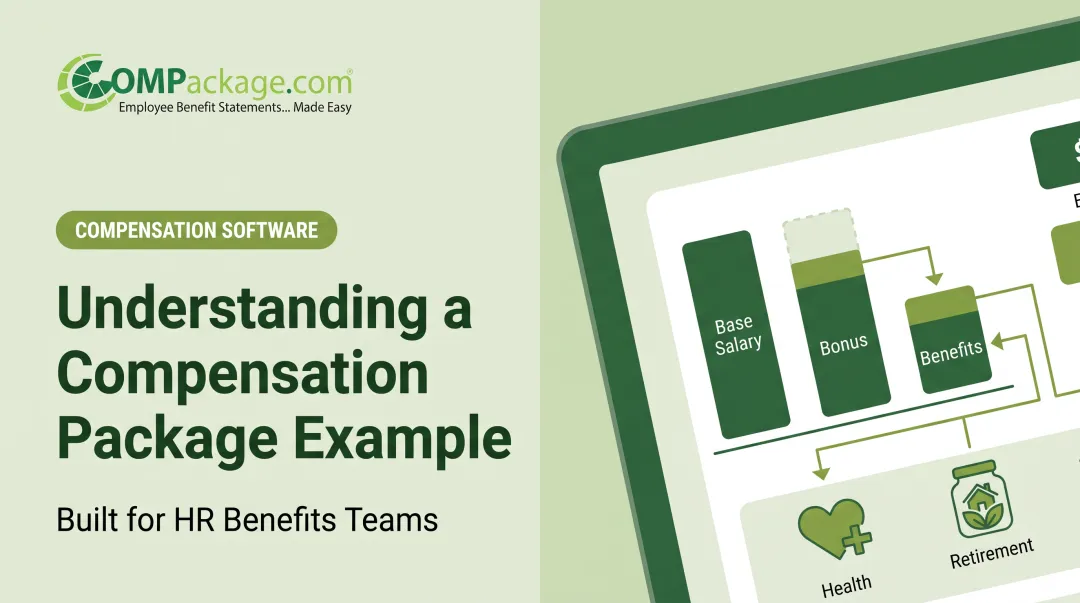
| Base pay ($28/hour, 2,000 hours) | $56,000 |
| Performance bonus | $1,786 |
| Employer-paid health, dental, vision, disability | $11,572 |
| Special benefits (auto, tech, education, wellness, child care) | $4,440 |
| Retirement match, paid leave, and legally required benefits | Added per plan terms |
To estimate annual value, add direct cash pay to the employer's estimated cost of eligible benefits.
A COMPackage sample report built this way lists base pay of $56,000 and company-paid benefits of $32,138. That is about 60.58% of base pay, for total compensation of $89,924.

A simpler case starts with a $50,000 salary. Total compensation reaches $71,839 once these employer costs are added:
- Insurance: $6,322
- Legally required benefits: $5,532
- Paid leave: $4,957
- Retirement: $3,233
- Supplemental pay: $1,796
What's guaranteed? Base pay generally is. The bonus depends on performance. Insurance depends on enrollment and eligibility, and leave depends on time worked and accrual.
How an Employee Should Evaluate the Example
- Compare the full terms of two offers, not just the salary line.
- Weigh take-home pay, benefit costs, out-of-pocket exposure, bonus likelihood, and retirement match.
- Consider leave policies, schedule flexibility, and advancement paths.
Not every benefit equals cash. Confirm plan documents, deadlines, exclusions, tax treatment, and vesting rules before assigning a personal value. Employee contributions are always 100% vested, but employer contributions can vest over time, according to the IRS.
Why Compensation Packages Matter to Employees and Employers
For employers, a clear package helps attract candidates, support retention, and reinforce performance goals without relying only on higher base pay.
For employees, it delivers financial security, health protection, time off, development, and flexibility.
A good package is:
- Appropriate for the role
- Competitive in its labor market
- Consistent internally
- Easy to understand
- Financially sustainable
- Aligned with what employees need
Employee survey data backs that focus. Gallup's 2025 survey found 54% of US employees rate pay or benefits very important when considering a new job, and 59% say the same of work-life balance. Those figures show what candidates value; they do not prove that richer packages alone stop turnover.
How to Calculate and Communicate Compensation Package Value
A Simple Framework
Estimated total compensation = direct pay + employer cost (or stated value) of eligible indirect compensation and other quantifiable rewards.
To build it:
- Pull data from payroll, benefits, retirement, leave, and incentive records.
- Avoid double counting, such as leave shown both as a benefit and inside pay.
- Don't present conditional benefits as guaranteed.
- Separate employer-paid from employee-paid amounts.

Create an employee-specific statement in plain language that splits:
- Guaranteed pay
- Variable pay
- Employer-paid benefits
- Employee costs
- Paid leave
- Non-cash rewards
Benefits differ by employee, so explain eligibility, effective dates, contribution limits, vesting, and renewal terms. Do not include legal or tax advice.
Employers who want to produce these reports in-house can use COMPackage, a self-service platform. It shows only the benefits that apply to each employee, imports census data from Excel, and lets HR update reports as information changes.
Communicating the Package During Recruiting and Employment
Share the full value at key moments so employees are not left guessing:
- At the offer stage: Share a complete summary of the offer's full value, with guaranteed amounts clearly separated from estimates, incentives, and optional benefits.
- During employment: Provide updated total compensation statements at least annually so employees see benefits they may overlook day to day.
- After changes: Refresh statements after raises, promotions, benefit changes, or bonuses so no one relies on outdated numbers.
Frequently Asked Questions
What is a compensation package?
A compensation package is the mix of pay, benefits, incentives, paid leave, and other rewards an employer offers in exchange for work. Employers differ on what they include.
What are the typical elements of a compensation package?
Typical elements include base pay, variable pay, insurance, retirement contributions, paid time off, workplace benefits, and non-monetary rewards such as flexibility and development.
What is considered a good compensation package?
One that is competitive, fair, transparent, sustainable, and relevant to the employee's needs. The highest salary alone doesn't make an offer the best one.
What is an example of a compensation package?
A hypothetical package might include $56,000 base pay, a $1,786 bonus, employer-paid insurance, retirement contributions, paid leave, and perks like a tech allowance.
Does compensation mean salary?
No. Salary is one form of direct compensation. Compensation can also cover benefits, incentives, and other rewards.
What does compensation for services mean?
Compensation for services is payment or other agreed value given to a person or business for work performed. Exact terms depend on the agreement and relationship.