Introduction
Only 29% of US employees are engaged at work, according to Gallup's October 2026 report. Another 53% are not engaged, and 18% are actively disengaged. For employers juggling retention, recruiting and tight budgets, that gap is expensive.
Engagement often gets treated as a culture topic. Its value shows up in plainer ways: whether people share ideas, use the benefits you pay for, stay, and recommend you to friends.
This article covers the main benefits of engagement, how benefits and total compensation visibility can support it, what happens when it slips, and how to measure progress.
Key Takeaways
- Engagement means connection to work, team and organization, not just satisfaction or perks.
- It's linked to retention, wellbeing, collaboration, productivity and recruiting.
- Benefits build engagement only when employees understand, trust and use them.
- Track engagement next to operational metrics, and review the whole employee experience regularly.
What Is Employee Engagement?
Engagement is how connected employees feel to their work, how supported they feel by the organization, and how motivated they are to contribute beyond the minimum. Gallup defines it as the involvement and enthusiasm of employees in their work and workplace.
It differs from related ideas:
- Satisfaction: someone can be content with their paycheck and still be detached.
- Happiness: a fleeting mood, not a lasting connection.
- Benefits participation: enrolling in a plan shows awareness, not necessarily commitment.
Engagement is shaped by managers, recognition, workload, career growth, flexibility, and pay and benefits communication. Benefits are one supporting mechanism. They don't replace good management.
Key Advantages of Employee Engagement
These advantages are outcomes HR teams can observe or measure. Results vary by workforce, industry, management quality and program design, and most of the research below shows association, not proof of cause.
Advantage 1: Greater Satisfaction, Wellbeing and Belonging
Engaged employees tend to feel their work matters, their contributions are noticed, and their wellbeing is supported. Benefits such as mental health coverage, flexibility, leave and development support reinforce that feeling when they match real needs and are explained clearly.
The APA's 2024 survey of 2,027 US workers found:
- 95% of workers with higher psychological safety were satisfied with their jobs, versus 85% with lower safety.
- 91% were satisfied when mental health support was offered, versus 76% when it wasn't.
This is a safety and support measure, not an engagement score, and it's a cross-sectional survey, so it can't prove cause.
Indicators to watch: survey scores, absenteeism, wellbeing program participation and manager feedback.
When it matters most: during organizational change, heavy workloads, hybrid work, benefits changes, or any stretch of uncertainty.
Advantage 2: Stronger Retention and Recruiting
Employees who feel valued are more likely to stay, and engaged employees give authentic referrals. A clearly communicated total rewards package helps both employees and candidates see the full offer: pay, insurance, retirement contributions, leave and less visible perks.
The evidence points to preventable turnover:
- Gallup found that 42% of voluntary leavers said their departure could have been prevented
- Compensation and benefits accounted for 30% of the preventive actions they named; daily management accounted for 70%
- In the APA data, 19% of workers with higher psychological safety intended to seek another job within a year, versus 41% with lower safety
That's intent, not actual exits.
Gallup also estimates replacement costs of roughly 40% of salary for frontline staff and up to 200% for leaders. Those are publisher estimates, not universal benchmarks.
KPIs: voluntary and regrettable turnover, time to fill, offer acceptance, referrals and new-hire retention.
When it matters most: small and mid-sized employers competing for talent, hard-to-fill roles, and experienced or high performers.
Advantage 3: Better Performance, Collaboration and Business Results
Engaged employees communicate more, solve problems, take ownership and contribute ideas. In customer-facing work, people who understand the organization's purpose and feel supported are better positioned to deliver consistent service.
Gallup's 2024 meta-analysis covered 183,806 work units across 90 countries, including US workplaces. It compared top-quartile and bottom-quartile engagement units:
| Outcome | Median difference |
|---|---|
| Profitability | 23% higher |
| Sales productivity | 18% higher |
| Absenteeism | 78% lower |
| Safety incidents | 63% lower |
| Quality defects | 32% lower |

These are relative differences between groups, not promised returns from any program. The data isn't US-only and isn't a randomized trial.
KPIs: output quality, project completion, customer satisfaction, error rates, safety incidents and revenue per employee.
When it matters most: work that depends on coordination, discretionary effort, customer relationships or decisions made without constant supervision.
What Happens When Engagement Is Missing or Ignored
Low engagement is rarely dramatic. Employees do the minimum, hold back ideas, ignore available support, or quietly start job hunting.
Common consequences:
- Inconsistent performance and avoidable errors
- Weaker collaboration and customer service
- Higher absenteeism and burnout
- More voluntary turnover
The numbers back this up. SHRM research found 44% of US workers were burned out, and those workers were nearly three times as likely to actively seek another job. Gallup found workers with fair or poor mental health reported about four times more unplanned absences.
Poor communication adds a second problem. SHRM found 67% of workers were unaware or only somewhat aware of their employer's mental health resources. When employees don't know what exists, a valuable benefit might as well not exist.
There's a perception gap too. Employees often assume benefits are 10 to 15 percent of total compensation, when they can represent 40 to 60 percent or more. When that gap goes unaddressed, turnover gets expensive. Replacing one employee costs at least 25 percent of annual salary by a commonly cited estimate. Treat that as a rough guide, not a forecast for your company.

How to Get the Most Value from Employee Engagement
Engagement improves when employers listen, communicate, act on feedback and review outcomes. A one-time survey or annual benefits announcement won't do it. Gallup warns that surveying without follow-up can reduce engagement.
1. Set a Baseline
Pull from several sources so the picture is complete:
- Engagement surveys and pulse checks
- Retention data and absenteeism rates
- Benefits participation
- Exit interviews and manager observations
Use demographic or work-pattern analysis only where appropriate and privacy-compliant. ADA rules limit how medical information from voluntary health programs can be handled, so check with counsel.
2. Segment Employee Needs
Don't assume everyone values the same thing. Use voluntary feedback to see differences by life stage, role, work arrangement, location, tenure and benefits access.
3. Communicate All Year
Aflac's 2025-2026 report found 46% of employers say they communicate benefits year-round, but only 34% of employees agree. Fully understanding policies was reported by 51% of employees with year-round communication versus 38% without. That's an association, not proof of higher utilization.

Use plain language through onboarding, manager conversations, open enrollment support and targeted reminders. Include examples of when and how to use each benefit.
4. Make Total Compensation Visible
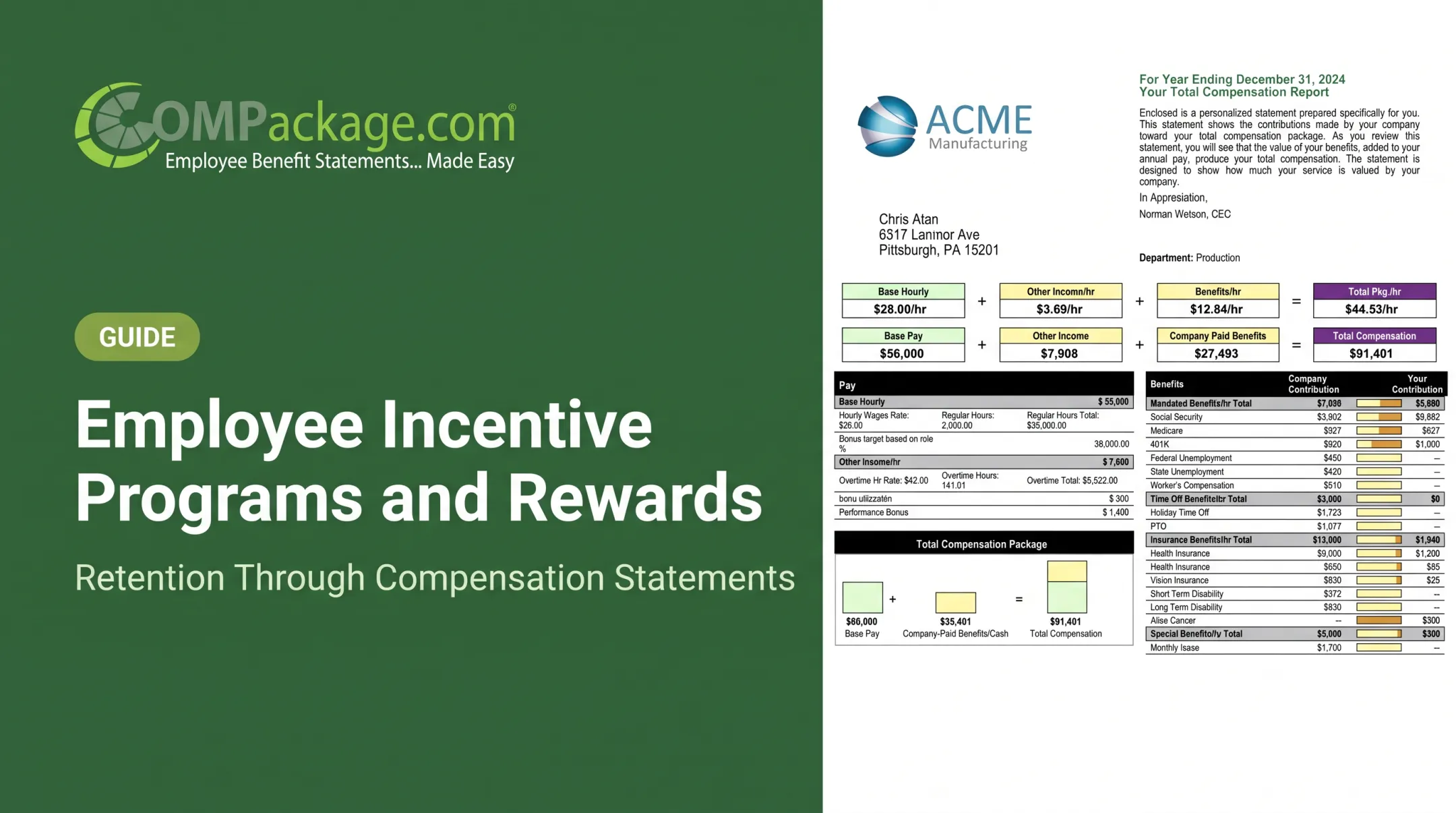
Give each employee a clear view of base pay, employer-paid benefits, incentives, paid time off and non-quantifiable perks. COMPackage is a self-service total compensation statement tool built for this.
Employers can:
- Create customizable reports in-house
- Update them throughout the year at no charge
- Show only benefits that apply to each employee
- Draw from more than 80 preprogrammed benefit categories
One caution: evidence that statements alone improve retention is limited. Pair them with manager conversations.
5. Review and Act
Assign owners and timelines, then tell employees what changed because of their feedback. Track participation and perception over time.
Conclusion
Engagement affects more than morale. It touches retention, recruiting, well-being, collaboration, performance, and customer experience.
Benefits work best when they're relevant, understandable and accessible, and when they sit alongside fair pay, capable managers, manageable workloads, recognition, and room to grow.
Engagement is an ongoing practice. Build it through clarity, trust, steady communication, and visible action.
Frequently Asked Questions
What are the benefits of employee engagement?
Engaged teams typically show higher satisfaction, retention, productivity, collaboration, well-being, customer experience, and recruiting strength. Results still depend on the broader employee experience, including management quality.
What are the 5 C's of employee engagement?
Commonly cited versions include connection, clarity, confidence, contribution and career growth. Frameworks vary in wording, so pick one and apply it consistently.
What is ERISA for dummies?
ERISA is a US federal law setting minimum standards for most voluntarily established private-sector retirement and welfare benefit plans. For plan-specific questions, check Department of Labor guidance and consult qualified benefits or legal counsel.
How can employee benefits improve employee engagement?
Relevant benefits signal organizational support and can improve financial and personal well-being. They strengthen retention when employees understand how to access them and what they are worth.
How do you measure the benefits of employee engagement?
Pair engagement surveys with retention, absenteeism, productivity, benefits utilization, and related business metrics. Track trends over time rather than judging from a single snapshot.