Introduction
Salary rarely explains why someone joins, stays with, or recommends an employer. Candidates and employees also weigh culture, growth, flexibility, purpose, leadership, and the full rewards package.
An employer value proposition (EVP) is the clear, credible promise of value an organization makes to employees in exchange for their skills, effort, and contributions. The trouble is delivery. Gartner found only 33% of employees say their organization consistently delivers on its promises.
This guide covers how an EVP differs from employer branding, five practical pillars, and a step-by-step process to create, communicate, and measure yours.
Key Takeaways
- An EVP blends tangible and intangible value: pay, benefits, culture, growth, flexibility, and purpose.
- A strong EVP is authentic, differentiated, relevant, and backed by real practices.
- Employee listening and candidate research should shape it, not leadership assumptions.
- Every promise needs a proof point, repeated across recruiting, onboarding, and management.
What Is an Employer Value Proposition?
An EVP is the total set of benefits, experiences, opportunities, and expectations an organization offers employees in return for their contributions. Gartner describes it as the attributes that the labor market and employees perceive as the value they gain through employment.
Tangible and intangible elements
- Tangible: pay, incentives, health coverage, retirement benefits, paid time off
- Intangible: culture, belonging, leadership, autonomy, development, purpose, work-life support
What an EVP is not
It isn't a mission statement, a customer value proposition, a list of perks, a recruiting slogan, or an unsupported claim about culture. Those may feed an EVP, but none replaces it.
A two-way deal
An EVP is reciprocal. Employees receive pay, growth, and support. The organization expects performance, collaboration, accountability, and commitment to shared values. Saying so openly makes the deal more believable.
EVP, employer brand, and employee experience
These terms get tangled. Here is how they fit:
- EVP: the promise
- Employee experience: the lived reality of that promise
- Employer brand: how people perceive the organization as a place to work
- Employer branding: the work of communicating and shaping that perception
CIPD says an employer brand should reflect actual experience. When it doesn't, new hires notice fast. Promoting benefits or values employees can't see invites bad reviews, early turnover, and lost trust.
What Should an EVP Include? The Five Practical Pillars
Treat these five pillars as a starting point, not a universal formula. Validate and rank them through employee and candidate research, because a 40-person design firm and a 4,000-person manufacturer will weigh them differently.
Compensation and total rewards
This pillar covers base pay, bonuses, benefits, paid leave, retirement offerings, recognition, and non-quantifiable rewards. Employees often see only salary, so the real value of their package stays hidden.
Gallup's 2025 research found 54% of US employees rate pay and benefits very important in a new job, while 59% say the same of balance and well-being.
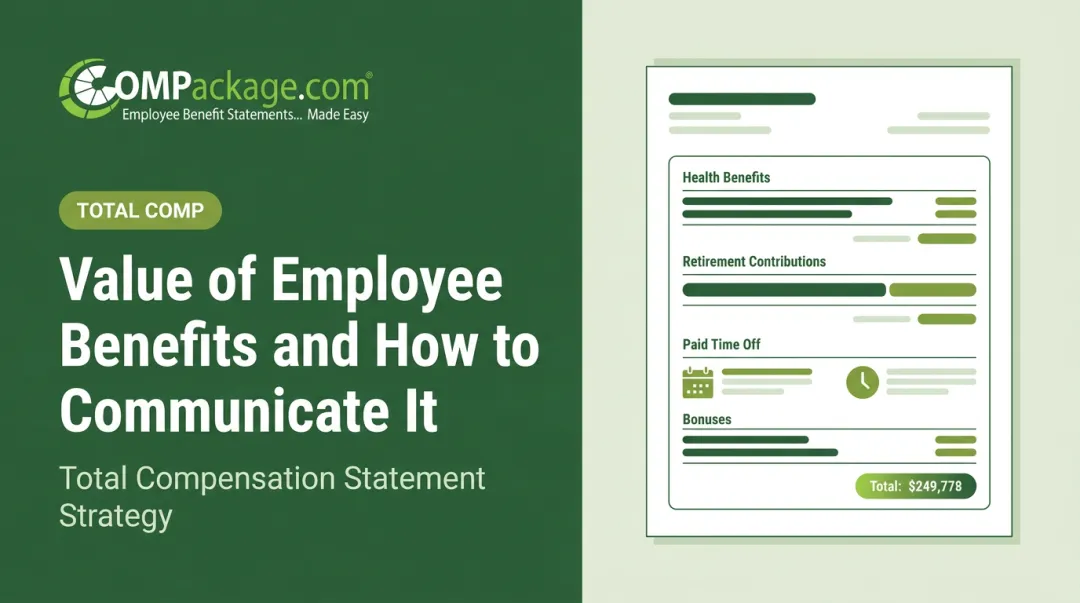
A total compensation report closes the visibility gap. COMPackage, for example, produces reports covering up to 60 customizable benefit areas, including non-payroll items. Its sample customer service report shows $56,000 base pay, $1,786 additional income, and $32,138 in employer-paid benefits, for $89,924 in total compensation. That is a 60% jump over the salary employees see on their paycheck.

Culture, leadership, and belonging
Values become part of an EVP only when they show up in leadership behavior, team norms, and everyday decisions. Proof points include:
- Manager training with clear expectations
- Regular listening practices, such as pulse surveys and skip-level meetings
- Recognition programs employees actually use
- Inclusive policies with documented outcomes
- Defined ways employees take part in decisions
Recognition matters. Gallup and Workhuman found well-recognized employees were 45% less likely to leave over two years, yet only 22% said they get the right amount.
Career development and growth
Cover advancement paths, mentoring, learning, internal mobility, feedback, and meaningful responsibility. "We invest in your growth" means little alone.
Make it genuine by naming the programs, the manager practices, and real employee progression stories. Even a small budget line helps: a company contribution of $1,200 per person for education and training is concrete in a way "growth culture" never is.
Work-life balance, flexibility, and well-being
Address scheduling flexibility, remote or hybrid options, manageable workloads, time off, mental health support, family support, and financial well-being.
Describe flexibility accurately by role. A hybrid schedule for office staff isn't a benefit for the warehouse team. Synchrony, for instance, documents hybrid flexibility specifically for its hourly employees rather than claiming it universally.
Purpose, impact, and meaningful work
Mission, customer impact, community involvement, sustainability, and ethics can all give work meaning. Tie each claim to measurable actions: volunteer hours paid by the company, leadership decisions that put values ahead of revenue, or visible customer outcomes.
Gallup's 2025 data shows strong-purpose employees are 5.6 times as likely to be engaged. Broad inspirational language won't produce that result.

How to Create an Employer Value Proposition
1. Listen to employees
Use engagement surveys, focus groups, interviews, exit interviews, stay interviews, and onboarding feedback. Ask what people value, where expectations went unmet, and why they stay or leave.
Then break results out by role, department, tenure, work arrangement, and career level. Otherwise the EVP reflects only the majority or leadership view.
2. Audit the current offer
Inventory compensation, benefits, development, culture programs, flexibility policies, leadership behaviors, recognition, and purpose initiatives. Then compare what you say with what employees experience.
The gaps show what to fix. The strengths become proof points.
3. Research candidates and competitors
Review candidate feedback, offer-decline reasons, recruiter conversations, job postings, career pages, employer reviews, and competitor messaging. Use competitors to find openings for differentiation, not language to copy.
4. Prioritize pillars and audiences
Decide which elements matter most to your priority talent groups while keeping one consistent core promise. Test each potential promise against five criteria:
- True
- Credible
- Relevant
- Distinctive
- Aspirational
Identify what is universal and what adapts by role, location, career stage, or work arrangement, without creating contradictory promises.
5. Draft the statement and proof points
Write a concise central statement covering who you are, what you offer, who thrives with you, and what employees contribute. Then attach evidence to every major claim: a policy, benefit, leadership behavior, development program, employee story, or total compensation detail.
6. Test, launch, and improve
Test the draft with employees, candidates, managers, executives, and recruiting or benefits teams. Is it clear, different, and believable? SHRM's guidance points to the same test: realistic, differentiating, authentic.
Then assign an owner, build an activation plan, train managers and recruiters, and review the EVP as priorities shift.

Employer Value Proposition Examples
Use these as inspiration only. Each rests on documented practices.
| Company | Central promise | Supporting practices |
|---|---|---|
| Marriott | "Begin, belong, become" | Digital learning, well-being support, flexible scheduling, stock purchase plan for US associates |
| Hilton | "Fully human experience at work" | Thrive Sabbatical and Reset programs offering paid time for passions, service, or recharging |
| Schneider Electric | "Impact starts with us" | Open Talent Market for jobs, mentoring, and part-time projects; My LearningLink |
| Synchrony | "We put people first, always" | Home, hub, or hybrid choices; tuition reimbursement |
Who each appeals to:
- Marriott suits early-career and growth-minded hospitality talent
- Hilton speaks to people who value time and recovery
- Schneider attracts internal-mobility seekers
- Synchrony draws people who want location choice
Mind the eligibility limits. Hilton's Sabbatical is for corporate and managed-hotel employees, with selected recipients only, while Reset is open to all team members. Marriott's stock plan is specified for US and USVI associates.
Each company communicates through careers sites, newsrooms, employee stories, and internal channels such as Schneider's intranet.
A hypothetical example for a small business
Imagine a 60-person regional accounting firm. Its draft promise: "Build your career without burning out."
- Growth proof: $1,500 annual education budget and a defined path from associate to senior
- Balance proof: no client emails after 7 p.m. in off-season months, and flexible hours year-round
- Rewards proof: every employee receives an annual total compensation report
- Expectation in return: accuracy, teamwork, and ownership of client relationships
Nothing here is borrowed from a large employer. Each line reflects what a firm that size can actually deliver.
How to Communicate and Measure Your EVP
Communicate consistently
Gartner found only 21% of employees say their employer communicates its EVP enough. Work your EVP into every major touchpoint:
- Job descriptions and career pages
- Interview conversations and offer materials
- Onboarding and manager communication
- Recognition, internal updates, and social media
Proof makes the message believable. Back it with employee stories, testimonials, day-in-the-life content, transparent benefit explanations, and specific examples of growth or flexibility.
Offer materials are a natural spot for a total compensation report, which shows candidates what the full package is worth beyond base pay.
Measure what matters
Set a baseline first, then track:
- Candidate awareness and application quality
- Offer acceptance and recruiting efficiency
- Employee understanding of the EVP
- Engagement and retention
- Internal mobility
- Employer brand sentiment
On recruiting efficiency, SHRM's 2025 benchmarking puts median time to fill at 45 calendar days—a useful reference point when you review offer acceptance and time-to-fill trends.
Pair the numbers with qualitative feedback and review results by employee and candidate segment. If data shows a promise is unclear, unimportant, or not delivered, revise the promise or fix the practice.

Frequently Asked Questions
What is an employer value proposition?
An EVP is the tangible and intangible value an organization offers employees in return for their contributions. It supports attraction, engagement, and retention by making the deal clear.
How do you create an employer value proposition?
Listen to employees, audit the current experience, and research candidates and competitors. Then define pillars, test the message, and activate it with proof points.
What should an employer value proposition include?
Compensation and benefits, culture and belonging, career development, flexibility and well-being, and purpose. Each promise needs evidence behind it.
What are the 5 pillars of EVP?
This guide uses compensation and total rewards; culture, leadership, and belonging; career development; work-life balance, flexibility, and well-being; and purpose and meaningful work.
What are examples of employer value propositions?
Examples center on themes such as growth, flexibility, purpose, well-being, belonging, or total rewards. Adapt them to your own employee experience rather than copying them.
What is an employer brand?
Employer brand is how current and prospective employees perceive your organization as a workplace. The EVP is the promise, and employer branding is how you communicate and reinforce it.