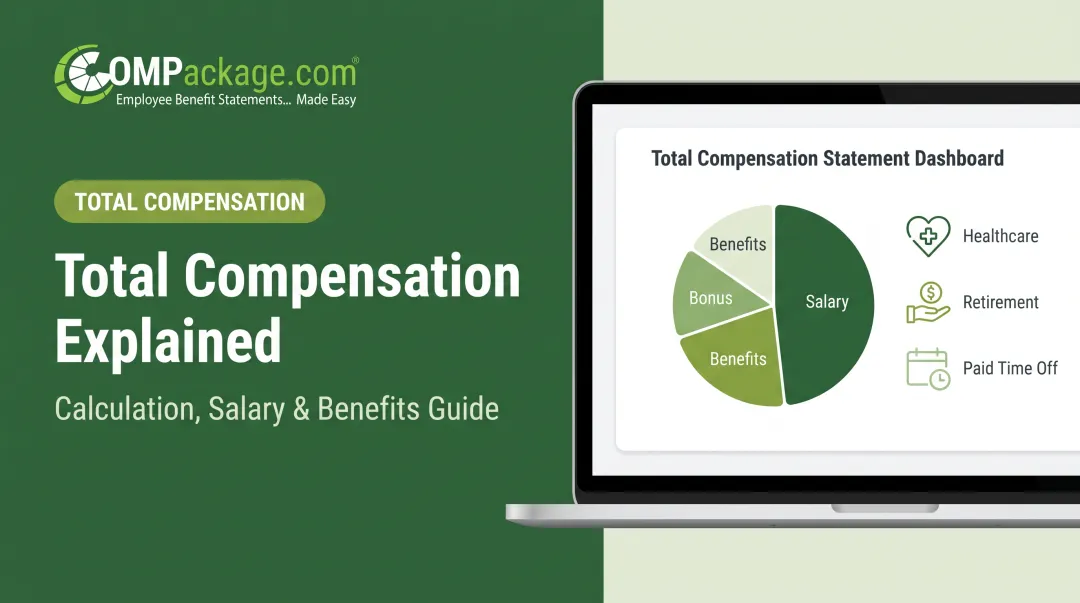
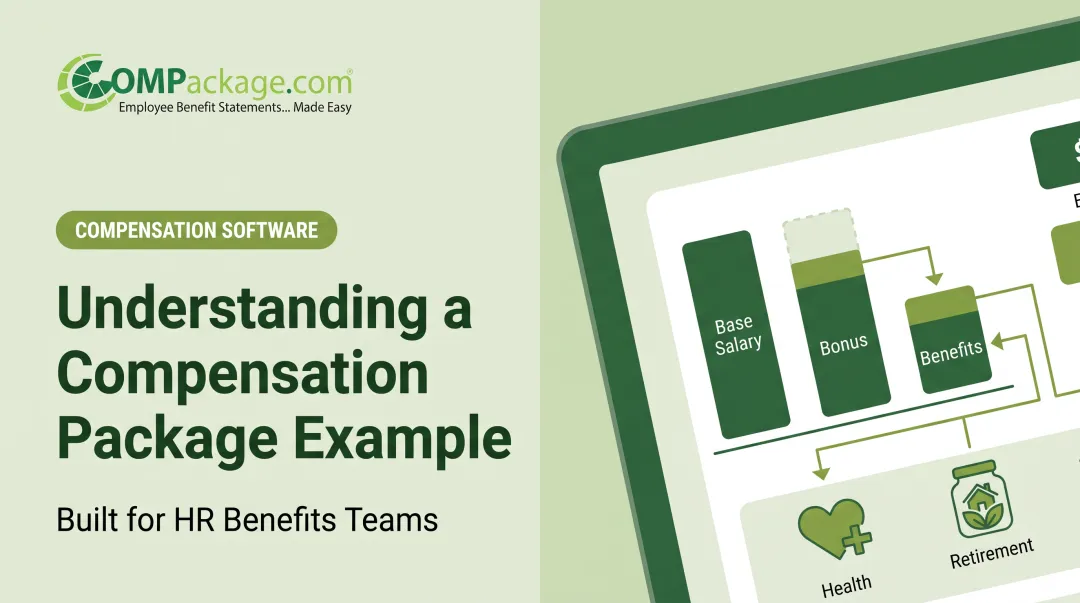
People often treat total compensation as the paycheck. It isn't. Calculating it means identifying, valuing, and documenting several components, then presenting them consistently. Below you'll find the formula, a three-step workflow, a worked example, the factors that change the result, and the limits of the number.
Key Takeaways
- Total compensation adds direct pay to the employer's cost or assigned value of benefits and perks.
- The formula is simple; the hard part is defining inclusions and valuation rules.
- Salary, gross pay, net pay, and employer labor cost are different measures.
- Current, employee-specific data makes the result credible and useful.
What Is Total Compensation and Why Is It Used?
Total compensation is the full monetary and estimated non-cash value an employee receives for work over a stated period, usually a year. It gives both sides a fuller view than a paycheck or base salary can.
It differs from related terms:
- Base salary: pay over a unit of time, excluding overtime and incentives.
- Gross pay: earnings before withholding and deductions.
- Net pay: take-home pay after taxes and deductions.
- Total rewards: WorldatWork's broader model, adding well-being, careers, and recognition.
- Employer labor cost: what the employer spends, which can include overhead.
Scope varies by employer, so state your methodology on the statement.
Direct Compensation
Direct compensation is cash pay: base salary, hourly wages, overtime, commissions, bonuses, incentives, shift differentials, and other cash awards. Separate three kinds of amounts:
- Guaranteed: base pay and fixed allowances
- Earned: overtime, commissions, and bonuses already paid
- Target: bonuses or incentives expected but not yet earned
Indirect Compensation
Indirect compensation covers employer-paid health, dental, vision, disability, and life insurance; retirement contributions; paid time off; equity; allowances; training; and wellness benefits. Each can be assigned a value.
Some items depend on your purpose and methodology: employer payroll taxes, workers' compensation, equity, discounts, and flexible work. Non-quantifiable benefits can be listed without a dollar figure.
Why Employers Use Total Compensation
Employers use total compensation for:
- Workforce budgeting and compensation planning
- Comparing roles and offers
- Recruiting and retention
- Showing employees the value of benefits that never hit take-home pay
BLS data shows private-industry compensation for June 2026 split 70.0% wages and 30.0% benefits. Understanding still lags: an EBRI survey found only 54% of workers highly understand their health benefits.

How Is Total Compensation Calculated?
The basic formula:
Total Compensation = Direct Compensation + Indirect Compensation
The period, inclusion rules, and valuation assumptions must stay consistent across employees or groups. The flow runs through gathering data, converting items to a common period, valuing each one, adding, reviewing, and reporting.
Step 1: Gather and classify compensation data
List each employee's base pay, overtime, commissions, bonuses, and other direct payments. Then collect employer-paid benefit costs, retirement contribution records, PTO balances, equity details, and allowances from payroll, benefits, finance, and HR systems.
Watch for complications:
- Plan participation and coverage tier differ by employee
- Eligibility changes with employment status and schedule
- Start and end dates mean partial-year figures
- Elected benefits change during the year
Step 2: Assign values and standardize the time period
Put everything on the same period, usually annual.
- Insurance: use the employer-paid share of premiums, not the full premium. KFF's 2026 family-coverage figures show an employer contribution of $20,833 of $28,303.
- Retirement: count employer matching and other employer contributions, not employee deferrals.
- PTO: use hours taken multiplied by the hourly rate, applied the same way for everyone.
- Variable pay and equity: pick actual, target, guaranteed, or estimated value, and label it.

Label hypothetical figures as hypothetical. A projection is not earned compensation.
Step 3: Add, review, and communicate the result
Add direct and indirect amounts. Check for duplicates and gaps, document assumptions, and show a line-item breakdown so employees can see how the total was built.
Software can consolidate the work. COMPackage imports employee data from Excel and produces editable, employee-specific reports.
A hypothetical example
These figures are illustrative only, not a typical package.
| Component | Annual value |
|---|---|
| Base salary | $60,000 |
| Employer health premium share | $8,000 |
| Employer 401(k) match | $2,400 |
| PTO (15 days, paid at $28.85/hour) | $3,462 |
| Employer payroll taxes (FICA) | $4,590 |
| Total | $78,452 |

Direct pay is $60,000. Everything else is indirect, so the total is $78,452. If the salary already covers PTO, don't count those days twice. Value only the paid time off as a separate benefit line when your methodology says so, and state the choice.
Where Total Compensation Is Applied and What Affects It?
Total compensation calculations show up across the employee lifecycle:
- Job offers and annual reviews
- Benefits enrollment or renewal
- Workforce budgeting and benchmarking
- Retention conversations and employee statements
Recalculate when salary, bonuses, benefit elections, employer contribution rates, PTO policies, equity values, employment status, or eligibility change.
Factors that affect the calculation
- Data quality: payroll records, benefit invoices, plan documents, and current participation records.
- Valuation assumptions: employer cost, fair-market value, replacement cost, or earned value. Document one approach per benefit category.
- System dependencies: payroll, HRIS, benefits, and accounting systems need compatible employee IDs, dates, and pay periods.
- Scale and frequency: a one-time offer is simple. Census-wide reporting needs standardized categories, bulk import, version control, and review.
- Compliance and privacy: not a tax document or future-pay guarantee; W-2 box 1 is taxable wages only. Check state rules such as California CCPA and Colorado benefit-posting requirements.

Common Issues and Misconceptions
Mistakes that skew the number
- Double-counting benefits or leave already in salary
- Mixing monthly and annual amounts
- Using the full premium instead of the employer share
- Treating target bonuses as guaranteed
- Omitting PTO or employer retirement contributions
- Using outdated plan costs
Misconceptions to correct
- Total compensation is not take-home pay. Net pay subtracts taxes and deductions. Total compensation generally adds employer-provided value.
- Employers differ. Inclusion rules and valuation methods vary, so use transparent labels instead of assuming one universal formula.
- Benefits don't equal cash to every employee. Employer cost, estimated value, and personal preference diverge, and flexibility or development can't be priced reliably.
- A statement can't settle pay equity, market competitiveness, tax liability, or wage-law compliance. The EEOC's comparison factors, such as skill, effort, and responsibility, are not captured in a package total.

When a Total Compensation Calculation May Not Be Appropriate
Skip the full calculation for:
- A quick hourly wage comparison
- An early job discussion with incomplete information
- Packages with highly uncertain equity or bonus values
- Benefits that can't be reliably valued
Narrower measures often fit better:
- Base pay for wage comparisons
- Gross pay for payroll review
- Net pay for personal budgeting
- Employer labor cost for financial planning
- Total rewards for qualitative strategy
Hold a report back for review if you see:
- Missing employee data
- Inconsistent plan-year assumptions
- Unclear eligibility
- Outdated costs
- Unexplained differences between employees
- A result implying guaranteed pay that isn't guaranteed
Conclusion
Total compensation is direct compensation plus the documented value of eligible indirect compensation, over a consistent period. A clear calculation improves budgeting and shows employees what their package really includes.
Define terms, state assumptions, use current data, and apply the result for the right purpose. A single headline number is never the whole story.
Frequently Asked Questions
What is total compensation?
It's direct pay plus the employer-provided value of eligible benefits and perks. Employers may use different inclusion and valuation methods, so check how a given figure was built.
How much compensation am I likely to get?
It depends on base pay, variable pay, benefits, role, experience, employer policy, and local market. An offer estimate is not guaranteed compensation, especially for bonuses and equity.
How can I calculate my net pay?
Start with gross wages and subtract taxes, employee benefit premiums, retirement contributions, and other deductions. Net pay is take-home pay, not total compensation.
What is the formula for calculating wages?
Hourly wages are rate times hours worked. Overtime for covered nonexempt employees is at least 1.5 times the regular rate after 40 hours in a workweek. Wage formulas cover direct pay only, not benefits.
How much is $20 an hour yearly salary?
At 40 hours a week for 52 weeks (2,080 hours), it's $41,600. Actual earnings change with overtime, unpaid time, and schedule shifts, and the figure excludes benefits.
Is 96% compa-ratio good?
Compa-ratio is pay divided by the pay-range midpoint, so 96% sits slightly below midpoint. Whether that's appropriate depends on the range, job level, market data, experience, performance, and the employer's pay philosophy.