Introduction
Employees don't judge a benefits package by its length. They judge it by whether it makes them feel secure on health, money, time, and growth. Yet many employers still buy the visible perk first (the snack wall, the gym discount) and sort out the essentials later.
The cost of getting this wrong is real. Private-industry benefits run $14.07 per hour, or 30.0% of total compensation, according to BLS data. Spend that much on the wrong things and you pay twice: once in budget, once in lost retention.
This guide groups benefits by the need they meet, shows how to choose among them, and explains how to communicate the full value to employees.
Key Takeaways
- Strong packages combine coverage, financial security, flexibility, wellbeing, and growth.
- Survey your own employees before assuming what they want.
- Small employers can compete with flexibility, leave, development, and recognition.
- Benefits only count if employees understand them, can use them, and you measure them.
Overview of Employee Benefits and Perks in the U.S. Workplace
Employee benefits are non-wage compensation that supports health, income, retirement, time off, or family needs. Perks are the optional extras: discounts, wellness allowances, recognition programs, and lifestyle support.
The U.S. landscape varies widely by employer size, industry, worker classification, and state. Access is a good example. Among private-industry workers, medical plan access reaches 87% of full-time workers but only 23% of part-time workers, per BLS March 2026.
Before describing any requirement or tax rule to staff, check current guidance from the U.S. Department of Labor, the IRS, and your state agencies. Rules differ by plan and by state.
Next, the best benefits grouped by the employee need they address. No single package fits every workforce.
Best Employee Benefits and Perks for U.S. Employers
Judge each option against the same criteria:
- Value employees report
- Breadth of support
- Accessibility and affordability
- Administrative effort
- Compliance exposure
- Likely effect on attraction, retention, and productivity
Healthcare, Insurance, and Protection Benefits
Health coverage is the foundation. Employers rate it highly: 88% call health-related benefits very or extremely important, according to SHRM's 2026 survey.
In EBRI's 2026 research, health insurance and retirement plans each contribute "a lot" to financial security for nearly two-thirds of workers.
Options include medical, dental, vision, life, short- and long-term disability, and employee assistance coverage. BLS reports private-industry access of 44% for dental, 29% for vision, 59% for life, and 44% and 37% for short- and long-term disability.
Costs are substantial. KFF's 2026 survey puts average annual premiums at $9,804 for single coverage and $28,303 for family coverage, with employees paying an average 18% and 27% of those premiums.
Offering a plan isn't the same as making it usable. Spell out:
- Employer cost-sharing and employee contributions
- Eligibility and any waiting period
- Dependent coverage rules
- Exclusions, in plain language
| Coverage | Need addressed | Employer considerations | Communication requirement |
|---|---|---|---|
| Medical, dental, vision | Healthcare access | High cost, ACA rules, strong participation | Show employer share vs. employee share |
| Disability, life | Income protection | Moderate cost, eligibility tiers | Explain what is replaced and for how long |
| Dependent and family coverage | Family security | Highest premium exposure | Show the total value, not just the paycheck deduction |

Retirement and Financial-Wellbeing Benefits
Financial stress is widespread. In PwC's 2026 survey, 59% of U.S. employees report being financially stressed. Retirement alone doesn't fix that, so pair long-term and short-term support.
- Retirement plans with an employer match build long-term security.
- Emergency savings options help with near-term shocks. SECURE 2.0 permits optional pension-linked emergency savings accounts.
- Student-loan help can take the form of a retirement match tied to loan payments (IRS Notice 2024-63) or Section 127 assistance, with a $5,250 annual exclusion.
- Financial coaching and budgeting resources cost little and reach employees who can't yet save.
Retirement access varies by size. BLS shows 55% access at establishments with 1-49 workers versus 91% at 500+.
Confirm IRS limits for the plan year you will fund. The 401(k) deferral limit is $24,500 for 2026 and $25,500 for 2027.
Employee deferrals are always 100% vested; employer match can follow a three-year cliff or six-year graded schedule. Small employers may also qualify for a startup tax credit of up to $5,000 annually for three years.
| Option | Need | Administration and communication |
|---|---|---|
| 401(k) with match | Long-term security | Explain vesting, eligibility, and employer cost |
| Emergency savings | Immediate support | Explain how employees opt in and withdraw |
| Student-loan match or assistance | Debt reduction | Certification rules apply; explain limits |
| Coaching, budgeting tools | Everyday stability | Low cost; promote often |

Paid Time Off, Flexibility, and Work-Design Benefits
Time is the benefit employees feel daily. BLS reports private-industry access of 80% for paid vacation, 81% for paid sick leave, and 49% for paid family and medical leave. Part-time workers fare worse: 38% have vacation and 59% have sick leave.
In EBRI's research, work-life balance (49%), schedule flexibility (37%), more generous PTO (35%), and location flexibility (29%) all rank as valued job attributes beyond pay. Among remote-capable workers, Gallup finds 61% prefer hybrid.
There is no general federal guarantee of private-sector paid leave. States fill the gap: paid family and medical leave programs exist in states including CA, NY, NJ, WA, and MA, and many states have paid sick leave laws. FMLA offers up to 12 weeks of unpaid, job-protected leave to eligible employees at covered employers (50+ employees).
Flexibility has tradeoffs. Plan for:
- Customer coverage and frontline roles that can't work remotely
- Consistent manager decisions
- Cybersecurity and equipment for remote staff
- Expense reimbursement, which some states require
| Flexibility type | Best-fit workforce | Safeguards |
|---|---|---|
| Time (flex hours, compressed weeks) | Caregivers, commuters, shift-capable roles | Core hours, coverage rules |
| Location (hybrid, remote) | Remote-capable knowledge roles | Security, equipment, reimbursement policy |
| Extended leave | Parents, caregivers, those with health needs | Clear eligibility, backfill plan |
Mental Health, Wellness, and Family-Support Benefits
Meaningful support addresses a real need: counseling, employee assistance programs, wellness stipends, ergonomic equipment, fertility and reproductive-health support, childcare and eldercare help, and bereavement leave. A gym discount nobody uses isn't support.
Coverage is still thin in places. Only 11% of employers provide eldercare services or information, per SHRM 2026.
Design for trust:
- Keep participation confidential. The ADA requires employee medical information to be kept separate and confidential.
- Know whether HIPAA applies. It covers group health plan wellness data, not every standalone employer program.
- Don't stigmatize use; promote benefits to everyone.
- Check whether employees can realistically use them (hours, locations, provider access).
- Remember mental health parity: covered plans generally can't impose stricter limits on mental health benefits than on medical benefits.
| Need | Delivery model | Measure |
|---|---|---|
| Mental health | Insurance, EAP, confidential access | Utilization, feedback |
| Physical | Stipends, ergonomic gear | Participation, absence trends |
| Family and caregiving | Reimbursement, paid time, resources | Satisfaction, retention |
Professional Development, Recognition, and Lifestyle Perks
Development is common: SHRM reports 72% of employers offer formal training for new skills and 81% support professional memberships. Options include tuition or certification help, mentoring, learning budgets, peer recognition, discounts, commuter support, home-office allowances, volunteer time off, and sabbaticals.
Recognition pays off. Gallup and Workhuman tracked nearly 3,500 employees from 2022 to 2024 and found well-recognized employees were 45% less likely to have turned over after two years. That's an association, not proof of cause.
Watch the tax side. For 2026, the qualified parking and transit exclusions are each $340 per month. Cash and gift cards don't qualify for the employee achievement-award exclusion.
Low-cost perks work when they match what employees want. They don't replace fair pay, safe conditions, foundational benefits, or good management.
| Perk | Employee value | Cost and complexity | Communication |
|---|---|---|---|
| Learning budget | Career growth | Reimbursed, low admin | Usage limits, approval steps |
| Peer recognition | Belonging | Low cost | How awards are given |
| Commuter support | Daily savings | Provider-based, tax limits | Enrollment, monthly caps |
| Sabbatical | Purpose, recovery | High cost, coverage planning | Eligibility, tenure rules |

How to Choose the Best Employee Benefits and Perks
- Start with employee input
Use anonymous surveys, focus groups, onboarding feedback, exit interviews, and manager observations. Segment results by role, work arrangement, life stage, and location. Don't assume what a 25-year-old or a remote worker wants; ask.
- Put foundations before novelty
Evaluate healthcare, paid time off, retirement, flexibility, and financial wellbeing first. The classic mistake is choosing benefits because leadership likes them or because they look good in a job posting, not because employees use them.
- Compare total cost and expected value
Review employer spend, employee contributions, administrative workload, tax and compliance requirements, and participation rates. Small firms still have strong options: KFF finds 66% of firms with 10-199 workers offer health coverage, and eligible small employers may claim a health care tax credit of up to 50% of qualifying premiums for two consecutive years.
- Communicate and measure
Understanding is the weak link. MetLife's 2025 report found 38% of employees struggle to understand benefits communications. Explain every benefit in plain language, show employer and employee contributions, track enrollment and use, and collect feedback after launch.
- Show the full package
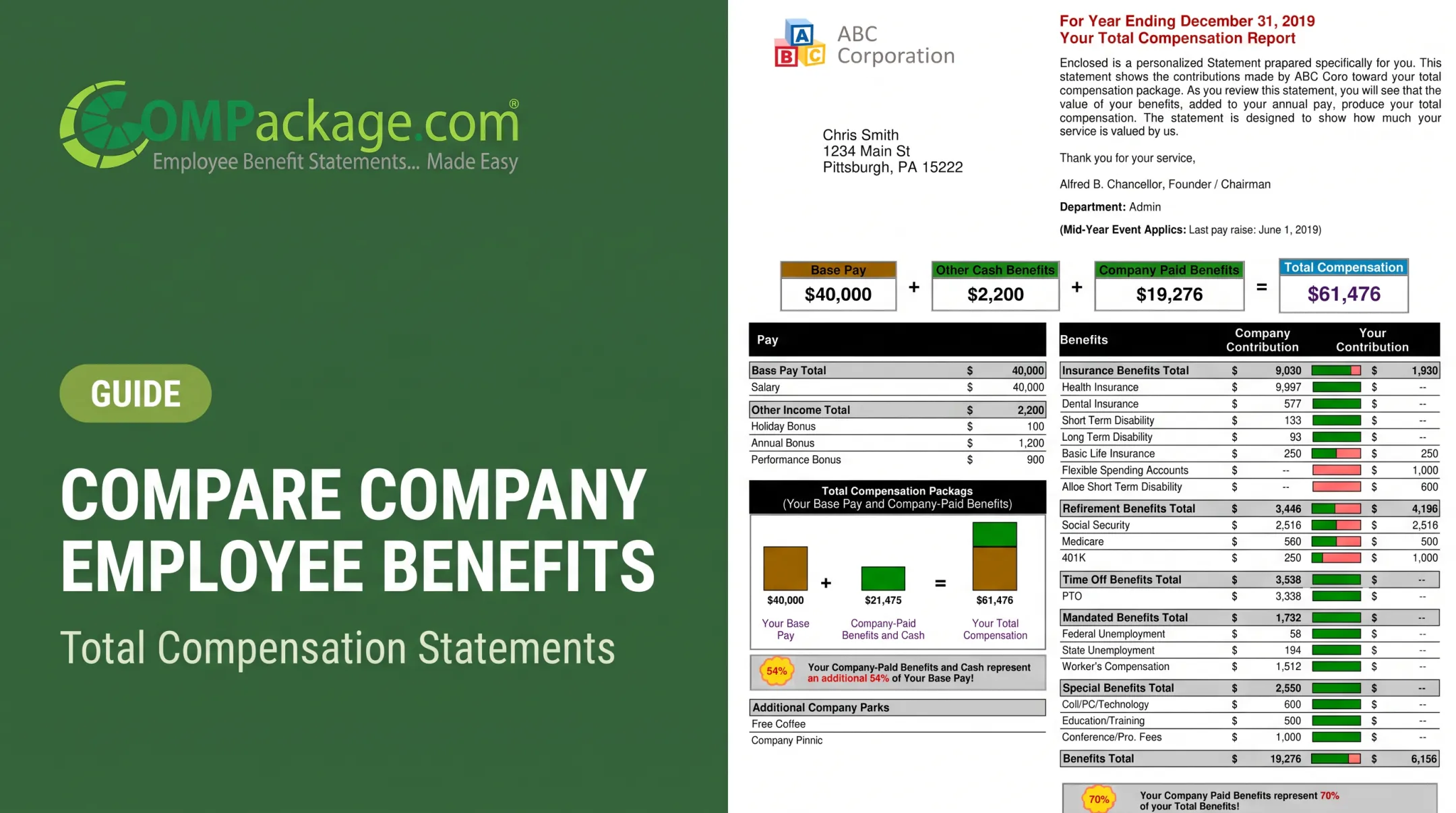
A total compensation statement turns scattered benefits into one number. COMPackage is self-service software that produces employee-specific reports, so each person sees only the benefits that apply to them.
- Import census data from Excel with the Employee LOADER
- Include quantifiable and non-quantifiable benefits
- Edit reports as plans change, at no extra charge
- Add a company logo and custom colors
In a sample report, $56,000 in base pay plus $1,786 in bonus and $32,138 in employer-paid benefits equals $89,924 in total compensation. Employees who see that figure understand their pay differently. Confirm current features and pricing with COMPackage before you buy.

Conclusion
The best package is one employees can use, understand, and value, and that still supports your business goals.
Review your package regularly. Use a total compensation reporting solution such as COMPackage to show what pay and benefits are really worth, and ask for a demo to see how the self-service platform could support reporting at your organization.
Frequently Asked Questions
What are the top employee benefits?
Healthcare, retirement, paid time off, flexibility, mental health support, financial wellbeing, and career development lead the list. Priorities vary by workforce, so validate them with employee feedback.
What perks can I give my employees?
Flexible scheduling, wellness stipends, learning budgets, recognition, discounts, home-office support, family assistance, and volunteer time off all work. Choose those that fit your budget and workforce.
Do I get benefits if I work 32 hours a week?
Not automatically. Eligibility depends on plan documents, worker classification, and federal or state rules. Under the ACA, full-time generally means 30 hours a week, so confirm with HR.
What is the difference between employee benefits and perks?
Benefits are structured non-wage compensation such as insurance, retirement, and leave. Perks are optional extras such as discounts, flexible arrangements, or wellness programs.
Which employee benefits are required in the U.S.?
It depends on employer size, worker classification, and state. Most employers owe Social Security, Medicare, unemployment insurance, and workers' compensation. FMLA and state paid leave apply selectively, so consult a qualified professional.
How can a small business afford competitive employee benefits?
Ask employees what they value, fund the essentials first, add flexible or voluntary options, and communicate clearly. Measure use regularly instead of trying to offer every perk.