Introduction: Employer Payroll Taxes in the U.S.
An employee's gross wage is never the full cost of employing them. On top of the paycheck, you may owe separate employer taxes, while also withholding the employee's share of other taxes and sending it to the government.
That's where the confusion starts. Federal, state, and local rules overlap. Wage bases and rates change. Deposit schedules differ by tax and by employer. And the line between employee and independent contractor affects all of it.
This guide covers the tax categories, a step-by-step calculation, registration and record-keeping, multi-state issues, and common mistakes. Figures reflect 2026 federal guidance. Always confirm against current agency sources before filing.
Key Takeaways
- Employer-funded taxes and employee taxes you withhold are different obligations.
- FICA, FUTA, state unemployment, and state or local programs all add to payroll cost.
- Accurate math needs current wage bases, classifications, work locations, and deposit schedules.
- Verify 2026 rules with official sources, and bring in a professional for complex cases.
Which Payroll Taxes Do Employers Pay?
Federal Insurance Contributions Act (FICA)
FICA covers Social Security and Medicare. Employers pay a share and also withhold the employee's matching share.
| Tax | Employer | Employee | 2026 wage base |
|---|---|---|---|
| Social Security | 6.2% | 6.2% | First $184,500 |
| Medicare | 1.45% | 1.45% | All wages, no cap |
| Additional Medicare | None | 0.9% | Wages above $200,000 |
Additional Medicare Tax is an employee-only liability. You start withholding once your wages to that employee pass $200,000 in the calendar year, but you don't match it. These figures come from IRS Publication 15.
Federal Unemployment Tax Act (FUTA)
FUTA is paid by the employer only. Nothing comes out of the employee's wages.
- The statutory rate is 6.0% on the first $7,000 per employee.
- Employers who pay state unemployment tax on time generally get a credit of up to 5.4%, leaving 0.6%.
- Credit reduction states lose part of that credit. For 2026, California has a 1.5-point reduction, a 2.1% net rate, and up to $105 more tax per employee.
Check the Department of Labor's final credit-reduction table for your state.
State, local, and supplemental obligations
Requirements follow where the employee physically works. Common items include:
- State unemployment insurance (SUI), with 2026 wage bases ranging from $7,000 to $78,200 according to Department of Labor data
- State income-tax withholding
- Local income taxes, such as Pennsylvania local earned income tax or Ohio school-district tax
- Paid-leave and disability programs, such as California SDI (1.3%, employee-funded) or Washington PFML (1.13%, shared by employers with 50+ employees)
Residency, reciprocity, and convenience rules can change the outcome, so don't stop at the work address.
Payroll taxes versus other employer costs
Payroll taxes are not the whole cost of an employee. Keep these separate:
- Payroll taxes: employer FICA, FUTA, SUI, and employer-funded state programs
- Other legally required costs: workers' compensation premiums
- Voluntary or negotiated benefits: health insurance, retirement contributions, paid leave
Only the first group belongs in a payroll-tax calculation. All of them belong in a total employer-cost view. BLS reports that legally required benefits average 7.2% of private-industry compensation, but that figure includes workers' compensation, so it isn't a payroll-tax-only number.
What Are Employer Payroll Taxes?
Employer payroll taxes are taxes tied to employee wages that a business either pays from its own funds or withholds and sends to a tax authority.
Three buckets
- Employer-paid: employer FICA share, FUTA, most state unemployment tax
- Employee-paid, withheld by you: employee FICA, Additional Medicare Tax, often state disability contributions
- Administered for the employee: federal and state income-tax withholding
Withheld amounts are the employee's liability, but you're responsible for remitting them correctly.
What changes the calculation
Gross wages, bonuses, commissions, overtime, taxable fringe benefits, and pre-tax deductions all affect taxable wages. A deduction can lower income-tax withholding wages without lowering FICA or FUTA wages. Traditional 401(k) deferrals are the classic case.
Payroll taxes and total compensation
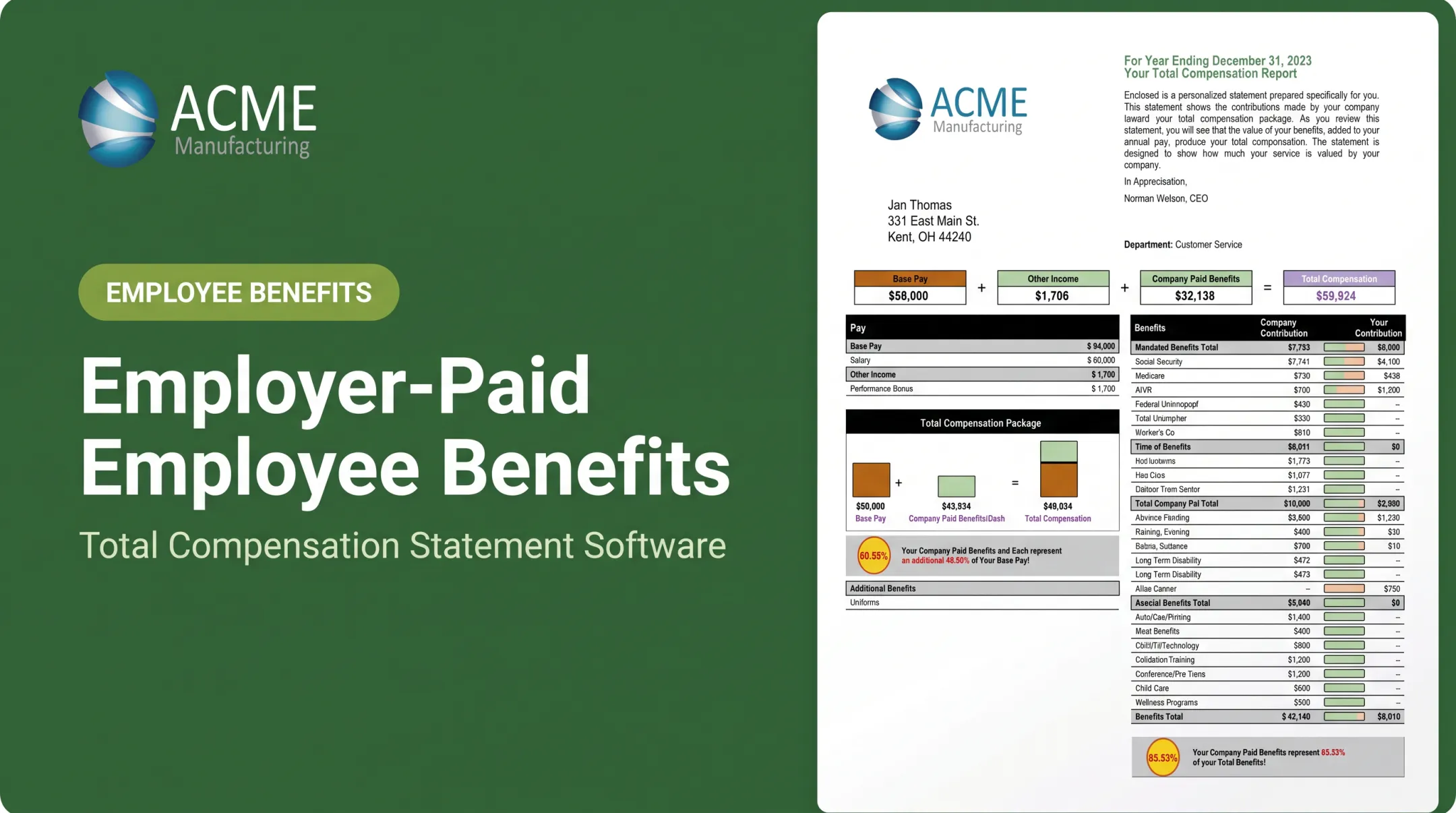
Employer-paid taxes are part of what a job costs you, and part of what an employee is actually worth to the company. Employees rarely see that. Tools like COMPackage let you present total compensation, including employer-paid costs and benefits, in a self-service report. It isn't payroll or tax-filing software, so use it for communication, not compliance.
How to Calculate Employer Payroll Taxes
Gather employee, payroll, and jurisdiction data
Start with:
- Employee classification and work location
- Gross wages and pay frequency
- Form W-4 and any state withholding forms
- Benefits and deductions
- Your federal and state tax account details
Determine taxable wages and wage bases
Review regular pay, overtime, bonuses, commissions, taxable fringe benefits, and deductions. Overtime, bonuses, and commissions are generally subject to withholding and employment taxes. Qualified Section 125 health benefits are generally excluded from FICA and FUTA wages.
Supplemental wages can be withheld at an optional 22%, or 37% above $1 million in a calendar year. Those are withholding rates, not employer taxes.
Calculate federal employer liabilities
- Social Security: 6.2% × wages up to $184,500
- Medicare: 1.45% × all Medicare wages
- FUTA (full credit): 0.6% × wages up to $7,000
Keep these apart from federal income-tax withholding and the employee's FICA share. For withholding, use the employee's W-4 with Publication 15-T methods. No universal percentage exists.
Add state and local obligations
Apply your assigned state unemployment rate and wage base. Then check whether state or local withholding applies, plus any paid-leave, disability, or local requirements tied to the work location. New employer rates vary widely; California's is 3.4% on a $7,000 base.
Reconcile and document an example
Take an employee earning $60,000 in fully taxable wages, with the full FUTA credit:
| Item | Amount |
|---|---|
| Employer Social Security (6.2%) | $3,720 |
| Employer Medicare (1.45%) | $870 |
| FUTA (0.6% of $7,000) | $42 |
| Employer federal total | $4,632 |

The employee would also have $3,720 and $870 withheld for their FICA share, plus income tax per the W-4. State taxes are extra, and this is a calculated illustration only.
Before finalizing payroll, reconcile the register, tax deposits, and liability accounts. Use a payroll calculator to verify, not replace, official guidance.
Employer Payroll Tax Compliance: Registration, Deposits, and Records
Register before processing payroll
- Get an EIN directly from the IRS. It's free.
- Register for state unemployment and withholding accounts, and confirm local requirements.
- Collect Form W-4, state forms, and Form I-9. Complete Section 2 of the I-9 within three business days of the start date.
- File new-hire reports within 20 days federally. Some states require sooner.
Deposit and report on the correct schedule
Form 941 deposits depend on your lookback period, not your pay frequency. For 2026 it runs July 1, 2024 to June 30, 2025. $50,000 or less generally means monthly deposits; more means semiweekly. Accumulating $100,000 triggers next-business-day deposits.

Key 2026 deadlines:
- Form 941: April 30, July 31, November 2, and February 1, 2027
- Forms 940, W-2, and W-3: February 1, 2027
Also expect state unemployment and withholding returns plus local filings. California's UI is quarterly, for instance, while SDI and income-tax deposits can be more frequent.
Late deposits cost 2% to 15% depending on delay. Responsible persons who willfully fail to remit trust-fund taxes can be personally liable under the Trust Fund Recovery Penalty.
Maintain records and manage notices
Keep these, generally at least four years for IRS employment-tax records:
- Payroll registers and time records
- W-4s and deduction authorizations
- Deposit confirmations and filed returns
- Worker-classification records
- Agency notices
Federal wage-and-hour payroll records require three years, with time cards for two. Practical steps include:
- Build a compliance calendar
- Review rates each year
- Reconcile payroll to the ledger
- Restrict access to payroll data
- Set a process for corrections and tax notices
Common Employer Payroll Tax Problems and How to Avoid Them
Misclassifying employees and independent contractors
You can't pick contractor status just to avoid payroll taxes. The IRS looks at behavioral control, financial control, and the relationship. States such as California and Massachusetts use stricter ABC tests. Federal wage-law standards differ from both.
- Collect Form W-9 from contractors.
- Report qualifying 2026 payments on Form 1099-NEC. The threshold is now $2,000, not $600.
- Know the back-tax exposure if you're wrong.
- Use the IRS Voluntary Classification Settlement Program when eligible; it lets you reclassify going forward for about 10% of one year's calculated liability.

Making improper deductions or withholding errors
Pre-tax and post-tax deductions behave differently, so check each one. Limits also apply:
- Ordinary garnishments: the lesser of 25% of disposable earnings or the excess over 30 times the federal minimum wage
- Child support: generally 50% to 60%, plus 5 points for older arrears
- IRS levies: governed by IRS exempt-amount rules, not ordinary garnishment caps
- Benefit deductions such as uniforms generally can't cut pay below minimum wage
Check state law too; it may be stricter.
Managing remote and multi-state employees
An employee working from home in another state can trigger registration, unemployment, withholding, and local-tax duties, even if you have no office there.
- Track work locations and relocations.
- Review reciprocity. Ohio, for example, has agreements with Indiana, Kentucky, Michigan, Pennsylvania, and West Virginia.
- Watch convenience rules. New York can treat home telework days as New York workdays for nonresidents with a New York office.
- Update registrations promptly and get professional advice for cross-state staff.
Frequently Asked Questions
What are the payroll tax rates for 2026?
Employers pay 6.2% Social Security (to $184,500), 1.45% Medicare, and FUTA of generally 0.6%. Employees pay matching FICA plus withholding. Confirm wage bases and credit rules with the IRS, Department of Labor, and your state.
What is the withholding tax rate?
There's no single rate. Federal income-tax withholding depends on the Form W-4, wages, pay frequency, and applicable state or local rules.
How much federal tax should be withheld from an employee's paycheck?
Use the employee's current W-4 with IRS Publication 15-T methods or compliant payroll software. The withholding is generally the employee's liability, which you collect and remit.
How often does an employer have to pay payroll taxes?
It depends on the tax type and your assigned schedule. Federal deposits are monthly or semiweekly based on your lookback period. Verify federal and state deadlines rather than assuming a universal rule.
What is included in payroll tax?
Employer and employee FICA, FUTA, state unemployment tax, and applicable state or local programs. Health insurance, retirement contributions, and workers' compensation premiums are separate employer costs.
What types of payroll taxes are there?
Federal (FICA, FUTA), state and local (SUI, local income tax), employer-only (FUTA), and employee taxes withheld through payroll (Additional Medicare Tax, income-tax withholding).