Introduction
Benefits are a major slice of what you pay people. Candidates weigh them when deciding whether to accept an offer, and employees weigh them when deciding whether to stay. Yet many workers don't know what their benefits cover.
Only 57% of employees fully understand their coverage, according to MetLife's 2025 survey. That gap hurts recruiting and retention, but small and midsize businesses can still compete. Prioritize benefits that fit your workforce and budget rather than copying a large employer's package.
This article covers seven benefits: what each is worth to employees, what it costs you, how hard it is to run, which compliance questions to check, and how to communicate it.
Key Takeaways
- Strong packages mix health protection, financial security, time flexibility, well-being, and career growth.
- The "best" benefit depends on your workforce, budget, and employee feedback, not popularity.
- Some benefits are legally required and others are voluntary; verify federal and state rules before finalizing policy.
- Clear communication helps employees see value they'd otherwise overlook.
Overview of Employee Benefits in the U.S. Workplace
Employee benefits are non-wage compensation: insurance, retirement contributions, paid leave, flexible work, wellness support, and professional development. They help with recruiting, retention, financial security, and productivity.
Benefits are a large cost. The BLS reports they make up 30.0% of private-industry compensation, though that figure includes legally required items such as Social Security and workers' compensation, not just optional perks. Establishments with 1-49 workers spend less (25.9%) than those with 500+ workers (35.3%).
Access varies by benefit type. In March 2026, private-industry workers had access to:
- Medical care: 71%
- Retirement plans: 72%
- Paid sick leave: 81%
- Paid vacation: 80%
The seven benefits below are practical priorities. No employer must adopt all of them, or in this order.
Top 7 Employee Benefits for U.S. Employers
These seven stand out on employee demand, effect on recruiting and retention, usefulness across workforce groups, affordability, administrative complexity, compliance exposure, and how easily their value can be communicated.
1. Health Insurance
Medical coverage, with dental and vision where appropriate, helps employees manage healthcare costs. It's usually the foundation of a package.
Compare these factors across plans:
- Employer and employee premium shares
- Deductibles and out-of-pocket exposure
- Provider networks and dependent coverage
- Access to preventive and mental healthcare
KFF's 2026 survey puts average annual premiums at $9,804 for single coverage and $28,303 for family coverage. Workers contribute about $1,672 and $7,471 respectively.
| Factor | What to weigh |
|---|---|
| Employer cost | Fully employer-paid, contributory, or voluntary designs change spend sharply |
| Employee value | Affordability, coverage breadth, network access, likely usage |
| Implementation | Plan administration, enrollment education, federal and state rules |

Check the ACA: employers with an average of 50+ full-time employees (including equivalents) face shared-responsibility rules. Employers with fewer than 25 FTEs may qualify for the Small Business Health Care Tax Credit, up to 50% of premiums.
2. Retirement Plans
A 401(k) or similar plan supports long-term security and helps you compete for experienced talent. Design matters more than the label.
Match formulas, automatic enrollment, vesting, investment choices, fees, and financial education all shape usefulness. Vanguard's How America Saves 2026 reports 94% participation in automatic-enrollment plans versus 64% in voluntary-enrollment plans. That's an association among Vanguard clients, not a guaranteed effect.
- Employer cost: matching contributions, administration, provider fees. Startup tax credits of up to $5,000 a year for three years may offset setup for small employers.
- Employee value: contribution support, easy enrollment, fund choices, education.
- Implementation: plan documents, fiduciary duties, participant notices, current rules.
A SIMPLE IRA, generally open to employers with 100 or fewer employees, is a lighter-lift option with a 3% match or 2% nonelective contribution.
3. Paid Time Off
PTO covers vacation, sick leave, holidays, personal days, and mental health days. It supports rest, recovery, and caregiving.
Clear rules make it work: eligibility, accrual, carryover, approval, blackout dates, and payout. Ambiguity frustrates employees and managers alike.
BLS data shows private-industry employees average 11 vacation days after one year of service, rising to 20 after twenty years, and about 7 sick days at any tenure. These are typical provisions, not legal minimums.
- Employer cost: paid non-working time, coverage, scheduling, possible unused-leave liability.
- Employee value: flexibility, predictability, time to recover, room for family or health needs.
- Implementation: the FLSA doesn't require paid vacation or sick leave, but many states and localities require paid sick time. Check final-pay rules too.
4. Flexible Work Arrangements
Remote, hybrid, compressed-week, flexible-hour, and shift-swap options help employees manage commutes, caregiving, and health needs.
Gallup finds 61% of remote-capable employees prefer hybrid work, while 54% actually work hybrid. That applies only to remote-capable roles.

Put expectations in writing: availability, communication, performance measures, technology, data security, and meeting norms.
- Employer cost: technology, cybersecurity, scheduling, manager training.
- Employee value: autonomy, shorter commutes, schedule control.
- Implementation: fairness between remote and site-based roles, cross-state employment issues, and wage-and-hour rules.
Nonexempt employees must be paid for all hours worked at home, and breaks of 20 minutes or less count as work time.
5. Mental Health Support
Options include employee assistance programs (EAPs), counseling access, behavioral health coverage, telehealth, manager training, and confidential pathways to help.
A benefit only has value if employees know how to reach it, trust its confidentiality, and face no stigma. The APA's 2025 survey found 93% of workers say employer support for psychological well-being matters.
- Employer cost: an EAP, expanded insurance coverage, digital tools, training, and paid time all price differently.
- Employee value: accessibility, privacy, provider availability, family support, crisis resources.
- Implementation: confidentiality, nondiscrimination, regular communication, utilization review, and health plan coordination.
Covered group plans must also meet mental health parity requirements.
6. Parental and Caregiver Leave
Parental leave, adoption and foster support, pregnancy-related leave, bereavement leave, and eldercare resources help during major family moments.
Define eligibility, paid versus unpaid time, job protection, documentation, coordination with other leave, phased returns, and support for nontraditional families.
Legal coverage is uneven. FMLA applies to employers with 50+ employees and gives eligible workers up to 12 weeks of unpaid, job-protected leave. 14 states and D.C. have enacted paid family and medical leave laws. BLS finds only 49% of private-industry workers have access to paid family and medical leave.

- Employer cost: paid leave, temporary coverage, workload planning, replacement staff.
- Employee value: income protection, job security, an easier return to work.
- Implementation: get legal review. Rules vary by employer size, work location, and leave type. The PWFA (15+ employees) and PUMP Act add accommodation duties.
7. Professional Development Opportunities
This covers tuition assistance, certification reimbursement, conferences, mentoring, coaching, internal training, and learning platforms.
Development builds capability and shows employees you're invested in their future. In SHRM and TalentLMS research, 76% of employees said they'd be more likely to stay with a company offering continuous training. That's stated intent, not measured turnover.
Under Section 127, employers can exclude up to $5,250 per employee in educational assistance from taxable income in 2026.
- Employer cost: tuition, subscriptions, paid learning time, conferences, program administration.
- Employee value: skills, promotion paths, mobility, fit with personal goals.
- Implementation: eligibility, annual limits, approved programs, service commitments, manager support, tracking outcomes.
How We Chose the Best Employee Benefits
Employee Value and Workforce Fit
Don't guess. Gather real input from:
- Surveys and listening sessions
- Exit interviews and recruiting feedback
- Participation data
Compare groups: hourly and salaried, remote and on-site, caregivers and employees without dependents, younger and older workers. A benefit prized by one group may barely register with another.
Cost, Compliance, and Administration
Count the full cost:
- Premiums and contributions
- Paid time and vendor fees
- Payroll work and employee support
- The cost of low participation
Verify federal, state, and local requirements with a qualified legal or benefits professional. A "voluntary" benefit can still trigger compliance duties. Under ERISA, calling insurance voluntary doesn't exempt it; the employer must make no contributions and keep a limited role.
Cafeteria plans need a written plan and can't favor highly compensated employees.
Communication and Total Compensation Visibility
Measure whether employees understand and use their benefits, not whether they appear in a handbook. MetLife found half of employees say better understanding would make them more loyal.
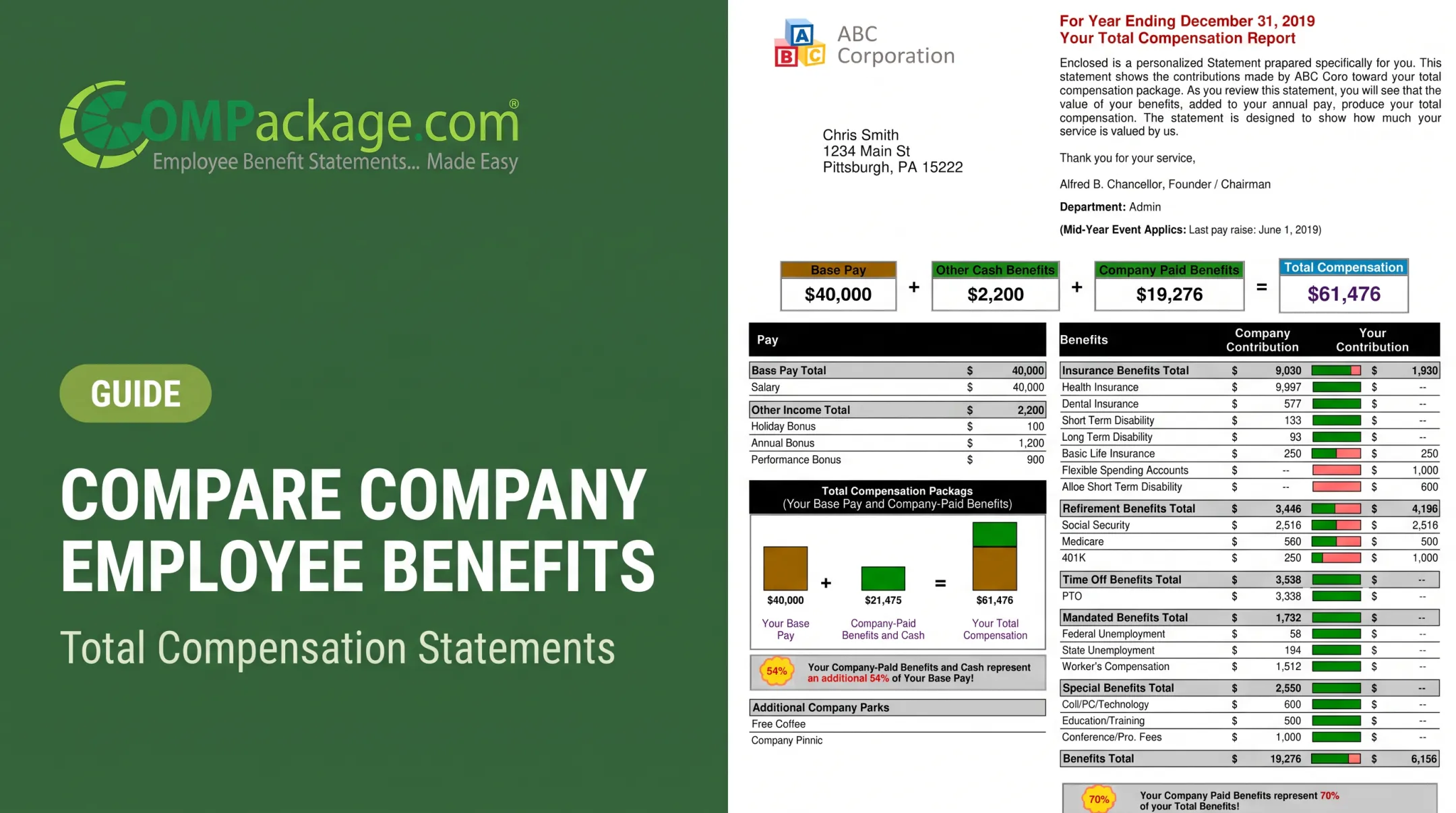
COMPackage offers self-service total compensation reports that show salary, employer-paid benefits, PTO, and other compensation in one employee-facing document. A sample COMPackage report shows $56,000 in base pay alongside $32,138 in company-paid benefits, which makes hidden value easy to see.

Conclusion
The strongest package aligns employee needs with your budget, workforce strategy, operations, and legal obligations. Review participation, feedback, recruiting outcomes, retention, utilization, and total cost regularly instead of setting benefits once and leaving them.
If employees can't see what you provide, they can't value it. Explore how COMPackage can help present the full value of your compensation package.
Frequently Asked Questions
What perks can I give my employees?
Flexible schedules, recognition programs, development support, wellness resources, discounts, and extra paid time are affordable options. Confirm tax and legal treatment first: cash and gift cards aren't de minimis fringe benefits, even when small.
What are the most important employee benefits for most workers?
Health coverage, retirement savings, paid time off, flexibility, mental health support, family leave, and development are common priorities. SHRM's 2026 survey shows employers rank health (88%), retirement (82%), and leave (82%) highest, but employee surveys should set your own ranking.
Are employee benefits legally required in the United States?
Some are: Social Security and Medicare taxes, unemployment insurance, and, by state, workers' compensation. FMLA and ACA duties depend on employer size. Most others are voluntary, though state and local rules vary.
Which benefits should a small business offer first?
Start with compliant paid leave, retirement savings (a SIMPLE IRA is one route), health coverage or support where feasible, flexibility, and clear communication. Let employee needs and budget decide the order.
How can a company offer employee benefits on a limited budget?
Survey employees, then use defined-contribution approaches such as an ICHRA or QSEHRA, flexible scheduling, and low-cost learning options. Benchmark against peers and review administrative costs before committing.
How do employee benefits help attract and retain employees?
They strengthen the overall offer, support employees' financial and personal well-being, and set you apart in recruiting. They improve retention when employees understand and can actually use them.