Non-monetary incentives cover a wide range: schedule control, appreciation, development, wellbeing support, and memorable experiences. Many work because they answer a personal need, not because they add dollars to a paycheck.
This article defines non-monetary incentives, compares them with cash rewards, gives practical examples, and shows how to build a fair program.
Key Takeaways
- Non-monetary incentives reward people without raising wages or paying cash.
- The best ones are timely, personalized, and tied to a clear goal.
- Flexibility, recognition, development, and wellbeing all motivate.
- They complement fair pay and benefits; they never replace them.
- Check eligibility, accessibility, tax treatment, and outcomes before launch.
Overview of Non-Monetary Incentives in the U.S. Workplace
Non-monetary incentives are rewards or opportunities that motivate, recognize, or support employees without being paid as direct cash compensation. Some still cost the employer money, such as a conference ticket or a paid day off.
How They Differ From Monetary Rewards
Monetary rewards include raises, bonuses, commissions, profit sharing, and cash-equivalent gift cards. Non-monetary incentives work through time, growth, appreciation, or experience.
They also overlap with other categories. WorldatWork's total rewards model includes compensation, benefits, well-being, careers, and recognition, so many incentives sit inside a broader rewards package.
Why It Matters Now
Retention is a live concern. In 2025, 56% of HR professionals cited retention as their top worry, and turnover can cost up to 200% of an employee's annual salary.
Engagement is also low. Gallup's 2025 data puts U.S. employee engagement at just 31%. The examples below show where employers can respond.

Top Non-Monetary Incentives and Examples
Good incentives share five traits:
- Matter to employees
- Suit the role
- Work across work arrangements
- Are sustainable for the employer
- Connect to outcomes such as engagement, retention, development, or collaboration
Flexible Work Arrangements and Time Autonomy
Flexibility works as a reward when it isn't already standard for the role. Examples:
- Adjusted start and end times
- Occasional remote work
- Shift swaps
- Compressed schedules
- Early Friday finishes
- Extra time off
Access is uneven. A BLS schedule survey found 53.8% of service workers had flexible schedules versus 73.5% in management, business, and financial roles.
Frontline and customer-facing jobs often can't go remote. Offer equivalent schedule control instead: swaps, choice of workdays, or longer breaks. Gallup found frontline workers value time flexibility more than location flexibility.

Recognition and Appreciation
Specific, timely recognition motivates without a dollar spent. Options include:
- Private praise from a manager
- Public acknowledgment
- Peer-to-peer thank-yous
- Handwritten notes
- Service milestones
- Employee-of-the-month
Name the behavior or result you're celebrating. "Great job" fades; "You caught the billing error before it reached the client" sticks.
Be careful with competition. SHRM warns that public programs can breed rivalry, favoritism, and resentment, and overlooked employees may help colleagues less.
Growth, Autonomy, and Career Development
Support what the employee actually wants:
- Mentorship with a senior leader
- Training access
- Conference or workshop attendance
- Stretch assignments
- Job shadowing
- Time for approved improvement projects
Gallup's 2025 survey found 48% of mentorship participants reported high job satisfaction versus 29% of nonparticipants. That's an association, not proof of cause.

Don't assume every strong performer wants a promotion. Ask first, then match the reward to the goal.
Wellbeing, Experiences, and Community
These incentives support health, belonging, and life outside work:
- Wellbeing days and birthday time off
- Paid volunteer time
- Wellness sessions
- Team meals and interest-based events
- Community service days
Time off only helps if people take it. In EBRI's 2024 survey, workers with limited PTO used 79% of available days, and many held back as an illness buffer.
Keep participation voluntary. Plan for accessibility, allergies, caregiving duties, and religious considerations. The EEOC requires reasonable accommodation for religious objections, and ADA rules cover employer-sponsored social programs.
Personal Choice and Meaningful Perks
Choice raises value. Let employees pick from time-off options, development opportunities, charities, experiences, or recognition formats.
Ask rather than guess. Use surveys, one-on-ones, or structured feedback. The National Academies cautions that generational categories can foster stereotyping, and people within a generation differ as much as people across generations.
How to Choose and Implement Non-Monetary Incentives
1. Start With the Business Objective
Decide whether you want to recognize performance, reinforce values, improve retention, support development, encourage wellbeing, or strengthen collaboration. Perks without a purpose get ignored.
Keep expectations honest. In the Gap stable scheduling study across 28 stores, employees in treatment stores reported more input into workdays (75% versus 66%), yet overall retention was unchanged. Benefits can be real without guaranteeing retention.
2. Assess Employee Needs and Job Realities
Factor in the realities of the role and workforce:
- Location and schedule
- Job type and accessibility
- Caregiving needs and culture
- Equal access across teams
Then run a short survey or preference conversation and turn the answers into a small menu of options.
3. Set Clear Rules
Define eligibility, timing, approval, and communication so managers apply incentives consistently. To prevent favoritism:
- Document the criteria
- Train managers
- Offer equivalent options across roles
- Review participation by employee group
4. Match the Reward and Deliver It Promptly
Fit the reward to the achievement and give it soon after. Pair formal incentives with everyday appreciation instead of waiting for the annual review. A small, personal reward often beats a bigger generic one.
5. Measure Results
Track:
- Participation
- Employee feedback
- Recognition frequency
- Retention and turnover
- Engagement or performance measures
Retention equals employees remaining through a period divided by starting headcount, times 100. Turnover equals separations divided by average headcount. They're related but not interchangeable.
No universal benchmark exists for non-monetary programs, so compare results against your own baseline.
6. Show the Full Value
Employees can't value benefits they don't understand. MetLife's 2025 survey found only 57% fully understood their benefits coverage, and 72% wanted tailored communication.
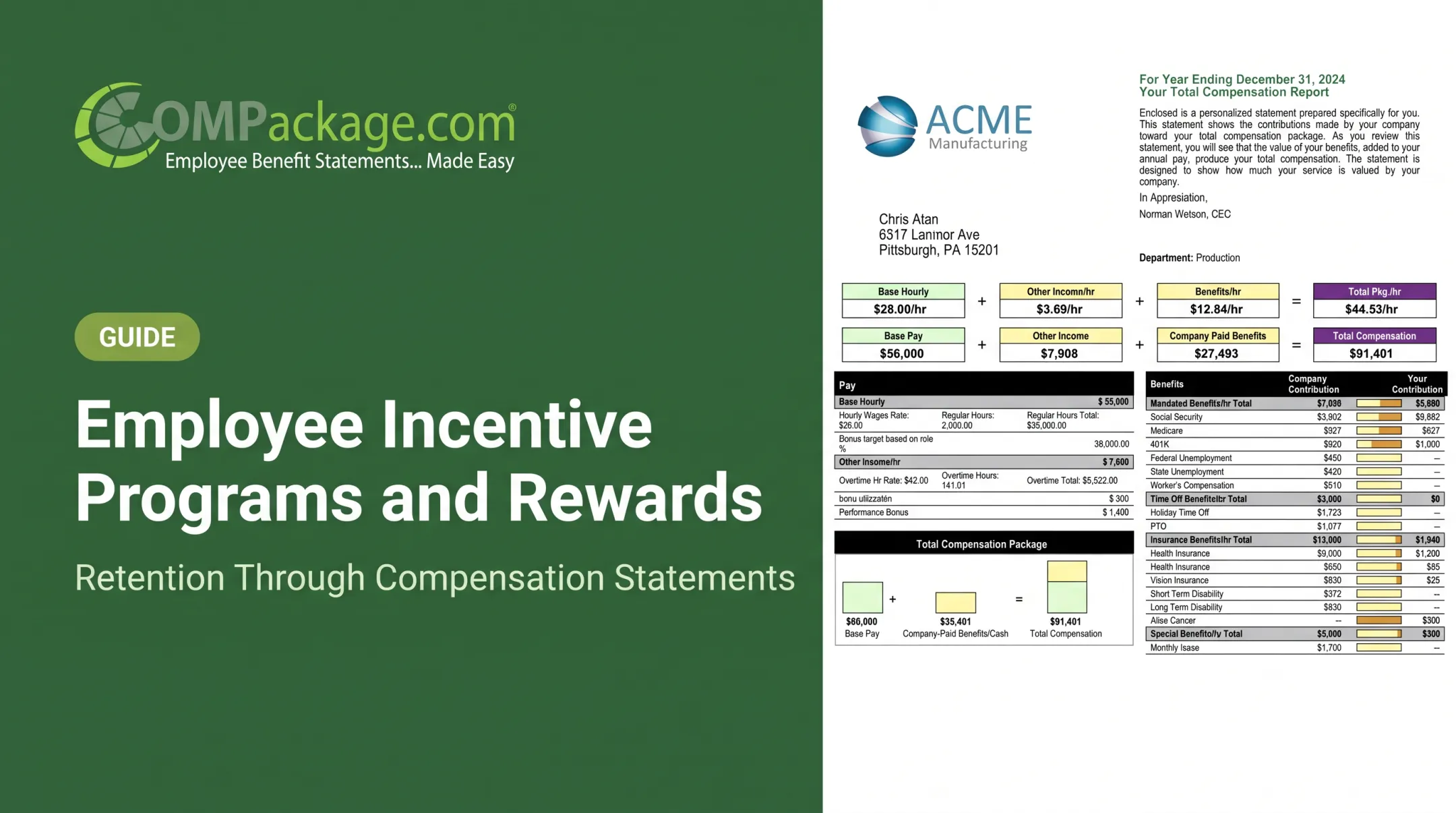
A total compensation statement puts non-monetary and non-quantifiable benefits next to base pay. COMPackage's hosted software does this, with 60 customizable benefit areas and room for non-quantifiable items. Its sample package shows company-paid benefits adding 60.58% to base pay, including $1,200 for education and $2,100 for conference fees.

Conclusion
The best incentive is relevant, fair, timely, and meaningful to the person receiving it. Lowest cost alone is a weak guide.
Combine flexibility, recognition, development, wellbeing, and choice with competitive pay and sound benefits. Perks can't cover for a pay problem.
To help employees see the full value of what they already receive, explore COMPackage's self-service total compensation reports.
Frequently Asked Questions
What are non-monetary incentives?
They motivate, recognize, or support employees without direct cash compensation. Examples include flexibility, recognition, development, time off, and wellbeing opportunities.
What is the difference between monetary and non-monetary incentives?
Monetary incentives, such as bonuses or raises, carry direct financial value. Non-monetary ones center on time, flexibility, recognition, growth, or experiences, though some still cost the employer.
What are the main types of incentives?
Monetary incentives, non-monetary rewards, recognition-based, development, flexibility and time-based, and wellbeing or experience-based incentives.
What are some examples of non-monetary incentives?
Flexible schedules, remote work where practical, extra time off, mentorship, training, autonomy, public recognition, volunteer time, wellness support, team experiences, and personalized perks.
What are some good non-monetary awards or gifts for employees?
Choose by preference: experiences, learning opportunities, flexibility, time off, recognition, charitable donations, or choice-based rewards. Gift cards are cash equivalents, so they aren't truly non-monetary.
Are there tax or legal limits on giving gifts to employees?
Yes, and treatment varies by reward type, employee status, and jurisdiction. In the U.S., gift cards don't qualify as de minimis fringe benefits, so review current IRS Publication 15-B and your state's guidance. For UK employees, get UK-specific advice; U.S. rules don't apply.