The benefits employees value most aren't always the flashiest or the costliest. Usefulness, affordability, flexibility, and clear communication decide perceived value. This article walks through the categories U.S. employees prioritize, then gives a framework for choosing and communicating them.
Key Takeaways
- Healthcare is the foundation; retirement, paid time off, flexibility, and mental health support follow.
- Employees favor financial security, health, family support, and balance over office amenities.
- The best package fits your workforce and budget, not the longest list.
- Survey employees, track usage, and show the full value of compensation.
Overview of Employee Benefits in the U.S. Workplace
Employee benefits are direct or indirect compensation on top of base wages: insurance, retirement plans, paid leave, flexibility, and optional perks. The Bureau of Labor Statistics puts benefits at 30.0% of private-industry employer compensation costs, or $14.07 of $46.89 per hour (June 2026).
Benefits fall into four buckets:
- Legally required: Social Security, Medicare, unemployment insurance, and workers' compensation. Rules vary by state and employer size, so verify current requirements before calling anything mandatory.
- Core: health, retirement, paid leave, life and disability insurance.
- Voluntary: supplemental insurance, dependent-care accounts, and similar elective offerings.
- Lifestyle perks: wellness stipends, commuter help, discounts.

This article judges benefits on employee value and business usefulness: does the benefit meet a real need, can people afford to use it, is it easy to understand, and does it work for the workforce?
Best Employee Benefits Employees Value Most
Rankings below draw on current U.S. employee research, workforce feedback, accessibility, and an employer's ability to deliver consistently. No survey ranks every benefit against every other, so treat these as well-supported priorities, not a universal order.
Health Insurance, Healthcare Access, and Mental Health Support
Health coverage sits at the top. In WTW's survey, 36% of employees name health benefits as a reason to stay. KFF's 2026 survey shows why cost matters: average premiums reach $9,804 for single and $28,303 for family coverage, with workers paying $1,672 and $7,471 of that.
Having coverage isn't the same as being able to use it. Employees weigh:
- Premium contributions and deductibles (38% of covered workers face a deductible of $2,000 or more)
- Provider access and ease of use
- Family coverage costs
- Privacy and behavioral health availability
Access is uneven. BLS data shows medical benefits reach 87% of full-time but 23% of part-time private-industry workers.
Mental health shows the gap between offering and using. SHRM reports 90% of organizations cover mental health, yet 55% of workers rarely or never use those benefits. EBRI found 33% of affected workers have trouble accessing services.
Telehealth (offered by 91% of organizations) and EAPs (72% of large employers) help only when people know about them.

Paid Time Off, Flexible Scheduling, and Work-Life Balance
Paid leave is widespread. BLS reports 81% of private-industry workers have paid sick leave, 80% paid vacation, and 51% paid personal leave. Flexibility matters too: 31% of WTW respondents cite flexible arrangements as a reason to stay.
The right mix depends on the job. Options include:
- Flexible start and end times
- Hybrid or remote work
- Compressed schedules
- Self-chosen workdays or a four-day week
A Pew survey from 2026 found 71% of working parents say remote work when needed would help, and 71% say choosing their hours would help. But remote work isn't for everyone. Gallup finds most on-site frontline workers aren't bothered by others working remotely; they prefer options like choosing workdays or more PTO.

Retirement Savings and Broader Financial Security
BLS data shows 72% of private-industry workers have access to a retirement plan, and 72% of those with access participate (52% overall). Employer money matters: Vanguard reports 96% of its plans include employer contributions, and half use matching only. Those are Vanguard plan figures, not all-employer numbers.
It helps to separate two jobs these benefits do:
- Protecting against risk: life insurance (59% access), short-term disability (44%), long-term disability (37%)
- Building wealth: 401(k) matches, HSAs (offered by 63% of organizations), financial education
No comparable national ranking shows which of these employees prize most, so survey your own people.
Family, Caregiver, and Life-Stage Support
Family benefits are less common. Only 49% of private-industry workers have paid family and medical leave. SHRM finds 46% of employers offer paid parental leave and 50% offer dependent-care FSAs. Eldercare is thin: 11% provide information or referrals, and 2% offer subsidies.
Childcare shows the biggest mismatch. Pew found 43% of working parents want on-site childcare (59% of those with a child five or younger), yet only 6% have it.
Other options include fertility coverage, adoption assistance, caregiver leave, and bereavement leave. Gauge demand first, and write eligibility rules plainly so they feel fair across ages and households. For dependent-care FSAs, the IRS exclusion is now $7,500 for 2026.

Career Development, Recognition, and Professional Growth
Growth helps people picture a future at your company. Gallup reports 48% of mentorship participants have high job satisfaction versus 29% of non-participants. That's an association, not proof of cause. About one in four employees say they lack advancement opportunities.
Options to consider:
- Tuition assistance (46% of organizations offer it; up to $5,250 per employee can be tax-free)
- Certification support and learning stipends
- Mentoring and defined career paths
- Internal mobility and regular recognition
Personalized Lifestyle Benefits and Workplace Perks
Perks rarely replace healthcare, retirement, leave, or flexibility. They differentiate. SHRM's 2026 figures:
- Home-office equipment subsidies: 53%
- Pet insurance: 27%
- Off-site fitness reimbursement: 25%
- Lifestyle spending accounts: 7% (a smaller, large-employer sample)
Commuter help reaches about 10% of private-industry workers. Utilization data for these perks is thin, so survey your own workforce before funding any of them.
How We Chose the Best Employee Benefits
We prioritized benefits that meet real needs, reach the whole workforce, and can be administered consistently. We also favored those that support attraction, retention, satisfaction, or financial security. Employers can apply the same test.
Avoid Common Mistakes
- Copying competitors
- Chasing novelty
- Assuming managers know what employees want
- Offering benefits employees can't afford to use
- Treating communication as an open-enrollment task
Gather Input and Weigh Costs
Collect input through surveys, focus groups, utilization reviews, and exit interviews. Segment results by job type, location, work arrangement, and life stage.
Then compare employer cost against:
- Perceived value and participation
- Accessibility
- Tax and compliance factors
- Administrative workload
- Scalability
Communicate Total Compensation
Communication changes how benefits are valued. Aflac's research found 51% of employees understand their health policies with year-round communication versus 38% without. Only 42% say they understand them at all. Those figures do not prove cause, yet the gap is hard to ignore.
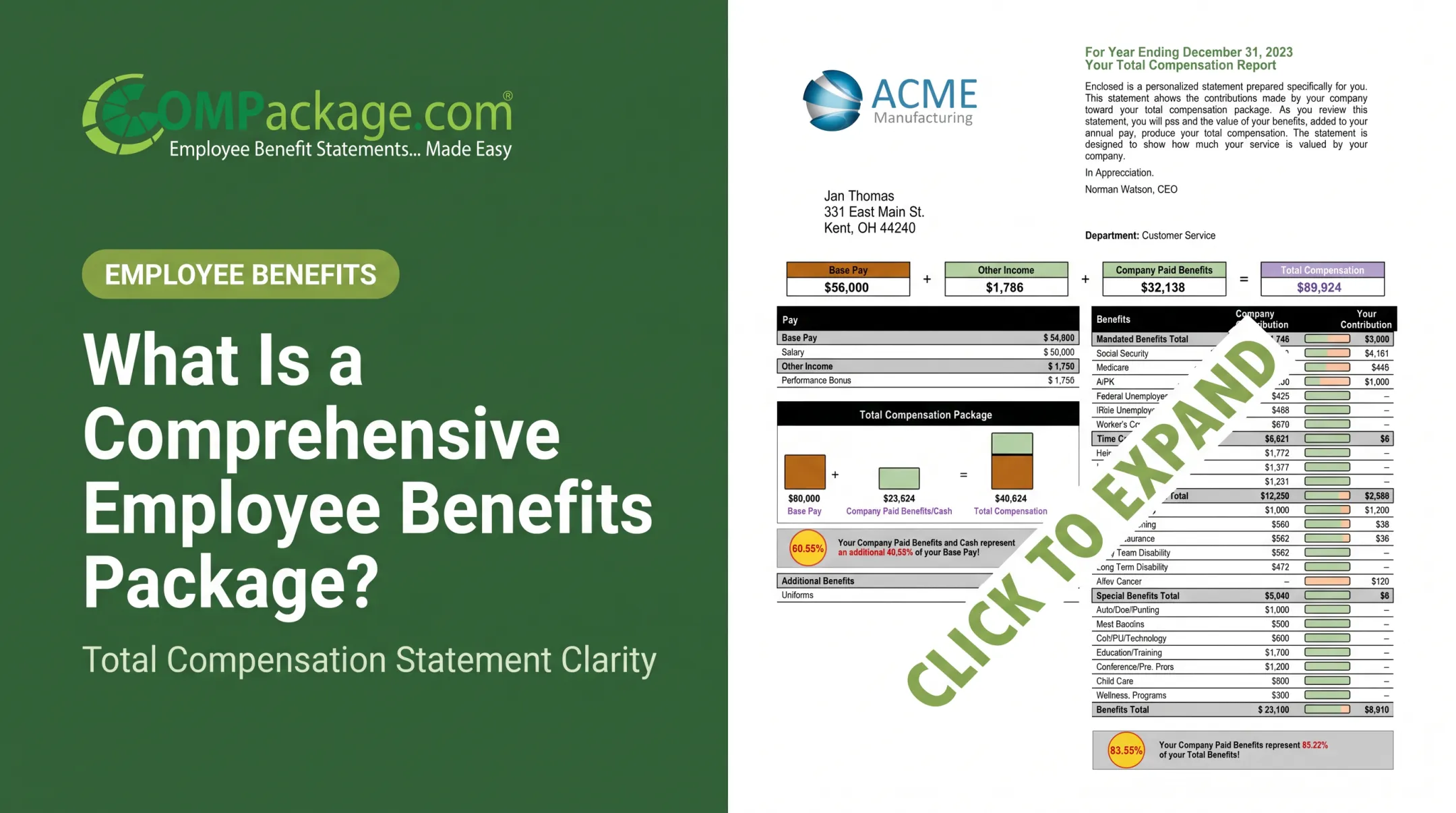
Individualized total compensation statements help close that gap. Employees often think benefits are 10% to 15% of pay when they can reach 40% to 60%. One example: a worker earning $50,000 may receive about $21,839 in benefits. A good statement lists employer-paid benefits, voluntary benefits, and non-quantifiable elements in plain language.

Conclusion
The best package matches what your workforce needs, not the longest list or the most recognizable brands. Review affordability, accessibility, participation, feedback, and business outcomes regularly, and adjust as needs and regulations change.
COMPackage offers self-service total compensation reporting software that lets employers create individualized reports showing what employees receive beyond base pay, including applicable benefits and non-quantifiable ones.
Frequently Asked Questions
What benefits do employees value most?
Healthcare leads: 36% of WTW respondents cite health benefits as a reason to stay. Flexible work (31%), retirement, paid time off, and mental health support also rank high, but needs vary by workforce.
What are the essential employee benefits employers should offer?
Legally required benefits include Social Security, Medicare, unemployment insurance, and workers' compensation. Health coverage, retirement, and paid leave are expected core offerings. Requirements vary by employer size, state, and industry.
What benefits are commonly provided to employees?
Common offerings include health, dental, and vision insurance, retirement plans, life and disability coverage, paid leave, flexible work, and employee assistance programs.
What are the main types of employee benefits?
They include legally required benefits, health insurance, retirement and financial benefits, paid leave, family and caregiver support, professional development, and voluntary perks.
What is the importance of employee benefits?
Benefits support financial security, health, and balance, and they aid recruiting and retention. They are 30.0% of private-industry compensation costs, and 54% of employees cite them as a reason to stay.
What are examples of employee amenities and workplace perks?
Examples include wellness programs, commuter support, home-office stipends, discounts, snacks, social events, and lifestyle spending accounts. Perks add appeal but don't replace essential benefits.