Treat national figures as a planning reference, not a quote. Small employers in particular face wide swings, and many struggle to tell whether a renewal is reasonable or whether the contribution strategy is working.
This article covers employer and employee contributions, cost drivers, hidden expenses, legal rules, and a practical way to build a 2026 benefits budget.
Key Takeaways
- Employers pay about 82% of single and 73% of family premiums on average.
- Small firms put more family cost on workers: $9,687 versus $6,840 at large firms.
- Plan type, group size, demographics, region, and funding method drive price.
- No federal rule sets a required employer contribution percentage.
- The lowest premium rarely means the lowest total cost.
How Much Do Employers Pay for Health Insurance in 2026?
There is no fixed national price. "What employers pay" can mean the total premium, the employer's share, or the full benefits cost including administration. Keep those three apart.
Typical 2026 Benchmark
The KFF 2026 survey (published October 22, 2026) reports these annual averages:
| Coverage | Total premium | Employer pays | Worker pays | Employer monthly |
|---|---|---|---|---|
| Single | $9,804 | $8,132 | $1,672 | $677.67 |
| Family | $28,303 | $20,833 | $7,471 | $1,736.08 |
By firm size, small-firm family coverage costs $27,288, with employers paying $17,601 and workers $9,687. Large firms pay $21,752 of a $28,592 family premium.

Monthly figures are calculated from KFF's rounded annual numbers, so components may not sum exactly.
These are national averages across industries, regions, and plan types. Your quote may be well above or below them. KFF surveys firms with 10 or more employees. State-level MEPS data from AHRQ uses a different sample, so don't mix the two.
What the Benchmark Includes and Excludes
Premiums cover the plan and its covered population. They generally leave out broker fees, compliance work, wellness programs, benefits technology, and self-funded claims expenses.
Deductibles, copays, and coinsurance are also separate. Among workers with a single-coverage deductible, KFF reports a mean of $1,955. Those costs don't hit the employer's premium budget, but they shape how valuable and affordable the plan feels.
Lower-Premium, Higher-Cost-Sharing Plans
HSA-qualified plans average $8,989 for single coverage versus $10,272 for PPOs, but carry a $2,912 average deductible. They suit employers with younger, healthier workforces or those willing to fund HSA contributions. These are observed differences, not guaranteed savings.
Balanced Employer-Sponsored Plans
HMOs and POS plans sit in the middle: single premiums of $9,730 and $9,854, deductibles of $1,562 and $1,902. Employers balancing cost against access often land here, adjusting contributions so workers still find the plan affordable.
Richer or Broader-Network Plans
PPOs enroll 50% of covered workers and cost the most ($10,272 single, $29,522 family) in exchange for broad provider choice and a lower deductible ($1,446). Paying more can make sense in tight labor markets where benefits drive recruiting and retention.

Key Factors That Affect Employer Health Insurance Costs
Pricing reflects plan design, workforce makeup, location, and regulation. Headcount alone doesn't explain it.
Plan Type, Network, and Cost-Sharing Design
Network breadth, provider prices, prescription coverage, and deductibles all shift costs between employer and employee. PPOs offer flexibility at higher premiums. HMOs and EPOs (grouped together in KFF data) restrict networks. HMOs typically require referrals.
The 2026 IRS limits for HSA-qualified plans: minimum deductible of $1,700 self-only / $3,400 family, with maximum out-of-pocket of $8,500 / $17,000.
Company Size, Participation, and Eligibility
Small-group markets pool risk across fewer people, so one high-cost claimant matters more. SHOP generally serves employers with 1-50 FTEs, and most states require 70% participation.
Don't confuse that with the ACA large-employer test. An applicable large employer averages at least 50 full-time employees and must offer coverage to at least 95% of full-time staff or risk assessments. For 2026, the 4980H(a) penalty is $3,340 per full-time employee (excluding the first 30). Insurer participation rules are separate from legal mandates.
Workforce Demographics and Coverage Tier
Small-group premiums can vary up to 3:1 by age and 1.5:1 for tobacco use (where state law permits). Dependent children can stay on plans until age 26.
Contribution policy matters here. A $28,303 family premium is a very different burden for a worker when the employer subsidizes only employee-only coverage.
Location and Local Health Care Prices
KFF's regional averages show the Northeast at $10,806 single / $31,378 family and the South at $9,272 / $26,702. RAND's 2024 hospital price report ties much of the price variation to hospital market power. State rules and network availability add to it.
Funding and Administration Arrangement
- Fully insured: fixed premiums, with renewal risk.
- Self-funded: the employer carries claims directly. KFF finds 71% of covered workers are in self-funded plans (25% at small firms, 85% at large).
- Level-funded: one fixed monthly payment covering claims funding, administration, and stop-loss.
Self-funding can save money, but claims volatility, compliance duties, and cash-flow swings are real risks. Stop-loss coverage limits exposure above set attachment points.

Cost Breakdown and Low-Cost vs. High-Cost Plans
A realistic budget goes beyond the advertised premium. Separate predictable recurring costs from variable ones.
Premium Contributions
Annual cost is the employer contribution per coverage tier multiplied by expected enrollment. Ten single enrollees at $8,132 plus five family enrollees at $20,833 comes to roughly $185,500 a year.

Administrative and Compliance Expenses
Budget for:
- Plan administration and enrollment support
- Payroll coordination
- Required notices (SPD, SBC, COBRA, HIPAA special enrollment)
- COBRA administration for employers with 20 or more employees
- Broker or consultant compensation (disclosure is required above $1,000)
- Benefits technology
Claims, Stop-Loss, and Renewal Exposure
Self-funded and level-funded plans add several variable costs:
- Expected claims
- TPA fees
- Stop-loss premiums
- Reserves
Bad claims experience can push renewal sharply higher.
Employee Cost-Sharing and Ancillary Benefits
Deductibles don't appear in the employer budget, but they affect enrollment and satisfaction. Ancillary benefits add up too. One benefits listing shows employer-paid dental at $650 and vision at $350 per year, alongside $9,600 for health.
Low-Cost vs. High-Cost Health Insurance: What's the Difference?
| Factor | Lower-cost | Higher-cost |
|---|---|---|
| Premium | HSA-qualified: $8,989 single | PPO: $10,272 single |
| Deductible | $2,912 average | $1,446 average |
| Provider access | Narrower | Broader |
| Employee affordability | Weaker if deductible is high | Stronger |
| Recruiting value | Moderate | Higher |
A lower premium with a high deductible can leave employees underinsured, and enrollment can fall as a result.
How to Estimate the Right 2026 Health Insurance Budget
The right budget fits your workforce and pay strategy. Copying a national average or picking the cheapest premium rarely works.
Build a Headcount and Enrollment Model
- Count eligible employees under your plan rules.
- Estimate enrollees. KFF's overall take-up rate is 74% (70% small, 75% large).
- Split enrollees into employee-only, employee-plus-one, and family tiers.
- Run scenarios at different participation and dependent rates to bound your cost range.
Set the Employer Contribution Policy
Common approaches include:
- Fixed dollar amount per employee
- Percentage of premium
- Defined contribution
- Different amounts by employee class (within nondiscrimination rules)
Heavy subsidies on employee-only coverage cost less and appeal to single workers. Contributing toward dependents costs far more but strengthens retention among employees with families.
Add All-In Costs and Renewal Assumptions
Build the full cost stack:
- Premiums
- Administration and compliance
- Broker fees
- HSA contributions
- Stop-loss
For renewals, forecasts vary. Aon reported 8.8% employer cost growth in 2026, and Mercer reported 7.3%. Model a conservative, expected, and higher-cost case at 6%, 8%, and 10%.

Check Legal, Tax, and Affordability Requirements
- ACA affordability threshold: 9.96% of household income for 2026
- Minimum value: at least 60% of allowed costs
- Waiting period: no more than 90 days
- Employer contributions are generally excluded from employee income
- Section 125 plans allow pre-tax payroll deductions
- Small employers with fewer than 25 FTEs may qualify for the Section 45R credit
Confirm details with a tax or compliance professional.
Make the Employer Contribution Visible in Total Compensation
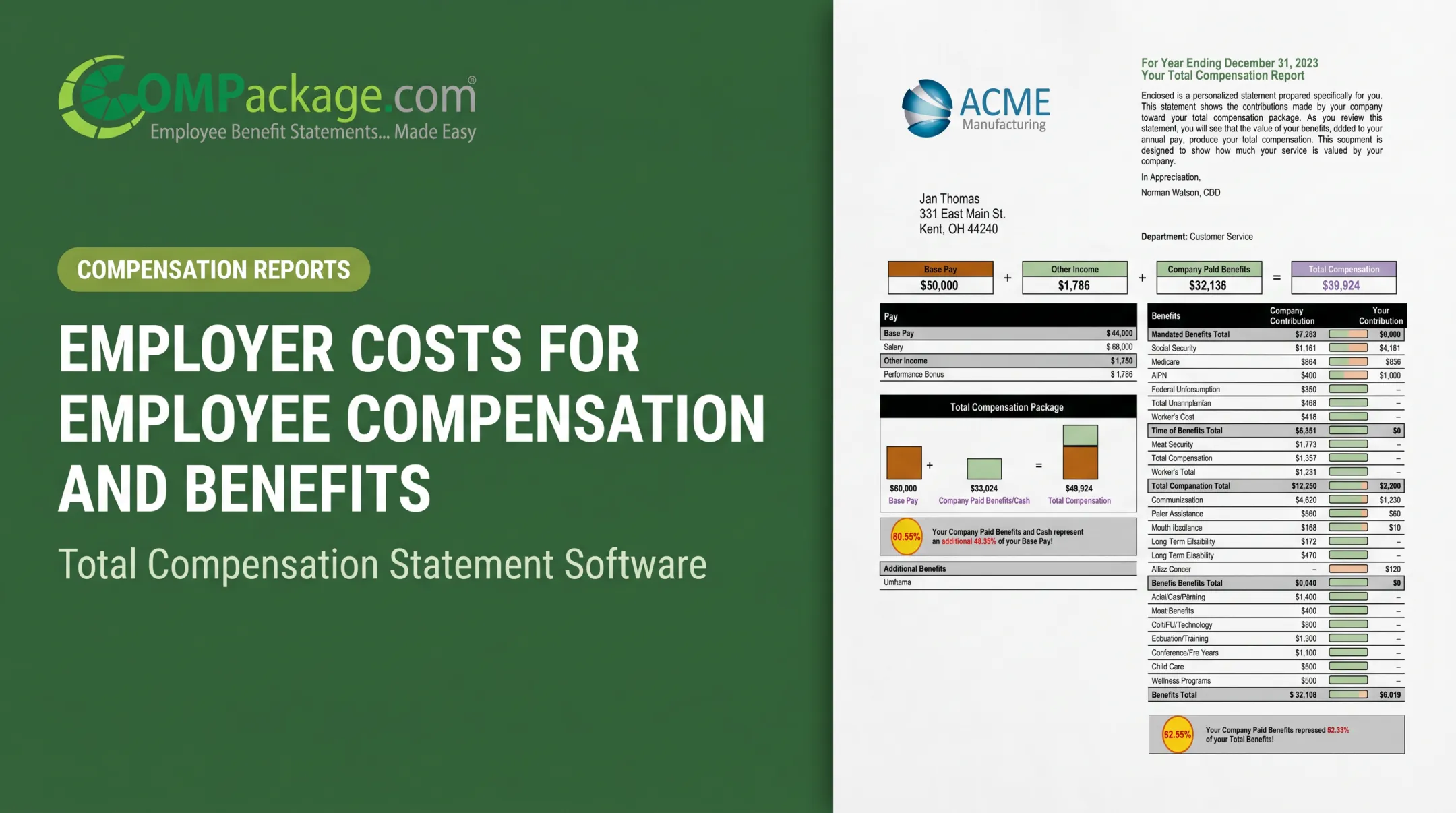
Employees rarely see what employers pay. BLS data shows health insurance at 7.4% of private-industry compensation, with total benefits at 30.0%. Showing the dollars alongside salary, retirement, and paid leave makes the value concrete.
COMPackage is a self-service total compensation reporting tool that shows individualized employer-paid health insurance and other benefit contributions on employee reports. Pricing is published by employee count.
What Most Employers Miss When Budgeting
- Premium tunnel vision. Deductibles, HSA or HRA contributions, administrative fees, and participation changes all matter.
- Cost shifting. Pushing too much onto employees can lower enrollment, weaken the benefit's perceived value, and hurt retention. At firms with larger lower-wage workforces, take-up is 64% versus 76% elsewhere.
- Treating averages as quotes. Compare your actual renewal with alternatives, workforce needs, and multi-year costs.
Conclusion
Employer health costs in 2026 vary by coverage tier, plan design, workforce, geography, group size, and funding arrangement. KFF's national data is a good starting benchmark, not a price.
A responsible budget goes beyond premiums. Factor in:
- Employee affordability
- Administration and risk
- Legal and compliance rules
- How you communicate the benefit within total compensation
Model several scenarios, then review the plan with a qualified benefits, tax, or compliance professional before you finalize your contribution strategy.
Frequently Asked Questions
How much do employers typically pay for employee health insurance?
Per KFF 2026, employers average $8,132 a year for single coverage and $20,833 for family coverage. Actual costs vary by plan, workforce, location, and contribution policy.
What is a typical monthly cost for health insurance?
Total premiums average about $817 monthly for single and $2,359 for family coverage. Employers pay roughly $678 and $1,736 of those amounts, respectively.
What is salary sacrifice medical insurance and how does it work?
"Salary sacrifice" is mainly U.K. terminology. U.S. employers typically use pre-tax payroll deductions through Section 125 cafeteria plans, which lower taxable pay but are not an added employer subsidy.
Is it cheaper to get health insurance through an employer?
Often, because employers pay most of the premium and contributions are generally tax-free. An affordable, minimum-value offer can block Marketplace tax credits, though family members may still qualify in some cases.
What do you do if your employer doesn't offer health insurance?
Look at Marketplace coverage, Medicaid or CHIP if eligible, or a spouse's employer plan. Compare premiums, subsidies, deductibles, and networks.
Can private health insurance be tax deductible?
It depends. Employer-paid premiums are generally business expenses, and Section 125 payroll deductions are pre-tax. Self-employed people may deduct premiums, and itemizers can deduct medical costs above 7.5% of AGI. Confirm with a tax professional.